
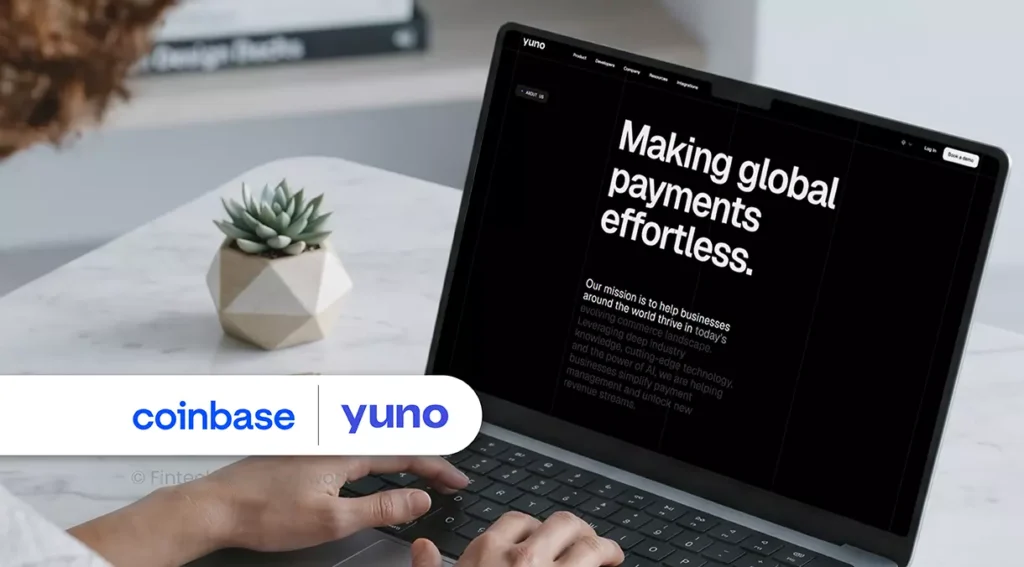
Paying with stablecoins has mostly been something crypto users did with each other. Yuno wants to make it something ordinary shoppers can do at an online checkout. The payments orchestration platform has added a one-click stablecoin checkout through a new integration with Coinbase, letting merchants accept stablecoin payments without replacing their existing payment systems, according to Fintech News Singapore. The service is live globally, and merchants can receive funds as soon as the same day.
Yuno connects enterprise merchants, banks and wallets to more than 1,000 payment methods through a single API, with 460 integrations across more than 190 countries. The announcement describes it as Coinbase's first global commerce orchestration partner. For merchants already using Yuno to manage cards, wallets and local payment methods, stablecoins become one more option they can turn on.

What Yuno and Coinbase launched
The new feature lets Yuno merchants offer a one-click stablecoin checkout powered by Coinbase. Merchants activate it through their existing Yuno integration, so they do not need to build new connections, hold crypto infrastructure or change payment providers.
The target is cross-border commerce. Merchants selling to customers in other countries face card decline rates, foreign exchange costs and limited card penetration in some markets. Stablecoin checkout offers an alternative for customers who hold digital dollars, especially in markets where card access is limited.
Settlement speed is part of the pitch. Merchants can receive funds as soon as the same day, compared with the several days that card settlement can take in cross-border transactions. Faster access to revenue improves cash flow, which matters for smaller merchants and fast-growing online sellers.
- Partner: Yuno, a payments orchestration platform.
- Reach: more than 1,000 payment methods, 460 integrations, over 190 countries.
- Feature: one-click stablecoin checkout powered by Coinbase.
- Setup: enabled through a merchant's existing Yuno integration.
- Settlement: funds as soon as the same day.
The feature fits Yuno's broader proposition. Merchants use orchestration to add local payment methods quickly when they enter new markets, from QR wallets in Asia to bank transfers in Latin America. Stablecoins become another regional or customer-specific method that can be enabled where it makes commercial sense.
Why orchestration matters for stablecoin adoption
Payment orchestration platforms sit between merchants and the many payment providers they use. Instead of integrating each card processor, wallet and local method separately, a merchant integrates once with the orchestrator, which routes each transaction to the best option. Large merchants use orchestration to improve approval rates, reduce costs and expand into new markets.
That position makes orchestrators powerful distribution channels for new payment methods. A stablecoin checkout that requires each merchant to build a custom integration would spread slowly. One that merchants can switch on through a platform they already use can reach thousands of businesses quickly.
For Coinbase, the partnership extends its payments business beyond its own app and exchange. Combined with its role in making USDC the default dollar stablecoin in Samsung Wallet in the United States, it shows Coinbase building infrastructure that brings stablecoins to places where everyday payments happen, as we covered in our report on the Samsung Wallet deal.
A new payment method spreads through the platforms merchants already use. Stablecoins just got a seat inside one of them.
Data is a further advantage. Orchestrators see which payment methods convert best in which markets and for which products. That visibility lets merchants test stablecoin checkout against cards and local methods, measure results and decide where to keep it, without committing to a large integration project upfront.
Stablecoins at the checkout: the wider trend
The Yuno launch is part of a broader move to make stablecoins usable in commerce. Visa reported roughly 200 percent annual growth in stablecoin-linked card payments, according to Fintech News Singapore, and in the same week SoFi Tech Solutions, Orbi and Mastercard announced a crypto-linked card in Mexico, according to FX News Group. Cards linked to stablecoin balances let users spend digital dollars wherever cards are accepted.
Checkout integrations take a different route. Rather than converting stablecoins into card payments, they let customers pay directly in stablecoins, with the merchant receiving funds through the payment provider. Both approaches aim to make stablecoins practical for spending, and both depend on reliable conversion and settlement behind the scenes.
New stablecoins designed for payments are also entering the market. A consortium-backed dollar stablecoin launched with Visa, Mastercard, Stripe and Coinbase among its founding partners, which we covered in our report on the OUSD launch. The competition among stablecoins and the infrastructure to spend them is intensifying.
The economics are part of the appeal for merchants. Card payments carry interchange and scheme fees, and cross-border cards often add currency conversion costs and higher fraud risk. Stablecoin payments can reduce some of those costs, although merchants must weigh conversion fees and the work of supporting a new method.
What merchants should consider
For merchants, the first question is demand. Stablecoin checkout makes most sense where a meaningful share of customers hold stablecoins or lack easy card access, such as in parts of Latin America, Africa, the Middle East and Southeast Asia, or among crypto-native audiences. Merchants can test demand at low cost when the option is a toggle in an existing platform.
The second is accounting and treasury. Merchants need to decide whether to receive stablecoins or convert them to local currency immediately, how to record them, and how refunds will work. Many will prefer automatic conversion so they never hold stablecoins on their balance sheet.
The third is compliance. Accepting stablecoins brings anti-money laundering and sanctions considerations, which providers like Coinbase handle in part. Merchants should understand where responsibility sits and ensure their terms and refund policies cover stablecoin payments.
Customer experience matters too. Shoppers paying with stablecoins need a smooth flow: clear instructions, quick confirmation and a familiar wallet connection. A clunky experience will push customers back to cards, so merchants should test the checkout journey before promoting it widely.

What it means for Southeast Asia
Southeast Asian commerce is dominated by local wallets and QR payments rather than cards, from GrabPay and GCash to DANA, TrueMoney and Touch 'n Go. Cross-border sellers reaching these markets already rely on orchestration platforms to offer local methods. Stablecoin checkout adds another option for cross-border buyers who hold digital dollars.
Regulation shapes how far that goes. Singapore has a framework for digital payment tokens and is moving to give its stablecoin rules legal force, while Indonesia and Thailand restrict the use of stablecoins for domestic payments. Merchants serving the region will need to apply stablecoin checkout carefully, focusing on cross-border sales where it is permitted.
Demand is there. Visa's survey of Asia Pacific consumers found that 46 percent expect to use stablecoins within five years, with strong interest in cross-border spending and online purchases. Merchants that prepare now will be ready if that intent turns into behaviour.
Selling across borders from Southeast Asia
Cross-border sellers in Southeast Asia that sell to customers abroad may also benefit. A Vietnamese or Indonesian online business selling to international buyers could accept stablecoins through an orchestrator and convert proceeds to local currency through licensed partners, subject to local foreign exchange rules.
What did Yuno launch with Coinbase?
Yuno launched a one-click stablecoin checkout powered by Coinbase, letting its merchants accept stablecoin payments through their existing Yuno integration, live globally.
How fast do merchants get paid?
Merchants can receive funds as soon as the same day, according to the announcement.
What is Yuno?
Yuno is a payments orchestration platform that connects merchants, banks and wallets to more than 1,000 payment methods through a single API, with 460 integrations across more than 190 countries.
Do merchants need new systems to accept stablecoins?
No. Merchants can turn on stablecoin checkout through their existing Yuno integration without replacing their payment systems.
Who benefits most from stablecoin checkout?
Merchants selling across borders, especially to customers in markets where card access is limited or who already hold stablecoins.
Are fees disclosed?
The announcement did not disclose fees for the stablecoin checkout.
Is Yuno the only Coinbase commerce partner?
The announcement described Yuno as Coinbase's first global commerce orchestration partner. Coinbase works with other partners in different parts of its payments business.
Can merchants convert stablecoin payments to local currency?
Merchants can typically choose to convert proceeds into fiat through their payment providers, which avoids holding stablecoins on their balance sheet. Details depend on provider and jurisdiction.
Which stablecoins does the Yuno checkout support?
The announcement did not list specific stablecoins. Merchants should confirm supported tokens and networks with Yuno and Coinbase before enabling the feature.
Does stablecoin checkout replace cards?
No. It is an additional option alongside cards, wallets and local methods, aimed mainly at cross-border buyers and customers who already hold stablecoins.
Yuno's Coinbase integration is a practical step for stablecoin payments. By putting a one-click stablecoin option inside an orchestration platform that merchants already use, it lowers the barrier to accepting digital dollars, with faster settlement as a bonus. Adoption will depend on customer demand and local rules, but the infrastructure to pay with stablecoins at the checkout is now arriving where commerce actually happens.
Talk to the SpinDepth deskYou've finished this story
Read on, send it to someone, or ask about it.