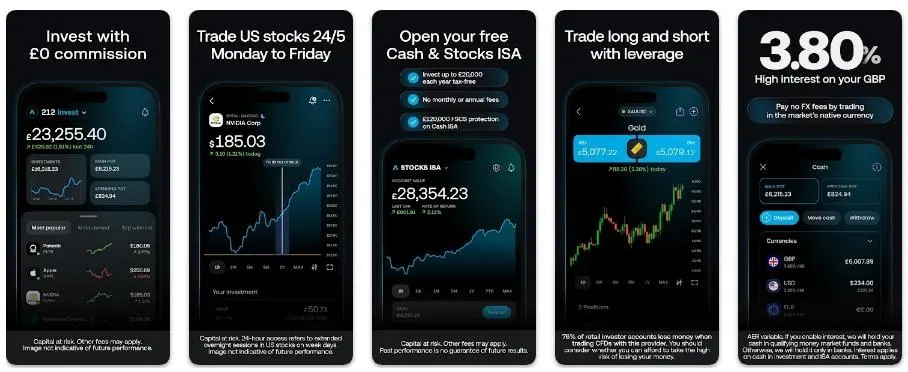
Trading 212 has published the numbers of a breakout year. Group revenue rose about 70 percent to 345.8 million pounds in 2025, and pre-tax profit more than doubled to 127.7 million pounds, according to accounts filed with Companies House on 28 September and reported by Finance Magnates. Reports differ slightly on profit after tax, putting it between about 94 million and 96 million pounds.
Behind the headline is a strategy question. The UK still generates about four-fifths of the group's revenue, and Trading 212 invested 44 million pounds in overseas subsidiaries during 2025, including 21.1 million pounds in Germany, according to Finance Magnates' weekly review. The company is using the profits of a dominant UK business to build a European one.
The 2025 numbers
The group's 345.8 million pounds of revenue came mainly from two entities. Trading 212 UK contributed 277.6 million pounds, up 72 percent from 2024. The Cypriot entity, Trading 212 Markets, was the second-largest contributor at 64.4 million pounds, up 59 percent.
Smaller entities added much less. The German unit, Trading 212 EU, generated 2.7 million pounds. The Australian and Bulgarian subsidiaries reported 0.4 million and 0.7 million pounds respectively, and the Irish entity booked no revenue in the year. In total, entities outside the UK generated about 68 million pounds, roughly one pound in every five.
Profitability is the most striking part. A pre-tax profit of 127.7 million pounds on revenue of 345.8 million implies a margin above a third, high for a broker that markets itself on commission-free investing. The growth came alongside strong markets in 2025, when equity indices rose and retail investor activity was high.
- Group revenue: about 345.8 million pounds, up roughly 70 percent.
- Pre-tax profit: 127.7 million pounds, more than doubled.
- UK revenue: 277.6 million pounds, up 72 percent.
- Cyprus revenue: 64.4 million pounds, up 59 percent.
- Germany revenue: 2.7 million pounds.
- Overseas investment: 44 million pounds in 2025, including 21.1 million in Germany.
The scale of the jump stands out against the wider industry. Many listed brokers reported mixed results in 2025 as volatility patterns shifted, while investing apps focused on long-term savers grew strongly. Trading 212's mix of commission-free investing, cash interest and CFDs placed it on the growth side of that divide.
Where the money comes from
Trading 212 offers commission-free investing in shares and ETFs, CFD trading, and interest on uninvested cash. In a period of higher interest rates, interest earned on client cash balances has been an important revenue source for many investing apps, alongside foreign exchange conversion fees and CFD trading revenue.
That mix matters for the future. Interest income depends on rate levels, so a lower-rate environment would reduce it, while CFD revenue depends on client trading activity and outcomes. Investing apps that diversify into subscriptions, premium features and broader financial products tend to be more resilient when any one revenue line weakens.
The UK's dominance reflects Trading 212's early success there, including its stocks and shares ISA product, which allows UK residents to invest tax-free within annual limits. Building similar positions in other countries requires local products, local regulation and local marketing.
The UK pays for the European expansion. Four pounds in five still come from home, and Germany is where Trading 212 is placing its biggest bet.
Client growth underpins the figures. Investing apps compete heavily for first-time investors through referral rewards, free shares and simple onboarding, and Trading 212 has been among the most visible in the UK. The challenge is converting new sign-ups into funded, active accounts that generate revenue over many years.
The German bet
Germany received nearly half of the 44 million pounds invested abroad. Trading 212 entered the German market by acquiring FXFlat Bank, a deal Finance Magnates reported in 2024, and began onboarding new clients through its German entity in January 2025. The unit, now known as Trading 212 EU, is regulated by BaFin, Germany's financial regulator.
The weekly review reported that the German unit was bought for about 4 million euros and generated 2.7 million pounds of revenue in 2025. The gap between that revenue and the 21.1 million pounds invested shows that Germany is still in an investment phase, with spending on marketing, staff and infrastructure ahead of returns.
Germany is one of Europe's most contested retail investing markets. Local players such as Trade Republic and Scalable Capital, along with international brokers and neobanks, compete for a large pool of savers who have traditionally held cash. A German banking licence lets Trading 212 offer local accounts and products that resonate with German customers, but winning share will take time.
The approach mirrors how other investing apps have entered Germany. A local banking or investment firm licence allows a provider to offer German IBANs, local tax handling and products tailored to German savers, which matter to customers who are wary of foreign providers. Building that trust takes time and sustained marketing spend.
How Trading 212 compares with rivals
The results land in a busy period for retail brokers. IG Group shares fell as much as 27 percent on 2 October after a weak trading update, CMC Markets and Plus500 shares dropped alongside it, and AvaTrade agreed to buy most of FXCM, as we covered in our report on the FXCM carve-up. Trading 212's growth contrasts with the pressure on traditional CFD-focused brokers.
The comparison with neobanks is also relevant. Revolut's retail platform has 68 million users, according to Finance Magnates, and offers investing alongside banking. Investing apps that remain focused on trading must differentiate through product depth, pricing and user experience to compete with all-in-one financial apps.
Elsewhere in Europe, brokers are expanding product ranges and trading hours. XTB expanded overnight US stock trading in October, and European venues are exploring round-the-clock trading. Trading 212 will need to keep pace with those features as it grows outside the UK.
The contrast with CFD-focused brokers is instructive. Brokers that depend heavily on leveraged trading revenue face swings when client performance or volatility changes, as IG's update showed. Investing apps with a broader base of long-term savers and cash balances have steadier revenue, though they are exposed to interest rate changes instead.
The risks to the strategy
Expansion is expensive and uncertain. Each new market requires regulatory approval, local products and customer acquisition spending, and payback periods can be long. The 44 million pounds invested in 2025 is significant relative to overseas revenue of about 68 million pounds, and investors will watch whether overseas growth accelerates.
Market conditions are another risk. Retail investing activity rises in bull markets and falls in downturns. A sustained market decline or lower interest rates could reduce revenue from trading and cash balances at the same time.
Regulation also evolves. Rules on payment for order flow, interest on client money, CFD marketing and investor protection differ across Europe and can change. A broker operating in several jurisdictions must adapt to each, which adds cost and complexity.
Defending the home market
Competition for UK customers is also intensifying. Banks, neobanks and other investing apps are targeting the same young, digital-first savers with stocks and shares ISAs, cash ISAs and pension products. Trading 212 will need to defend its home market while funding expansion abroad.
How much revenue did Trading 212 make in 2025?
Trading 212's group revenue rose about 70 percent to roughly 345.8 million pounds in 2025, according to accounts filed with Companies House on 28 September 2026.
Is Trading 212 profitable?
Yes. Pre-tax profit more than doubled to 127.7 million pounds in 2025, with reported profit after tax of between about 94 million and 96 million pounds.
Where does Trading 212 make most of its money?
The UK business contributed 277.6 million pounds, about four-fifths of group revenue, followed by the Cypriot entity at 64.4 million pounds.
Is Trading 212 regulated in Germany?
Yes. Its German unit, Trading 212 EU, formerly FXFlat Bank, is regulated by BaFin and began onboarding new clients in January 2025.
How much did Trading 212 invest abroad?
The group invested 44 million pounds in overseas subsidiaries in 2025, including 21.1 million pounds in Germany.
Who are Trading 212's competitors in Germany?
Competitors include local investing platforms such as Trade Republic and Scalable Capital, as well as international brokers and neobanks.
Does Trading 212 offer CFDs?
Yes. Trading 212 offers commission-free investing in shares and ETFs alongside CFD trading and interest on uninvested cash, with availability depending on the entity and country.
How many people does Trading 212 employ in Germany?
The accounts summary did not give a German headcount. The group said it invested 21.1 million pounds in Germany in 2025 as it builds its BaFin-regulated business.
Trading 212's 2025 results show a highly profitable investing app using its UK strength to fund a European push. Revenue and profit surged, but the UK still dominates, and Germany remains an investment rather than a return. The next few years will test whether Trading 212 can repeat its UK success in Europe's most competitive markets, while managing the cyclical risks that come with retail investing.
Talk to the SpinDepth deskYou've finished this story
Read on, send it to someone, or ask about it.