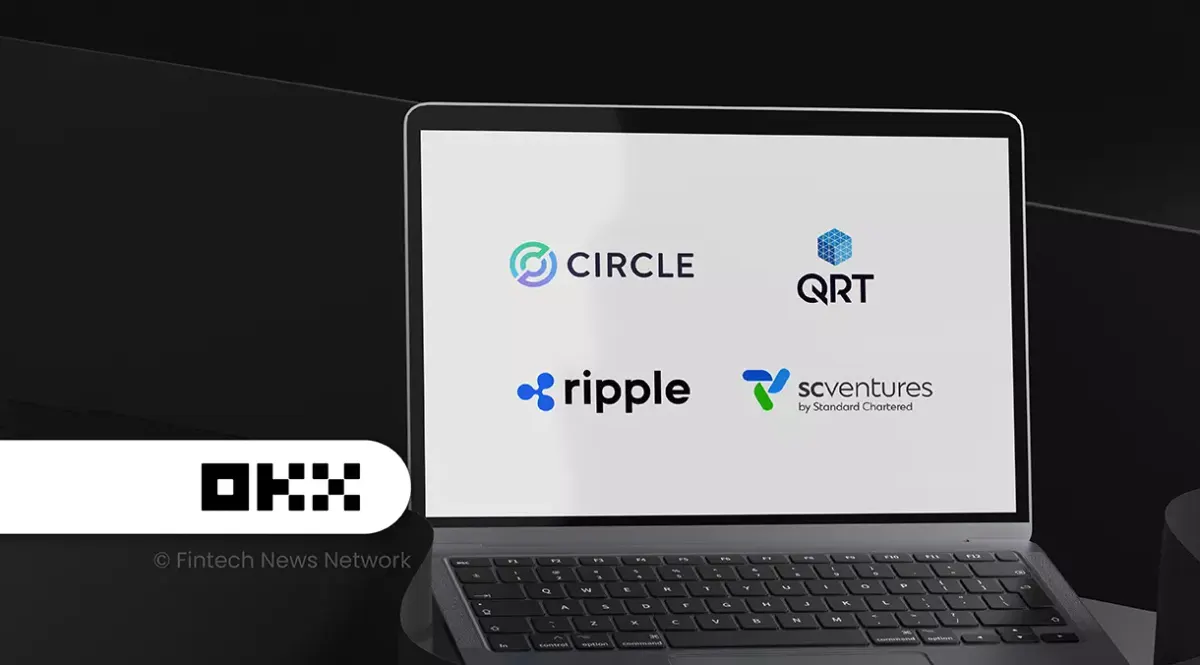
OKX has added four strategic investors to the funding round that Intercontinental Exchange, the owner of the New York Stock Exchange, led in March. Circle, Ripple, quantitative trading firm Qube Research & Technologies and SC Ventures, the venture arm of Standard Chartered, all joined at a pre-money valuation of 25 billion US dollars, according to the company's announcement on 6 October, as reported by Fintech News Singapore. OKX did not disclose how much the new investors put in.
The headline number is large, but the more revealing detail is the shape of the cap table. In a single round, OKX now counts a stock exchange operator, the issuers of two dollar stablecoins, a global bank and an institutional market maker among its backers. Each one brings something the exchange needs if it wants to be valued like a regulated financial platform rather than a trading venue that lives and dies with crypto prices.
What each investor brings to OKX
Circle issues USDC, which is already integrated across OKX's platform. A closer relationship with the issuer of the second-largest dollar stablecoin gives OKX deeper access to dollar liquidity on its order books and a partner for payment products that settle in stablecoins rather than bank wires.
Ripple's RLUSD stablecoin is available across OKX's unified order book, and Ripple said its investment could deepen collaboration on stablecoins, payments and institutional markets. Qube Research & Technologies provides liquidity and risk capacity as an institutional counterparty and works with OKX to launch and grow new products and markets, which matters for any exchange trying to keep spreads tight in new instruments.
Standard Chartered may be the most strategically important name. The bank acts as custodian for BlackRock's tokenized Treasury fund, BUIDL, which anchors a collateral framework OKX developed with BlackRock. That arrangement lets institutions post tokenized Treasuries as collateral while the underlying asset stays with a regulated bank custodian, a structure designed to answer the counterparty concerns that kept many funds away from exchanges after 2022.
- ICE: led the round in March and brings exchange infrastructure and credibility with traditional markets.
- Circle: USDC liquidity and stablecoin payment rails.
- Ripple: RLUSD and institutional payments relationships.
- QRT: liquidity provision and risk capacity as a counterparty.
- SC Ventures: links to Standard Chartered's custody and tokenized collateral work.
The mix also hedges OKX's own dependence on any single partner. An exchange that relies on one stablecoin issuer, one bank or one market maker is exposed if that relationship sours or a regulator restricts it. Bringing two dollar stablecoin issuers, a bank custodian and an institutional liquidity provider into the shareholder base spreads that dependence and gives each partner a financial reason to keep sending business through the platform.
From exchange to fintech platform
OKX founder and CEO Star Xu described the vision in four verbs: hold it, pay with it, invest it and grow it. He said the goal is a financial technology platform for the next generation that combines crypto technology with global institutional standards, and that the exchange was OKX's starting point rather than its destination.
That language mirrors what the largest exchanges have been telling investors all year. Trading fees are volatile and compress when markets are quiet. Payments, custody, yield products, tokenized assets and card programmes generate steadier revenue and keep users inside an ecosystem even when they are not trading. A valuation of 25 billion dollars only makes sense if investors believe OKX can capture that steadier revenue at scale.
The company said the new capital will fund growth and the tokenization of real-world assets. Tokenization is where the ICE relationship becomes concrete: OKX and ICE have since filed with US regulators for a venture to trade tokenized versions of NYSE-listed stocks around the clock, a project we will examine separately this week.
A stock exchange, two stablecoin issuers, a global bank and a market maker in one round. OKX is buying credibility as much as capital.
Why the valuation matters for the rest of crypto
Private valuations for crypto exchanges are a signal of how institutional money now prices the sector. A 25 billion dollar mark puts OKX among the most valuable privately held financial technology companies in the world, at a time when bitcoin has been trading below its highs and spot ETF flows have turned negative in some sessions.
It also sets a benchmark for peers. Exchanges that are weighing public listings, or that have already listed, will be compared with the multiple implied by OKX's round. Coinbase is the obvious public comparison, while private rivals in Asia and the Middle East will cite the deal when they raise their own capital.
For investors, the presence of strategic backers is part of the valuation. Capital from partners who also send business through the platform is worth more than capital from purely financial investors, because it comes with distribution, liquidity and credibility attached. That is the bet SC Ventures, Circle and Ripple are making.
There is a regional angle as well. Asian exchanges have historically been valued below their US peers because of regulatory uncertainty and concerns about governance. A round anchored by ICE and joined by a British bank's venture arm narrows that discount, at least on paper, and gives other Asia-rooted platforms an argument when they negotiate with investors of their own.
What it means for Asia and Singapore
OKX has deep roots in Asia, and the Standard Chartered connection lands in a region where the bank is expanding its own digital asset services. In the same week as the OKX announcement, Standard Chartered said it plans to offer digital asset custody in Singapore for institutional and accredited corporate clients, subject to regulatory requirements, adding to its existing custody operations in the UAE, Luxembourg and Hong Kong.
The timing coincided with TOKEN2049 in Singapore on 7 and 8 October, the largest annual gathering of the crypto industry, where institutional participation was a central theme. Exchanges that want access to Asian institutional money increasingly need bank partners, local licences and custody arrangements that satisfy risk committees, not just deep order books.
For Southeast Asian users, the practical effect is likely to show up in products rather than headlines: stablecoin payment features, tokenized fund access and collateral options that look more like prime brokerage. Our coverage of OKX's position against Bybit looks at how the two exchanges already differ for regional traders.
The questions the round does not answer
The announcement left important details out. OKX did not say how much capital the four investors committed, how ownership is now split, or whether the round brings it closer to a public listing. Those are the numbers that would show how much of the 25 billion dollar valuation reflects new money and how much reflects the March round.
Regulatory exposure remains the other open question. Exchanges operate under a patchwork of licences, and enforcement history follows them into every new market. Strategic investors that are themselves regulated, such as a bank and a stock exchange operator, will expect higher standards of compliance, reporting and governance than a crypto-native shareholder base might have demanded.
Finally, execution risk is real. Becoming a fintech platform means competing with banks, payment companies and brokers that already own customer relationships. OKX has the capital and the partners to try. Whether users treat it as their financial home rather than their trading app is something no funding round can settle.
Governance becomes the real test
Investors will also watch how OKX balances its offshore business with its regulated entities. Products that are available to users in some jurisdictions are restricted in others, and every new licence comes with conditions. A shareholder base that includes regulated institutions raises the cost of getting that balance wrong.
What valuation did OKX raise at?
OKX said the new investment came at a pre-money valuation of 25 billion US dollars. The amount raised was not disclosed.
Who invested in OKX in October 2026?
Circle, Ripple, Qube Research & Technologies and Standard Chartered's venture arm SC Ventures joined the round, which extends an investment led by Intercontinental Exchange in March 2026.
What will OKX do with the money?
OKX said it will use the capital for growth and to tokenize real-world assets, as it expands from a crypto exchange into a broader financial technology platform.
Why does Standard Chartered matter to OKX?
Standard Chartered is custodian for BlackRock's tokenized Treasury fund BUIDL, which anchors a collateral framework OKX built with BlackRock. The bank's venture arm is now also an investor.
Is OKX planning an IPO?
OKX has not announced a listing. The round sets a valuation benchmark that would matter if it chooses to go public, but no timetable has been disclosed.
Who leads OKX?
OKX is led by founder and chief executive Star Xu, who described the company's goal as building a financial technology platform that combines crypto technology with global institutional standards.
OKX's round is less about cash than about who signed the cheque. By assembling a stock exchange operator, two stablecoin issuers, a global bank and an institutional liquidity provider, OKX is presenting itself as infrastructure for the next phase of digital finance. The valuation will be tested by execution, regulation and market cycles, but the strategic direction is now explicit: the biggest exchanges want to be judged as regulated fintech platforms, and they are recruiting the institutions that can vouch for them.
Talk to the SpinDepth deskYou've finished this story
Read on, send it to someone, or ask about it.