For three years the fintech IPO was treated as a closed door. Investors who chased 2021 valuations watched them collapse, and the best names stayed private. That door is open again. In 2025 and 2026, Circle, eToro and Chime returned to public markets and raised a combined sum in the billions, and the reception reset the calculus for a long backlog of candidates. The question is no longer whether fintech can list. It is which name goes next and at what price.
Circle set the tone for the new wave
Stablecoin issuer Circle priced its Nasdaq listing and raised roughly $1.1 billion. Its shares rose about 168 percent on the first trading day, described by Renaissance Capital as the largest first-day gain for a billion-dollar US listing on record. That single debut did more to reopen the window than a dozen analyst notes. It proved that a crypto-adjacent fintech with a clear business model could clear pricing and then hold demand, rather than fade after the opening print.
eToro followed with its own trading debut, and the stock moved sharply higher on opening. The pattern was consistent. Public investors were not punishing fintech for the sins of the 2021 cycle. They were rewarding companies that had reached scale, cut losses, or found a defensible niche. The market had not lost its appetite for fintech. It had lost its patience for unproven economics, and the recent listings supplied the proof points.
Chime and the neobank reset
Chime, the largest US neobank by members, came to market at a valuation well below its 2021 peak. Reports put its targeted Nasdaq valuation around $9.1 billion, a deliberate discount that acknowledged how far the market had moved. The strategy worked because it priced for the current environment rather than the old one. A neobank that accepted a smaller number could still access public capital and use it as a platform for growth, without the burden of defending an inflated multiple.
The lesson for the pipeline is blunt. The 2021 multiple is gone and will not return on debut. The firms that list successfully are the ones that meet the market where it stands, with clean unit economics and a credible path to profitability. Chime's reception showed that a realistic price buys more than a proud one, and that the public market now rewards discipline over ambition.
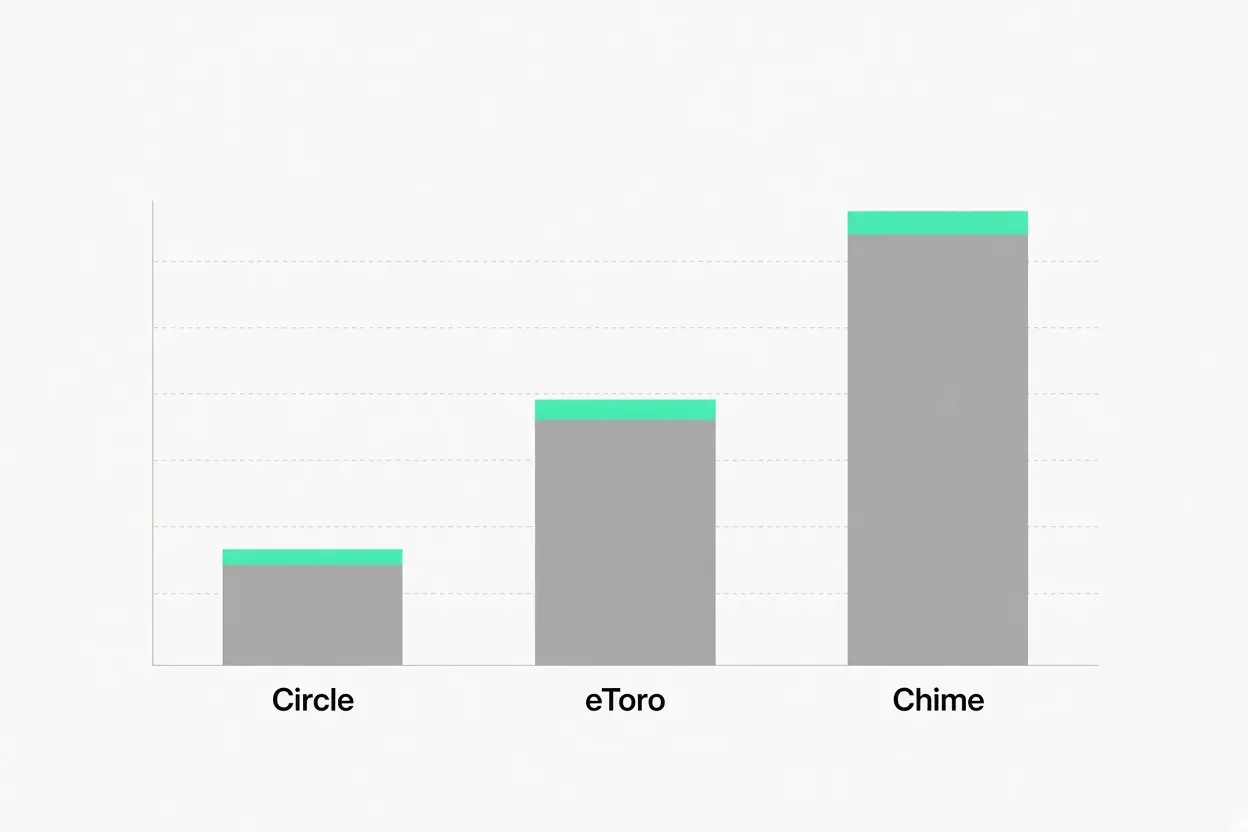
- Circle: ~$1.1B raised, 168% first-day gain.
- eToro: strong trading debut, validating trading platforms.
- Chime: ~$9.1B targeted valuation, below 2021 peak.
- Combined 2025 fintech IPOs (Circle, Chime, Klarna): ~$3.2B raised.
The backlog waiting at the door
A queue of names is watching the receptions closely. Klarna, the Swedish buy-now-pay-later leader, has already tested the market. Gemini, the crypto exchange, and Bullish, a Peter Thiel-backed digital asset marketplace, are positioned to file when conditions allow. Each represents a different slice of fintech, from consumer credit to crypto infrastructure, and each will be read as a verdict on its subsector rather than on the market alone.
What the market is screening for
Investors have narrowed their tolerance. They want proven demand, regulatory clarity, and a moat that does not depend on cheap capital. Crypto-linked names carry extra scrutiny because their earnings swing with token markets. Consumer lenders carry scrutiny because credit cycles turn. The common requirement is a story that survives a downturn, not just a buoyant listing day, and that bar is now explicit rather than implied.
The 2021 multiple is gone and will not return on debut.
Why this matters beyond Wall Street
A functioning IPO window is not just a US event. It sets the benchmark that private investors use to price later rounds, and it gives founders in Europe, Asia, and Latin America a template for what scale looks like when it meets public scrutiny. When US exchanges welcome fintech, capital allocators worldwide recalibrate their own exit assumptions, and the effect cascades into secondary markets and employee liquidity.
The geographic spread of the candidates matters too. Klarna is European, eToro is Israel-headquartered with global reach, and Circle sits at the intersection of traditional finance and crypto. The revival is therefore a global signal, not a Silicon Valley story, and it invites comparable names from Singapore to Sao Paulo to prepare. SpinDepth tracks the regional read-through in APAC fintech listings.
What this means for operators
Founders should read the window as conditional, not permanent. It is open because recent debuts performed, and it will close just as fast if the next few listings disappoint. The preparation that pays off is the boring kind: audited financials, a clean cap table, defensible metrics, and a narrative that an institutional investor can repeat without flinching. The firms that treat the IPO as the start of a public relationship, not the exit, are the ones that hold their price.
Is the fintech IPO window open for crypto firms?
Yes, with conditions. Circle's debut showed appetite, but crypto-linked listings face extra volatility and regulatory scrutiny, so timing and disclosure discipline matter more.
Why did Chime list below its 2021 valuation?
It priced for the current market rather than historical peaks, accepting a lower number to ensure the deal cleared and the stock held demand post-listing.
Which fintechs are next in the pipeline?
Klarna has already moved, and Gemini and Bullish are positioned to file when market conditions allow, each representing a different fintech subsector.
The fintech IPO revival is less a celebration than a test. Each listing now ratifies or retracts the window for everyone behind it, which means the sector's public future will be written one priced debut at a time, and the names that follow are already being graded on the ones that came before.
Speak with the SpinDepth desk