

Agentic commerce moves from demo to rails
Visa and OpenAI partnered in 2026 to put agent-led payments on a global network, while Stripe and Mastercard built their own rails. AI is starting to spend money, not just describe it.
For years the useful line about AI was that it could tell you how to buy something but could not actually buy it. That line expired in 2026. Visa announced a strategic collaboration with OpenAI to enable secure agent-led payments on its global network, and Stripe and Mastercard moved in parallel with their own infrastructure. The shift is not a feature release. It is the construction of a new transaction rail, one where the payer is sometimes a machine acting on permission rather than a human tapping a card.
The rails are being laid in parallel
The major networks did not wait for a standard to settle. Visa introduced Intelligent Commerce and paired it with the OpenAI collaboration announced at its Payments Forum in San Francisco, bringing its network and security stack to AI experiences. Stripe launched its Agentic Commerce Suite in late 2025, letting businesses make products discoverable to agents and accept agentic payments through one integration. Mastercard built Agent Pay on a similar premise. The result is three competing stacks with a shared assumption: agents will transact, and the network that hosts them earns the fee. Details are in the Visa investor release.
Google's Agent Payments Protocol, referenced as AP2, adds a cross-industry attempt to standardise how intent and payment are verified between agents and merchants. The coexistence of proprietary stacks and an open protocol is normal at this stage. It is also the stage where early positioning determines who sets defaults later, and the merchants who ignore the standard debate do so at their own cost.
What an agentic transaction actually looks like
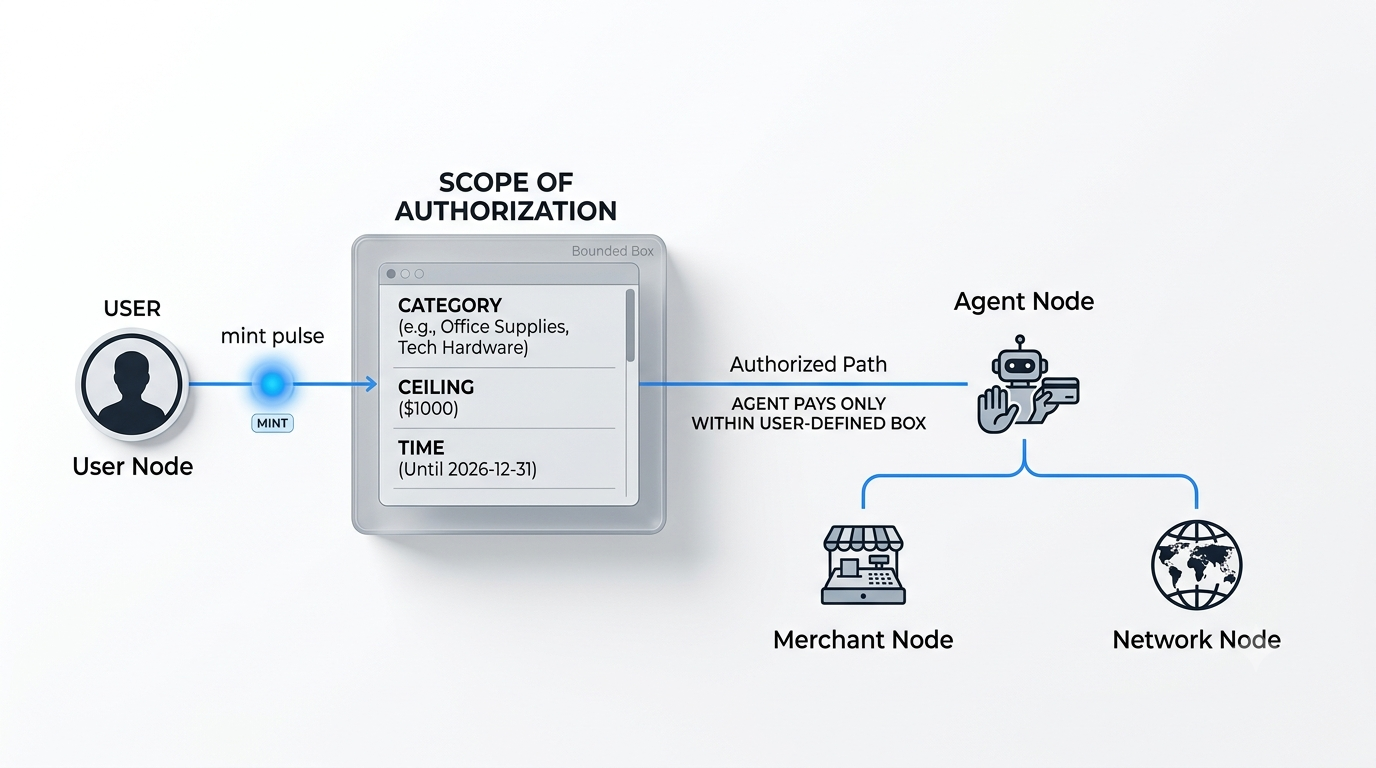
The mechanism relies on tokenized credentials and scoped spending mandates. A user grants an agent a bounded authority, such as a category, a ceiling, or a time window, and the agent negotiates and pays within that box. Cryptographic intent verification lets the merchant confirm the purchase is authorised without exposing the underlying card number. This is the same tokenization logic that already protects card-not-present commerce, extended to a payer that is software rather than a person.
Why merchants should care now
The immediate opportunity is distribution. An agent that shops on a user's behalf will rank merchants by structured data, price, and fulfilment reliability, not by who bought the loudest ad. Businesses that make their inventory machine-readable and their checkout agent-ready enter a channel with lower acquisition cost and higher intent. The risk is being invisible to agents that never see your catalogue, a quiet form of exclusion that compounds over time.
- Visa Intelligent Commerce plus OpenAI: agent payments on a global network.
- Stripe Agentic Commerce Suite: single integration to sell to agents.
- Mastercard Agent Pay: network-level agent transaction rails.
- Google AP2: open protocol for intent and payment verification.
The trust and fraud questions are the real product
Letting software spend money raises problems that marketing copy tends to skip. Who is liable when an agent oversteps its mandate. How is a disputed agent purchase reconciled when no human clicked confirm. What stops a malicious agent from exploiting a broadly scoped permission. The networks are answering with the same tools used for card risk, but the agent layer multiplies the number of authorised actors touching an account, and that multiplication is the hard part.
This is where the durable advantage sits. The winner in agentic commerce is not the one with the smoothest demo. It is the one whose authorization, dispute, and fraud controls survive millions of autonomous transactions. Payments is a trust business, and agents intensify rather than relax that truth, which is why the infrastructure conversation keeps returning to liability and verification.
The winner in agentic commerce is not the one with the smoothest demo. It is the one whose controls survive millions of autonomous transactions.
Why this is a worldwide shift, not a US one
Agentic commerce is being built by US networks, but the behaviour it enables is borderless. A consumer in Singapore or Brazil using an AI assistant to book travel or restock supplies will route through the same global rails. The merchants that win are those who structure their offers for agents regardless of where they are incorporated. Local payment methods still matter at settlement, but the discovery and decision layer is rapidly becoming language- and location-agnostic, a point SpinDepth examines in cross-border payment rails.
Regulators are watching from the start this time, which is new. Because agentic payments touch authorization and consumer protection directly, supervisors in the EU, UK, and parts of Asia are engaging while the rails are forming rather than after a failure. That early scrutiny is healthy. It lowers the chance of a messy retrofit later, and it gives international operators a clearer compliance frame to build against.
What this means for operators
Brands and platforms should treat agent-readiness as a 2026 priority, not a 2027 experiment. The work is concrete: structured product data, agent-compatible checkout, scoped authorization policies, and clear dispute handling. Companies that build for human-only commerce will still function, but they will cede the agent-mediated channel to competitors who treated it as core infrastructure, and that channel is where the next wave of low-friction demand is forming.
Can an AI agent actually complete a payment today?
Yes. Visa, Stripe and Mastercard have live or piloted infrastructure in 2026 that lets agents transact within scoped mandates, though mainstream consumer use is still scaling.
Who is liable if an agent makes an unauthorized purchase?
Liability frameworks are still settling, but the model mirrors card tokenization, with authorization scoped by the user and dispute handling handled by the network and merchant.
How should a merchant prepare for agentic commerce?
Make inventory machine-readable, support agent-compatible checkout, define scoped spending permissions, and clarify dispute resolution so agents can transact confidently.
Agentic commerce is the rare shift where the infrastructure, the standards debate, and the regulatory gaze all arrive at once. The firms that treat agents as a first-class customer now will own the shelf space of a channel that does not sleep, and the ones that wait will find the shelf already stocked by someone else.
Speak with the SpinDepth desk