
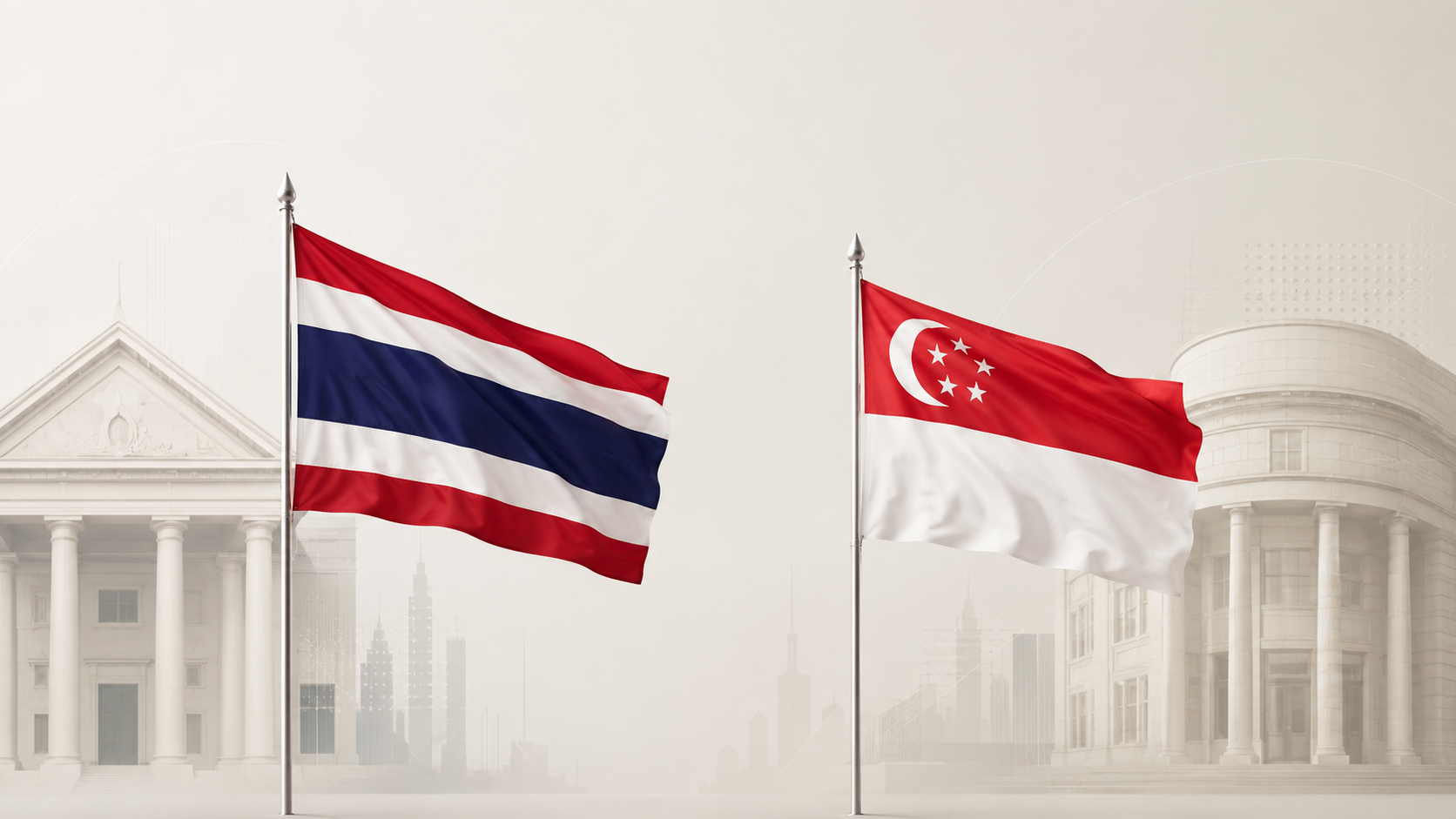
Thailand virtual banking versus Singapore digital banking: two inclusion strategies
Thailand licensed three virtual banks in 2025 for a 2026 launch with a high capital floor, while Singapore awarded four digital bank licences in 2020 with a wholesale-retail split, showing two different inclusion paths.
Thailand and Singapore both set out to use digital banks for inclusion, but they built different machines to do it. Thailand approved three virtual banks in June 2025 for a 2026 launch, with a high capital floor and a consortium model. Singapore awarded four digital bank licences back in 2020, launched in 2022, and split them into retail and wholesale tiers. Same goal, different regulatory architecture. Thailand's licensing path is detailed in our piece on why its virtual banks were delayed.
Singapore's four-bank model
The Monetary Authority of Singapore awarded four digital bank licences in 2020. Two were Digital Full Banks that can serve both retail and business customers: the Grab-Singtel consortium, which launched as GXS Bank, and Sea Group, which launched as MariBank. The other two were Digital Wholesale Banks, limited to serving businesses rather than retail customers, and one of those went to Ant Group. The wholesale-retail split let MAS open the market while ring-fencing retail depositors behind stricter rules. The winners are listed in our Thailand virtual bank licence winners article for contrast.
Thailand's three-consortium model
Thailand chose three consortia, each pairing a Thai anchor with distribution or technology partners, and attached a 5 billion baht capital floor. The winners, SCBX, Krungthai Bank, and Ascend Money, are profiled in our licence-winners breakdown. Thailand did not split retail and wholesale tiers the way Singapore did; instead it leaned on the capital floor and a phased sandbox to protect depositors. The result is a smaller, more concentrated first cohort than Singapore's, by deliberate choice rather than smaller demand.
- Singapore: four licences in 2020, launched 2022
- Singapore split: two Digital Full Banks, two Digital Wholesale Banks
- Thailand: three licences in 2025, launch by 2026
- Thailand: 5 billion baht capital floor, consortium model, phased sandbox
Why the paths diverged
The difference comes down to regulator appetite for risk. Singapore moved earlier and structured tiers to separate retail from wholesale risk. Thailand moved later and concentrated the market, using a high capital floor and a sandbox to keep the first cohort safe. Neither is wrong; they reflect different starting points and different readings of depositor risk. Thailand's caution is the subject of our delay piece, and Ascend Bank's entry shows how a payments-led player fits the Thai model specifically.
Same inclusion goal, different machines: Singapore tiered the risk, Thailand concentrated and capitalised it.
What operators should take away
For any operator planning across ASEAN, the lesson is that digital bank entry is a regulator-specific exercise. A playbook that worked in Singapore, a tiered wholesale-retail model with earlier timing, does not map cleanly onto Thailand's concentrated, capital-heavy, sandbox-paced regime. The winning Thai strategy is the consortium shape, as the licence winners show, whereas Singapore's winners were platform and ecosystem giants. The inclusion thesis itself, reaching the underserved, is common to both, and is examined in our article on virtual banks serving underserved consumers in Thailand.
The bigger picture
The Thailand-Singapore contrast is the clearest lens on how Southeast Asia is building virtual banking. There is no single regional template. Each central bank weights inclusion against depositor protection differently, and that weighting drives the licence count, the capital rules, and the launch pace. Thailand's cautious three-bank model and Singapore's tiered four-bank model are both defensible, and both will be judged on whether they actually bank the underserved rather than just compete for the banked. The next few years of loan-book data from both markets will settle which architecture serves inclusion better.
What to watch next
Compare the two markets on the same metric: net-new credit to first-time borrowers in the first two years of operation. Singapore's banks have a head start from their 2022 launch; Thailand's will report from 2026. Watching the inclusion numbers side by side is the only fair way to judge whether concentration or tiering is the better route to the same goal.
How many digital banks did Singapore licence?
Four, awarded by the Monetary Authority of Singapore in 2020 and launched in 2022: two Digital Full Banks for retail and business customers, including Grab-Singtel's GXS Bank and Sea's MariBank, and two Digital Wholesale Banks, one of which went to Ant Group.
How does that differ from Thailand?
Thailand approved three virtual banks in 2025 for a 2026 launch, with a 5 billion baht capital floor and a consortium model, rather than Singapore's earlier four-bank retail-wholesale split.