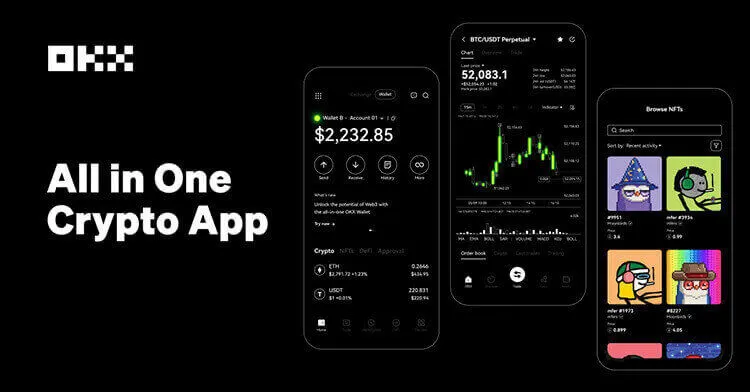
OKX and Bybit are the two exchange giants traders most often weigh against each other, and the 2026 comparisons split on fine margins. CoinBureau's Bybit vs OKX scores fees, safety, futures, Web3 and cards, while TheMEXC's breakdown and Yieldo's live fee data track the moving parts. Neither is a universal winner; each wins a trader type. The Bybit super-app piece covers the European equities push in depth. Exchanges can partner with SpinDepth on ecosystem comparison content.
Fees, futures and Web3 depth
Bybit's taker fees edge lower on some USDT pairs per Yieldo's live data, while OKX counters with deeper Web3 wallet and DeFi integration. Futures liquidity, KYC friction and regional access shift the answer by geography. CoinBureau's methodology isolates the dimensions, and the PrimeXBT comparison scores the broker-versus-exchange axis separately.
Expansion strategy diverges
Bybit pushes into regulated equities and super-app territory in Europe, while OKX deepens its Web3 and institutional rails. One buys regulated-asset reach, the other buys ecosystem depth. For traders, the choice is which roadmap matches their next twelve months. The licence guide still applies to the custody and KYC layers.
- Bybit: lower some fees, equities push
- OKX: deeper Web3 wallet and DeFi
- Futures liquidity close across both
- Verdict splits by trader type
Key takeaways
Fee-sensitive spot and futures traders lean Bybit; Web3 and DeFi users lean OKX. Both are solvent-grade venues, so the decision is feature fit, not survival.
Two giants, two roadmaps: one buys regulated reach, the other buys ecosystem depth.
Two exchanges with different histories
OKX began as OKEx in 2017 and grew into one of the largest crypto exchanges by derivatives volume, with a strong Web3 wallet built into its app. Bybit was founded in 2018 as a derivatives exchange and expanded into spot trading, copy trading, cards and, more recently, traditional assets. Both are headquartered outside the United States, both run large futures markets and both have spent the past few years adding licences in specific regions.
Safety records, honestly
Any comparison of exchanges has to include what happened when things went wrong. In February 2025 Bybit suffered one of the largest hacks in the industry's history, with roughly 1.5 billion dollars in Ether stolen from a cold wallet. The exchange covered the loss, kept withdrawals open and replenished its reserves within days, which became a test case for how an exchange can survive a major breach.
OKX's record includes a settlement with the US Department of Justice in 2025, when its operating company pleaded guilty to operating an unlicensed money transmitting business and agreed to pay more than 500 million dollars. The case concerned serving US clients without the required licences.
Neither event decides the comparison on its own. They show what to look for: how an exchange handles a crisis, and whether it operates inside the rules of the countries it serves.
Licences and regional access
Both exchanges now hold licences in several jurisdictions and operate regional entities to serve them. In Europe, both have sought authorisation under MiCA, the EU's crypto-asset regulation, through EU-based subsidiaries. Elsewhere, access depends on local rules, and some products available in one region are blocked in another.
For a trader, the practical step is to check which entity serves your country and what that entity is licensed to offer. A derivatives product available on the global site may not be legally offered to residents of your country, and using it anyway can leave you without recourse if something goes wrong.
Proof of reserves and custody
After the collapse of FTX in 2022, major exchanges began publishing proof of reserves: snapshots showing they hold at least as much of each asset as clients have deposited, often with a Merkle tree that lets users check their own balance is included. Both OKX and Bybit publish such reports. They are useful but limited: a snapshot shows assets at one moment and does not on its own show liabilities, which is why independent audits carry more weight when available.
Holding assets on any exchange means trusting its custody. Long-term holdings are safer in a wallet the user controls, with only trading balances kept on the exchange.
Fees, in context
Fee tables change often and depend on the user's tier, trading volume and whether the order adds or removes liquidity. Maker fees are charged when an order rests on the book, taker fees when an order fills against one. Both exchanges discount fees for high-volume users and for holding their own tokens in some cases. For most retail traders the difference between the two is small, and funding rates on perpetual futures, which are paid between long and short traders every few hours, often matter more than trading fees for anyone holding leveraged positions.
Choosing by use case
- A trader focused on perpetual futures should compare funding rates, liquidity on the pairs they trade and liquidation rules.
- A user who wants to interact with decentralised applications may value OKX's built-in Web3 wallet.
- A user interested in traditional assets alongside crypto may look at Bybit's expansion into those products, where available in their region.
- Everyone should check which entity serves their country and keep long-term holdings off the exchange.
Security features every user should switch on
Whichever exchange a trader picks, account security is partly in the user's hands. Both exchanges support two-factor authentication through an authenticator app, withdrawal address whitelists that only allow transfers to saved addresses, anti-phishing codes that appear in genuine emails, and login alerts. Switching all of them on takes a few minutes and blocks the most common ways accounts are emptied: stolen passwords, SIM-swap attacks and fake support messages. No genuine exchange support agent will ask for a password, a two-factor code or a seed phrase.
Copy trading and bots on both platforms
Both exchanges offer copy trading and automated trading bots, such as grid bots that buy and sell within a price range. These tools are convenient but carry the same risk as manual trading, with leverage often added. Before using them, check the leader's track record over months, the fee charged for copying, and what happens to open positions if the leader stops trading or the market moves sharply.
The verdict, by trader
For a futures trader in a country both exchanges serve, the decision often comes down to the pairs they trade, funding rates and the interface they prefer, so testing both with small balances is reasonable. For a user who wants on-chain access from the same app, OKX's wallet is the stronger draw. For a user curious about traditional assets inside a crypto app, Bybit's expansion is the one to watch. In every case, check the licensed entity for your country and keep long-term savings in a wallet you control.
The bigger picture
Exchange competition has moved from listing wars to ecosystem wars: regulated reach versus on-chain depth. OKX and Bybit are the two clearest representatives of each bet.
What to watch next
Watch Bybit's European licence approvals. Watch OKX's Web3 user growth. And watch fee-table drift, the fastest competitive signal.
Which is better, OKX or Bybit?
Bybit for fee-sensitive spot and futures traders, OKX for Web3 and DeFi depth; both are top-tier venues.
Do their fees differ?
Bybit edges lower on some USDT pairs per live data, while OKX counters with ecosystem features.
How do their strategies differ?
Bybit pushes into regulated equities and super-app territory, OKX deepens Web3 and institutional rails.
Was Bybit insolvent after the 2025 hack?
No. Bybit covered the stolen funds, kept withdrawals running and restored its reserves, and continued operating normally.
Can US residents use OKX or Bybit?
The global platforms do not serve US residents. OKX has a separate US offering; Bybit does not serve the US. Check the current terms for your country.
What is proof of reserves?
A report showing an exchange holds client assets at a point in time, often with a tool for users to check their balance is included. It is a snapshot, not a full audit.
You've finished this story
Read on, send it to someone, or ask about it.