
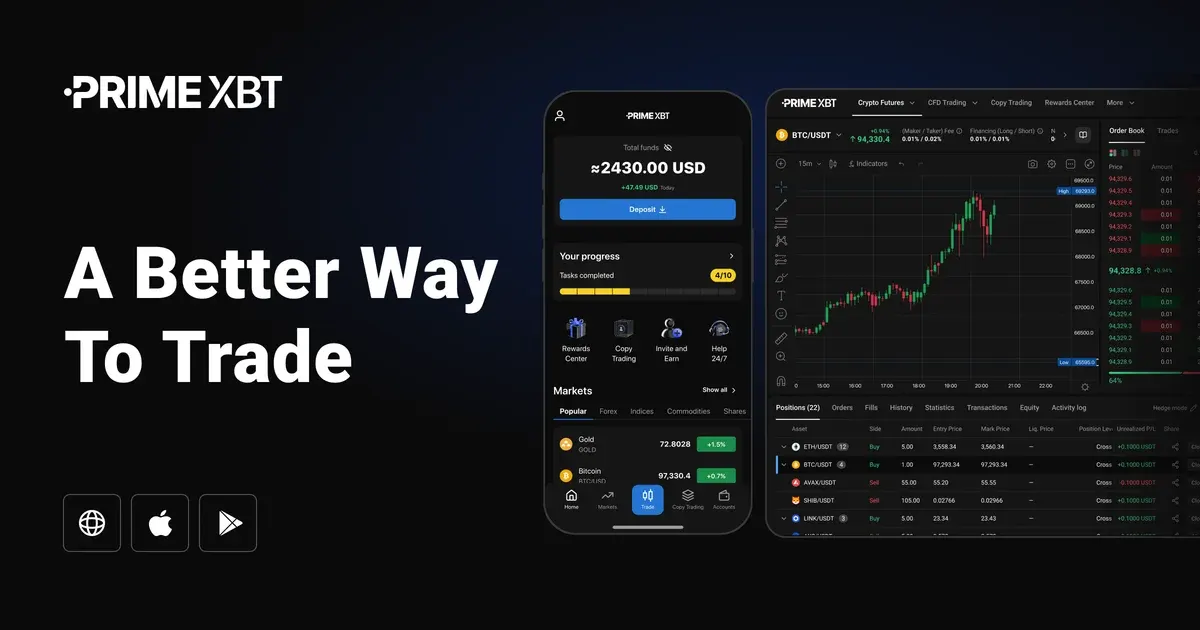
PrimeXBT and Bybit sound like rivals but sell different machines. PrimeXBT is a crypto and CFD broker serving 150-plus countries with high leverage and copy trading, profiled by Coin Bureau and CryptoNews. Bybit is a full crypto exchange with its own orderbook, futures and, per recent reports, a European super-app push. One is a broker on top of crypto, the other is the venue itself. The risk and regulation differ accordingly. Crypto trading brands can partner with SpinDepth on cross-asset campaigns.
Broker versus exchange, and why it matters
PrimeXBT wraps crypto exposure in CFD-style leverage, meaning you trade a contract against the broker rather than owning the asset, with the broker's liquidity and counterparty risk in between. Bybit's spot and futures run on an exchange orderbook where you face the market. Counterparty risk sits with the broker in one case and with the venue plus self-custody discipline in the other. Neither is tier-one in the FCA sense, so the licence guide applies to both.
Leverage, fees and fit
PrimeXBT's appeal is high leverage and copy trading for traders who want amplified crypto without holding it. Bybit's appeal is depth, derivatives and an app ecosystem, now expanding into equities per the Bybit super-app piece. The OKX comparison in this edition scores the exchange side of the ledger separately.
- PrimeXBT: crypto CFDs, 150-plus countries
- Bybit: full exchange plus super-app push
- Counterparty risk differs by structure
- Neither holds tier-one licences
Key takeaways
Pick by structure: broker-side CFD leverage for simplicity, exchange orderbook for depth and ownership. Verify regulation and withdraw early regardless of route.
A broker wraps crypto in a contract; an exchange wraps it in an orderbook. Know which risk you are holding.
Owning crypto versus trading a contract
When a client buys bitcoin on an exchange's spot market, they own the coin and can withdraw it to their own wallet. When a client trades a bitcoin CFD with a broker, they own a contract with the broker that pays the difference between the opening and closing price. The client never holds the coin, cannot move it to a wallet and depends on the broker to honour the contract.
Exchanges also offer derivatives, such as perpetual futures, which do not involve owning the coin either. The difference is the venue: on an exchange, the client trades against other market participants through an order book, while with a CFD broker the client usually trades against the broker or its liquidity providers.
How the costs differ
Crypto CFDs are typically priced through a spread and charged overnight financing for leveraged positions held past the daily cut-off. Perpetual futures on exchanges charge maker and taker fees and a funding rate, paid between long and short traders every few hours, which can be positive or negative depending on market sentiment. In a strongly rising market, funding rates for longs can become expensive. Comparing the two means estimating the full cost of holding a position for as long as you usually do, not just the cost of opening it.
What happens when a position goes wrong
Both brokers and exchanges close leveraged positions when margin runs out, but the mechanics differ. Exchanges use liquidation engines that close positions at a liquidation price, backed by an insurance fund that covers losses beyond a trader's margin. In extreme markets, some exchanges use auto-deleveraging, reducing profitable positions on the other side to cover shortfalls. CFD brokers apply a margin call and stop-out level set in the client agreement, and some offer negative balance protection so a client cannot lose more than the account balance.
Knowing the liquidation or stop-out rules before trading is essential at high leverage, because crypto prices can move several percent in minutes.
Regulation in the crypto space
Crypto regulation is uneven around the world. In the EU, MiCA now governs crypto service providers, and crypto derivatives fall under financial instrument rules. In the UK, the sale of crypto derivatives to retail clients has been banned since 2021. Many crypto brokers and exchanges serve clients from offshore jurisdictions with lighter supervision. For any platform, check which entity serves your country and whether it is licensed to offer leveraged crypto products there.
Copy trading in crypto
Copy trading is popular on both crypto brokers and exchanges. It lets a client mirror a lead trader's positions automatically. In crypto, the combination of high volatility and high leverage means a lead trader's bad week can be severe. Look at results over many months, check how deep the largest drawdown went, understand the fees and set a stop on the copied strategy as a whole.
Custody, withdrawals and security
For exchange users, custody is a key decision: keeping coins on the exchange is convenient for trading but exposes them to the exchange's security and solvency. Long-term holdings are safer in a wallet the user controls. For CFD broker clients, custody is not an issue for coins, but the broker holds the client's cash, so client-money practices and withdrawal records matter. On both, switch on two-factor authentication, use withdrawal address whitelists where available and test a small withdrawal early.
Choosing by goal
- To own crypto and move it to your own wallet, use an exchange's spot market.
- To trade price movements with leverage and stop-out rules set by a broker, a CFD account may suit.
- To trade perpetual futures with deep order books, a major exchange offers more liquidity.
- In every case, check the licence for your country, understand the liquidation rules and keep leverage low.
Leverage in crypto, in numbers
At 100 to 1 leverage, a 1 percent move against a position wipes out its margin. Bitcoin regularly moves more than 1 percent in an hour, and smaller coins move far more. That is why crypto liquidations cluster around sharp moves, often in cascades as one wave of forced selling triggers the next. Using low leverage, or none, and sizing positions so a stop loss caps the loss at a small share of the account, keeps a trader in the market through those swings.
The bigger picture
Crypto trading keeps splitting into broker-wrapped and exchange-native routes, and the convergence is blurring the line. Traders who understand counterparty risk choose better than traders who follow logos.
What to watch next
Watch Bybit's equities launch for the convergence signal. Watch PrimeXBT copy-trading leaderboards for survivorship traps. And watch leverage caps, where regulators eventually intervene.
What is the difference between PrimeXBT and Bybit?
PrimeXBT is a crypto CFD broker with high leverage and copy trading, while Bybit is a full exchange with an orderbook, futures and a super-app push.
Which is safer?
Neither holds tier-one licences; PrimeXBT carries broker counterparty risk and Bybit carries venue and custody risk, so verify regulation and test withdrawals.
Which should I choose?
Broker-side CFD leverage for simplicity, exchange orderbook for depth and asset ownership.
Do I own bitcoin when I trade a crypto CFD?
No. A CFD is a contract with the broker that tracks bitcoin's price. You cannot withdraw coins to a wallet.
What is a funding rate?
A periodic payment between long and short traders on perpetual futures, which keeps the contract price close to the spot price. It can be positive or negative.
Can retail clients trade crypto CFDs in the UK?
No. The FCA has banned the sale of crypto derivatives, including CFDs, to retail clients since 2021.
You've finished this story
Read on, send it to someone, or ask about it.