 Media & Reputation
 Football
 Culture
 Experiences
 Advertising


For most of its history, Graviton Research Capital made its money at home. The Gurugram-based firm became India's first billion-dollar quantitative trading venture, Bloomberg says, in a derivatives market where speed and algorithms decide who captures the spread. In its latest financial year that changed. Graviton's Singapore unit, which it says represents its global business, earned more than its Indian one.
The numbers are a snapshot of two markets moving in opposite directions for a trading firm. India has tightened rules on retail options trading and raised taxes on derivatives, while Graviton's business outside India has been growing fast. We compared the two units, using figures reported by Bloomberg and Finance Magnates, and looked at what they say about where high-speed trading money is now made in Asia.
The two units, side by side
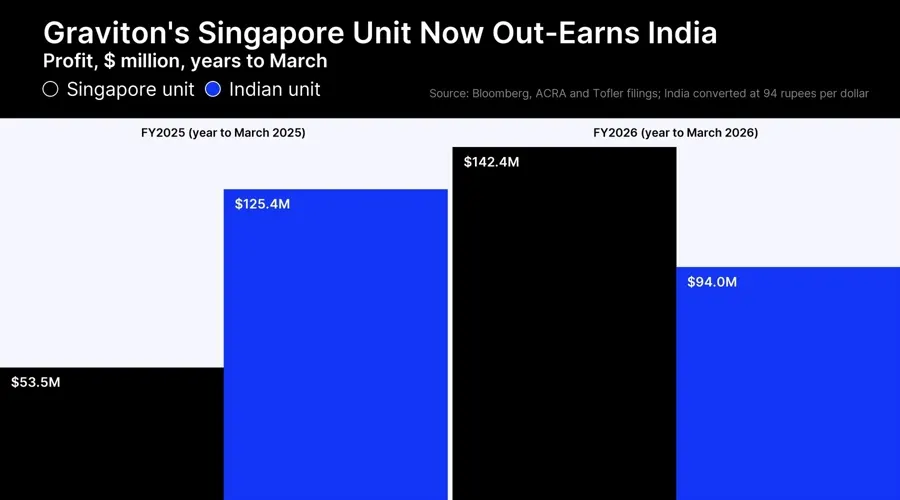
The Singapore result is the headline. Graviton's Singapore unit nearly tripled its annual profit to 142.4 million dollars in the year to March 2026, a rise of 166 percent, and more than doubled revenue to 239.4 million dollars, up 112 percent, Graviton told Bloomberg. Profit came to about 59 percent of revenue. "Our Singapore entity's growth reflects the strong momentum in our global business," a spokesperson said.
India went the other way. The Indian unit's profit fell 25 percent to 8.84 billion rupees, about 94 million dollars at current exchange rates by Finance Magnates' calculation. Its revenue fell 11 percent to 22.8 billion rupees, according to a filing made available by data provider Tofler, while personnel expenses rose 21 percent to 11.6 billion rupees, about half of revenue.
The reversal is sharp. A year earlier, the Indian unit's profit had been more than twice the Singapore figure. Both entities also changed their accounting for the latest and prior years, so revenue is now shown net of trading expenses, which makes the year-on-year comparison cleaner than headline revenue alone would suggest.
The margins tell their own story. In Singapore, profit was about 59 percent of revenue, a level that shows how much of each dollar of trading income the global business kept. In India, personnel costs alone took about half of revenue, and they rose while revenue fell. A trading firm's main expenses are people and technology, so when revenue shrinks and the wage bill grows, profit falls faster than revenue, which is what the Indian figures show: revenue down 11 percent, profit down 25 percent.
Why India got harder
Graviton put the decline down to "headwinds" in the Indian trading environment. Bloomberg tied those headwinds to regulation and competition. India reined in its options market after retail losses mounted, and the Securities and Exchange Board of India found that nearly 91 percent of individual futures and options traders lost money in the year to March 2025.
Costs rose too. The government raised the securities transaction tax on futures and options from 1 April 2026, the first day of Graviton's current financial year, which means the full effect of that change is not yet in the figures above. A transaction tax is charged on every trade, so it weighs most on strategies that trade very often for small gains, the business model of a high-frequency firm. Retail interest has cooled beyond the exchanges as well: organic traffic from India to retail broker websites fell 47.1 percent in the third quarter from the second, Finance Magnates' broker traffic data show.
Competition has also arrived. Jane Street, Citadel Securities and Hudson River Trading have expanded in India, adding large global competitors to the market Graviton grew up in. The pool is still large: proprietary traders made about 440 billion rupees in gross trading profit in India last financial year, SEBI data show, and algorithmic firms took 99 percent of the profit earned by proprietary traders and foreign investors.
India is still one of the deepest derivatives markets in the world, but it is no longer the easiest. Graviton's numbers show the profit moving to wherever the firm trades outside it.
Singapore as the global hub
Singapore's role is partly structural. Graviton says its Singapore entity represents its global business, so the growth there reflects trading outside India rather than in Singapore's own market alone. Singapore is a common regional base for trading firms, and Graviton is hiring there, in Amsterdam and in India, with advertisements for quantitative researchers graduating in 2027 to work in Singapore, London, Amsterdam or New York.
The firm is also building in the US. Two months ago it named Adam Celentano chief operating officer in the United States, with a remit to build the business there, Bloomberg reported. That leaves Graviton looking less like an Indian trading house with an overseas arm and more like a global firm with an Indian origin.

The founders have done well from the shift. The results lifted Graviton's valuation by about a third from 1.46 billion dollars, the figure based on both entities' accounts for the year to March 2025, putting co-founders Nishil Gupta and Ankit Gupta, both 39, at about 1 billion dollars each on the Bloomberg Billionaires Index. The two hold equal stakes, are not related, and founded Graviton in 2014 after meeting at the Indian Institute of Technology in New Delhi.
How Graviton compares with bigger market makers
The comparison with larger firms is mixed. Virtu Financial's net income rose 89.6 percent to 282.5 million dollars in its third quarter, while Citadel Securities' UK market-making arm reported 2025 profit down 38.3 percent at 29.2 million dollars, Finance Magnates reported. Graviton's Singapore growth of 166 percent stands out against both, although the periods and structures differ.
The broader comparison comes down to a few points:
- Graviton's Singapore unit: profit up 166 percent to 142.4 million dollars in the year to March 2026.
- Graviton's Indian unit: profit down 25 percent to about 94 million dollars.
- Virtu Financial: third-quarter net income up 89.6 percent to 282.5 million dollars.
- Citadel Securities' UK market-making arm: 2025 profit down 38.3 percent to 29.2 million dollars.
For India's market, the numbers fit the purpose of SEBI's curbs, which were aimed at reducing retail losses in options. A smaller profit pool for trading firms is consistent with that aim. The same rules also push firms like Graviton to grow elsewhere, which is what its Singapore figures show.
What it means for Asian markets
For Singapore, Graviton's results are another example of the city acting as the regional base for trading and market-making firms. We have covered Singapore's economy this year in our report on Singapore's third-quarter growth, and how its banks compare with the region's in our Southeast Asia banks league.
For traders, the Graviton story is a reminder of who is on the other side of the trade. In India, SEBI's data show that algorithmic firms took almost all the profit earned by proprietary traders and foreign investors, while most individual options traders lost money. A firm earning tens of millions of dollars a year from speed is the counterpart to retail traders who pay the spread.
What is Graviton Research Capital?
A high-frequency and quantitative trading firm based in Gurugram, India, founded in 2014 by Nishil Gupta and Ankit Gupta.
How much did Graviton's Singapore unit earn?
142.4 million dollars in the year to March 2026, up 166 percent, on revenue of 239.4 million dollars.
How much did Graviton earn in India?
Its Indian unit's profit fell 25 percent to 8.84 billion rupees, about 94 million dollars.
Why did Graviton's Indian profit fall?
Graviton cited headwinds in India's trading environment. Bloomberg linked them to tighter options rules, higher transaction tax and more competition.
What did SEBI find about retail options traders?
Nearly 91 percent of individual futures and options traders lost money in the year to March 2025.
When did India raise the securities transaction tax on derivatives?
From 1 April 2026, the start of Graviton's current financial year.
Which global firms have expanded in India?
Jane Street, Citadel Securities and Hudson River Trading, according to Bloomberg.
Are Graviton's founders billionaires?
The Bloomberg Billionaires Index puts Nishil Gupta and Ankit Gupta at about 1 billion dollars each.
Why does Graviton's Singapore unit matter?
Graviton says it represents the firm's global business outside India, which is now growing faster than its home market.
Is Graviton expanding outside Asia?
Yes. It is hiring in Amsterdam, London and New York and named a US chief operating officer to build its American business.
Graviton's year shows a trading firm following the profit out of a market that has deliberately made fast money harder to earn. India's curbs and taxes cut the home unit's profit by a quarter, while the Singapore unit that carries its global business nearly tripled.
Talk to SpinDepth about financial communication in Singapore and IndiaYou've finished this story
Read on, send it to someone, or ask about it.