 Media & Reputation
 Football
 Culture
 Experiences
 Advertising
With StoneX's annual results this month, five of the best-known listed retail brokers have now reported the July to September quarter, and the results do not tell one story. StoneX, the group behind FOREX.com, posted its weakest retail FX and CFD revenue in at least three years in the same quarter in which XTB's revenue rose two-thirds and a Japanese FX brand more than doubled its takings.
The difference is not only about clients trading more or less. XTB described the quarter as calmer than the first half, with less activity on stock indices, and IG called conditions less supportive. What separated them was where their clients traded, how much of the flow each broker kept as revenue, and how much each was spending to win new accounts. We compared five of them on the numbers they published.
StoneX: a record year, and a three-year low in retail
StoneX's annual results showed how small retail has become inside the group. Net income for the 12 months to 30 September rose 72 percent to 525.4 million dollars on operating revenue of 5.93 billion dollars, helped by a full year of R.J. O'Brien, the US futures broker it agreed to buy in April 2025. Chief executive Philip Smith pointed to "record annual performance in our Commercial, Institutional and Payments segments".
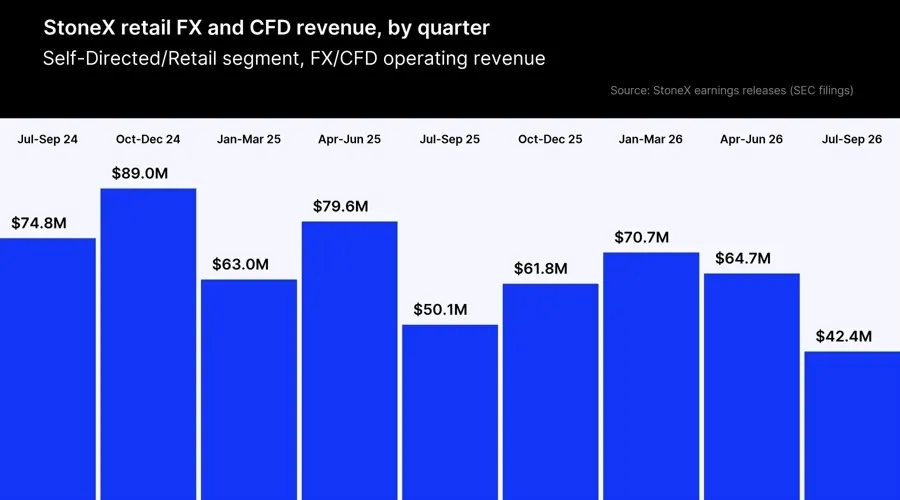
Retail went the other way. Finance Magnates reported that retail FX and CFD revenue fell 15 percent to 42.4 million dollars in the September quarter, the lowest in at least three years of StoneX's releases. Average daily FX and CFD volume fell 17 percent to 6.15 billion dollars, while revenue per million dollars traded was little changed at 106 dollars. After 15.6 million dollars of allocated overhead, the segment lost 9.2 million dollars, against income of 1.9 million a year earlier.
The full year shows the same trend. Retail FX and CFD revenue fell 15 percent to 239.6 million dollars, and the segment's income after overhead dropped 77 percent to 18.2 million dollars. The Self-Directed/Retail segment was the only one of StoneX's four segments with lower annual revenue, and its share of the group fell to 6.3 percent from 9.8 percent. In the UK the City Index name gave way to StoneX Trading on 12 September.
Plus500: growth and a raised outlook
Plus500 reported steady growth. Revenue rose 11 percent to 203.2 million dollars in the three months to 30 September, from 182.7 million a year earlier, and EBITDA rose 7 percent to 88.4 million dollars, a 44 percent margin, according to its trading update. Over nine months, revenue reached 666.1 million dollars, up 11 percent.
The outlook moved up. "With momentum accelerating across the Group, the Board expects that FY 2026 revenue and EBITDA will be ahead of current market expectations," chief executive David Zruia said. Finance Magnates noted that this was a shift from July, when the company guided in line with consensus.
The customer numbers explain part of it. New customers rose to 28,747 from 22,644, active customers rose 4 percent to 119,528, and average revenue per user rose 7 percent to 1,700 dollars, while the average cost of acquiring a customer fell 14 percent to 1,150 dollars. Customer deposits reached a quarterly record of 1.9 billion dollars, and the non-OTC business, including its US futures arm, made up about 16 percent of revenue year to date.
XTB: fewer lots, twice the revenue per lot
XTB's quarter was the most dramatic. Net profit rose about fourfold to PLN 213.7 million, around 54 million dollars, beating the analyst average by 6.4 percent, and revenue rose 65.9 percent to PLN 623.3 million. Clients traded 18.3 percent fewer CFD lots, but XTB earned PLN 301 per lot, almost double the PLN 152 of a year earlier, Finance Magnates reported.
Commodities did the work. Gold, crude oil, natural gas and silver CFDs produced 70.8 percent of XTB's gross result on financial instruments, against 48.5 percent a year earlier, while index CFDs fell to 12.0 percent from 32.4 percent. The comparison base was also weak: a year ago XTB's profit had fallen 74 percent on low volatility. Its revenue was still 37.2 percent below the second quarter's PLN 992.3 million.
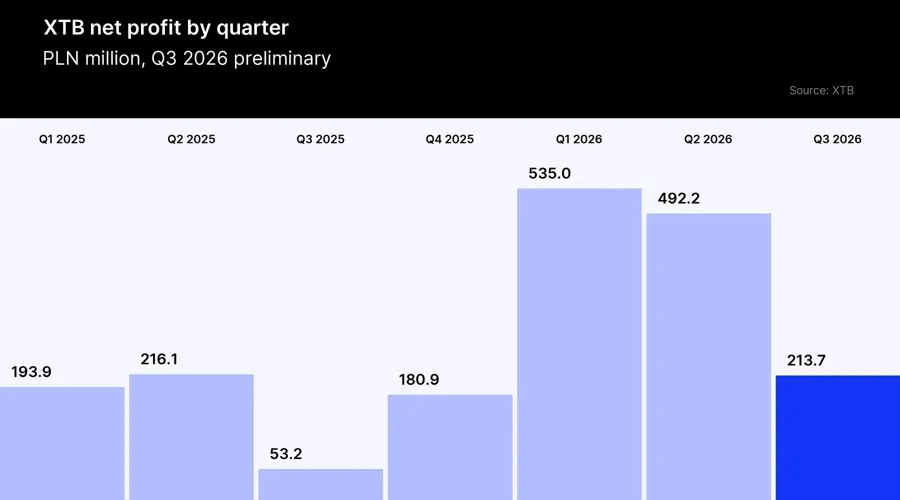
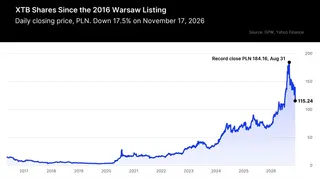
XTB is also spending the most to grow. It added 335,704 new clients, up 51.4 percent, reaching 3.14 million in total, with active clients up 70.3 percent to 1.57 million. Operating costs rose 23.2 percent to PLN 397.6 million, mainly on marketing, and a campaign with Zlatan Ibrahimovic and Tyson Fury began on 1 October. We looked at the regulatory risk around XTB earlier this week in our report on XTB's share fall and Poland's CFD curbs.
IG and Gaitame: retention and the yen
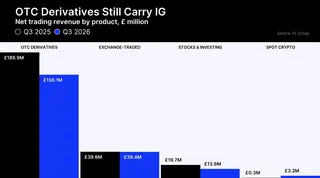
IG's quarter turned on how much of its clients' trading it kept. The group expected total revenue of about 240 million pounds for the three months to 30 September, down about 14 percent from 280.1 million, with net trading revenue of about 210 million pounds. Within OTC derivatives, revenue retention was about 70 percent, against an average of about 80 percent since IG introduced market-making optimisation measures in the second half of 2025, and OTC net trading revenue fell about 18 percent to around 155 million pounds.
The customer side was healthier than the revenue. OTC customer income rose about 8 percent, organic first trades rose more than 25 percent and active customers about 17 percent, IG said. "Lower Q3 revenue reflected reduced OTC revenue retention in less supportive market conditions," chief executive Breon Corcoran said, adding that he remained confident of meeting medium-term guidance. The board cut its 2026 outlook to revenue growth in the mid-single digits.
In the same quarter, the brokers that earned more per trade grew and the ones that kept less of the flow shrank. Volume alone explained very little.
Japan was the outlier. Compagnie Financiere Tradition, the Swiss interdealer broker that owns Gaitame.com, said revenue in its retail segment, driven mainly by the Japanese FX business, rose 117.6 percent at constant currency to 16.2 million dollars, from 7.7 million a year earlier. Finance Magnates said that was consistent with heightened yen trading in July and August, when intervention and a partial unwinding of carry trades raised volatility. In the first half, Tradition's retail FX revenue had grown just 9 percent.

What separated the winners from the rest
Put side by side, the five results show three drivers that matter more than headline volume:
- Product mix: XTB's shift to commodity CFDs nearly doubled its revenue per lot while lots fell.
- Retention: IG's revenue fell mainly because it kept about 70 percent of OTC flow as revenue, not 80 percent.
- Market: Gaitame's Japanese clients traded through a volatile quarter for the yen.
- Scale and focus: StoneX's retail unit is now a small part of a group whose growth comes from institutional and commercial clients.
The comparison also matters for Asia. FOREX.com and IG both serve clients in the region, XTB has expanded in the Gulf, and Plus500 has built a futures business alongside its CFDs. For traders, these numbers are a reminder that a broker's results reflect its own risk and pricing choices, not only market conditions. We covered how brokers are buying growth instead in our comparison of client book deals.
Why did StoneX's retail revenue fall?
Clients traded less: average daily FX and CFD volume fell 17 percent to 6.15 billion dollars, and revenue fell 15 percent to 42.4 million dollars.
Is FOREX.com part of StoneX?
Yes. FOREX.com sits in StoneX's Self-Directed/Retail segment.
How did Plus500 do in Q3 2026?
Revenue rose 11 percent to 203.2 million dollars and the company said full-year revenue and EBITDA would be ahead of market expectations.
Why did XTB's revenue rise while trading fell?
XTB earned PLN 301 per lot, almost double a year earlier, as commodity CFDs produced 70.8 percent of its trading result.
Why did IG's revenue fall?
IG's OTC revenue retention fell to about 70 percent from an average of about 80 percent, cutting total revenue by about 14 percent.
What is revenue retention?
The share of clients' trading activity a broker keeps as revenue after hedging and client gains and losses.
What is Gaitame.com?
A Japanese retail FX broker owned by Compagnie Financiere Tradition. Its segment's revenue rose 117.6 percent at constant currency in the third quarter.
Which broker grew fastest in Q3 2026?
Among the five compared, Gaitame's segment grew fastest in percentage terms, followed by XTB's revenue growth of 65.9 percent.
Did StoneX make a profit in 2026?
Yes. Group net income for the fiscal year rose 72 percent to a record 525.4 million dollars, even as its retail unit lost money in the quarter.
What happened to City Index?
StoneX replaced the City Index brand with StoneX Trading in the UK on 12 September 2026.
The July to September quarter split the listed retail brokers into those that earned more from each trade and those that did not. Plus500, XTB and Gaitame grew, IG kept less of its flow, and StoneX's FOREX.com unit shrank to a three-year low inside a group having its best year.
Talk to SpinDepth about broker growth and positioning in AsiaYou've finished this story
Read on, send it to someone, or ask about it.