 Media & Reputation
 Football
 Culture
 Experiences
 Advertising

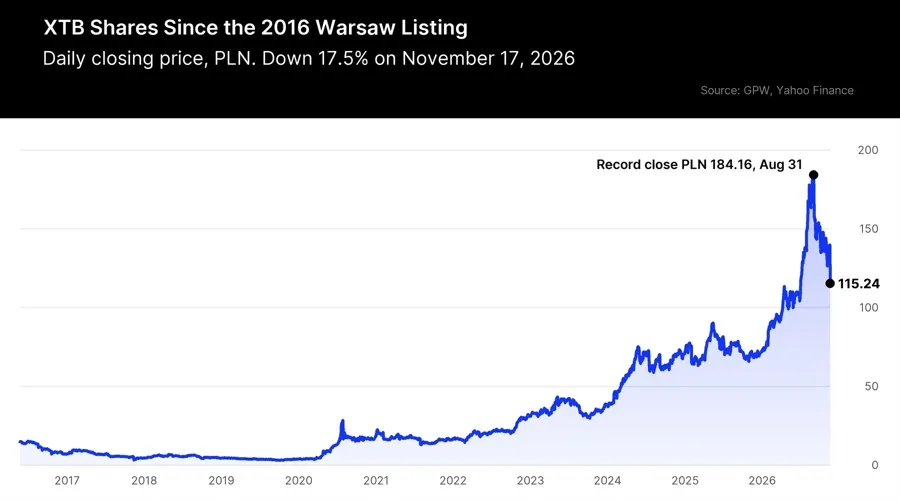
"In the case of CFDs, the broker becomes not an intermediary but a bookmaker." Dariusz Adamski, deputy chairman of Poland's Financial Supervision Authority, said it at a newspaper conference in Warsaw on Tuesday 17 November, and Warsaw-listed broker XTB lost almost a fifth of its value before the closing bell.
XTB fell 17.5 percent that day and touched another low the next morning, about 23 percent below where it had started the week. Its London-listed rivals barely moved by comparison. The difference says a lot about how each listed broker makes its money, and about where retail CFD regulation is heading.
What the regulator said
Adamski did not name XTB and gave no timetable. He told the Parkiet conference that a new product intervention on CFDs would come "soon", and backed it with numbers: 267,000 clients of Polish brokers lost money on CFDs last year, with losses of nearly PLN 2 billion, about 500 million US dollars and almost seven times the 2019 level, Finance Magnates reported.
His argument was that Poland's 2019 intervention, which capped leverage but still let experienced traders use up to 100 to 1, did not have the intended effect. The bookmaker line was the headline, but the substance was the loss figure: the regulator is saying that leverage limits alone have not reduced the damage.
This was not the first warning. In May, Adamski's comments on steering clients from simple products into complex ones cost XTB more than 8 percent in a session, and he said then that the KNF's review of CFD sales would extend to cross-border brokers. In August the regulator said the review remained open, without measures or a timetable.
Why XTB fell six times harder than its rivals
The answer is concentration. CFDs generated 90.5 percent of XTB's gross result on financial instruments in the third quarter, even though stocks and ETFs hold most of its clients' money. More than half of XTB's revenue came from its home market of Poland in 2025, FX News Group noted. A Polish CFD rule therefore hits XTB's main product in its main market at the same time.
The London-listed brokers sell CFDs too, but their exposure to Poland is small. On Tuesday Plus500 lost 3.1 percent, IG Group 3.5 percent and CMC Markets 2.7 percent, while Swissquote fell 3.1 percent in Zurich, all in line with a 1.8 percent fall in the STOXX Europe 600. Bank Ochrony Środowiska, whose brokerage arm is one of two bank-owned brokers left in Poland's CFD market, slipped 1.7 percent.
The shares had been moving apart before this week. In the third quarter XTB rose 41.2 percent while IG fell 27.1 percent, according to Finance Magnates data, as we discussed in our report on IG's share price slide. Even after Tuesday, XTB stood about 60 percent above its end-2025 close, though 37 percent below its record close of PLN 184.16 on 31 August.
XTB's answer: we are becoming an investment app
XTB responded on Wednesday with a statement on its investor relations site. It said it remained in dialogue with the KNF, that the CFD market was one of the topics, and that it would comment on specific measures once the regulator issued a formal decision. Most of the statement was about the rest of the business.
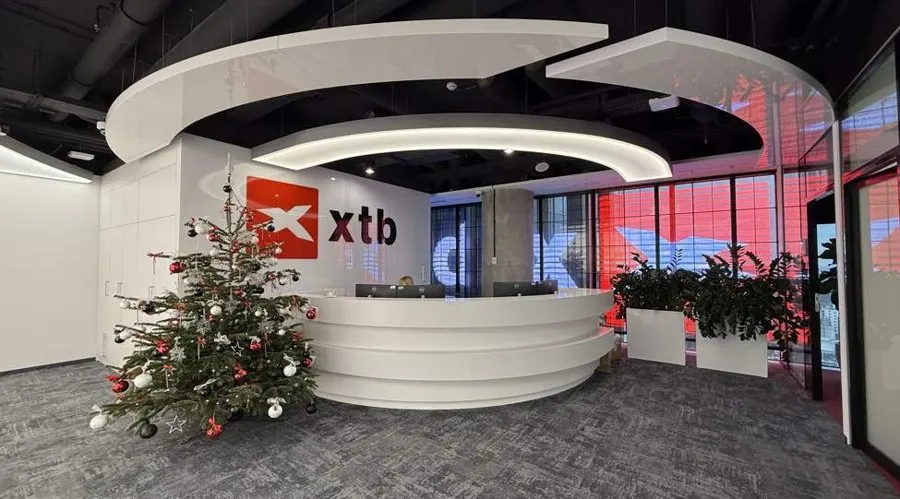
It said 80 percent of new brokerage accounts in Poland are opened with XTB and that it leads the market in IKE and IKZE retirement accounts, with more than 290,000 between them. It described its "transformation from a broker associated with CFDs into an investment app" for passive investors, savers and active traders alike, FX News Group reported.
Investors are not pricing what the KNF said. They are pricing what XTB earns: nine-tenths of its trading result comes from the product Poland now calls a bet.

Chief executive Omar Arnaout had argued earlier that the KNF is more likely to tighten how brokers assess client suitability than to separate CFD and stock accounts. If he is right, the effect would fall on onboarding rather than on the product itself. If the regulator goes further, the transformation XTB describes becomes a necessity rather than a strategy.
XTB and the regulator: a long history
The broker's dealings with the KNF have moved its shares before. In November 2017 the stock lost 40 percent in a day after a press report that the regulator had notified prosecutors after an inspection, the only regulator-linked fall deeper than this week's. In 2018 the KNF fined XTB PLN 9.9 million over asymmetric price slippage, a penalty XTB fought in court until March 2023.
This year the KNF fined it PLN 20 million over CFD onboarding questionnaires, a decision upheld on 28 August. Investors shrugged that one off; the stock hit a record days later. The difference this time is that the regulator is talking about the product, not a procedure.
XTB is also fighting on other fronts. It faces a CFD advertising ban in Spain, which it has said accounts for only about 10 percent of revenue. We set out how XTB's licences and entities fit together in our explainer on which XTB entity you trade with.
What it means beyond Poland
For traders in Asia the message is about direction. Europe has had leverage caps since 2018, and Poland's regulator is now saying caps are not enough. Possible next steps discussed in the market include tougher suitability tests, restrictions on marketing and separating CFD accounts from investment accounts. Each would raise the cost of acquiring and keeping CFD clients.
That matters for brokers that rely on European revenue and for the offshore brands that compete with them in Asia and the Gulf. When European rules tighten, brokers push harder into markets with lighter regimes, which is one reason the UAE, Southeast Asia and Latin America have become so crowded.
For XTB, the key unknowns are simple:
- What the KNF's intervention will cover, and whether it applies to cross-border brokers serving Polish clients.
- How fast it comes into force, since the regulator has given no timetable.
- Whether XTB's investment accounts grow fast enough to offset any fall in CFD income.
Why did XTB shares fall in November 2026?
On 17 November KNF deputy chairman Dariusz Adamski said a new product intervention on CFDs would come soon. XTB, which relies heavily on CFDs, fell 17.5 percent that day.
How much did XTB fall?
The shares closed at PLN 115.24 on 17 November, down from PLN 139.72, and touched PLN 103.24 the next day, about 23 percent below Monday's close.
What did the KNF say about CFD losses?
Adamski said 267,000 clients of Polish brokers lost money on CFDs in 2025, with losses of nearly PLN 2 billion, almost seven times the 2019 level.
Did the KNF say it will ban CFDs?
No. Adamski said an intervention would come soon but gave no details or timetable, and did not name XTB.
Why did Plus500, IG and CMC fall less?
Their exposure to Poland is small. They fell about 3 percent on 17 November, in line with a broad fall in European shares.
How dependent is XTB on CFDs?
CFDs produced 90.5 percent of XTB's gross result on financial instruments in the third quarter of 2026.
What did XTB say?
It said it was in dialogue with the KNF, would comment once a formal decision was issued, and highlighted that 80 percent of new Polish brokerage accounts are opened with XTB.
What are Poland's current CFD rules?
Poland's 2019 intervention capped leverage, while allowing experienced traders up to 100 to 1. The KNF now says those limits did not work as intended.
Has XTB been fined before?
Yes. The KNF fined it PLN 9.9 million in 2018 over asymmetric slippage and PLN 20 million in 2026 over CFD onboarding questionnaires.
Does this affect XTB clients outside Poland?
Not directly. A KNF intervention would apply to the Polish market; Adamski has said the review covers cross-border brokers serving Polish clients.
Is XTB still up in 2026?
Yes. Even after the fall it stood about 60 percent above its end-2025 close, though 37 percent below its August record.
What could the KNF change?
The market expects stricter suitability assessment at minimum. XTB's chief executive has said he expects tighter suitability tests rather than separating CFD and stock accounts.
Poland has put a number on retail CFD losses and a word on the business model, and the market has already marked XTB down for it. Whatever the KNF publishes, the lesson for every listed broker is the same: the more of your profit comes from one product in one market, the more one sentence from one regulator can cost.
Talk to SpinDepth about broker communication in a regulatory stormYou've finished this story
Read on, send it to someone, or ask about it.