 Media & Reputation
 Football
 Culture
 Experiences
 Advertising


Is a prediction market a financial exchange or a casino with better branding? In the United States, the answer is worth tens of billions of dollars. Kalshi traded 98.2 billion dollars of contracts in October and is reportedly raising money at a 65 billion dollar valuation, Polymarket is cutting staff after losing the lead it held two years ago, and state attorneys general are filing lawsuits faster than courts can rule on them.
In most of Southeast Asia, the argument was settled long ago. Singapore blocked Polymarket as unlawful gambling, Thai police moved to ban it, and India blocked it this year. So who is winning, how big is this business really, and why will Asian traders mostly watch it from the outside? We compared the two leaders and the rules around them.
Volume: Kalshi's runaway lead
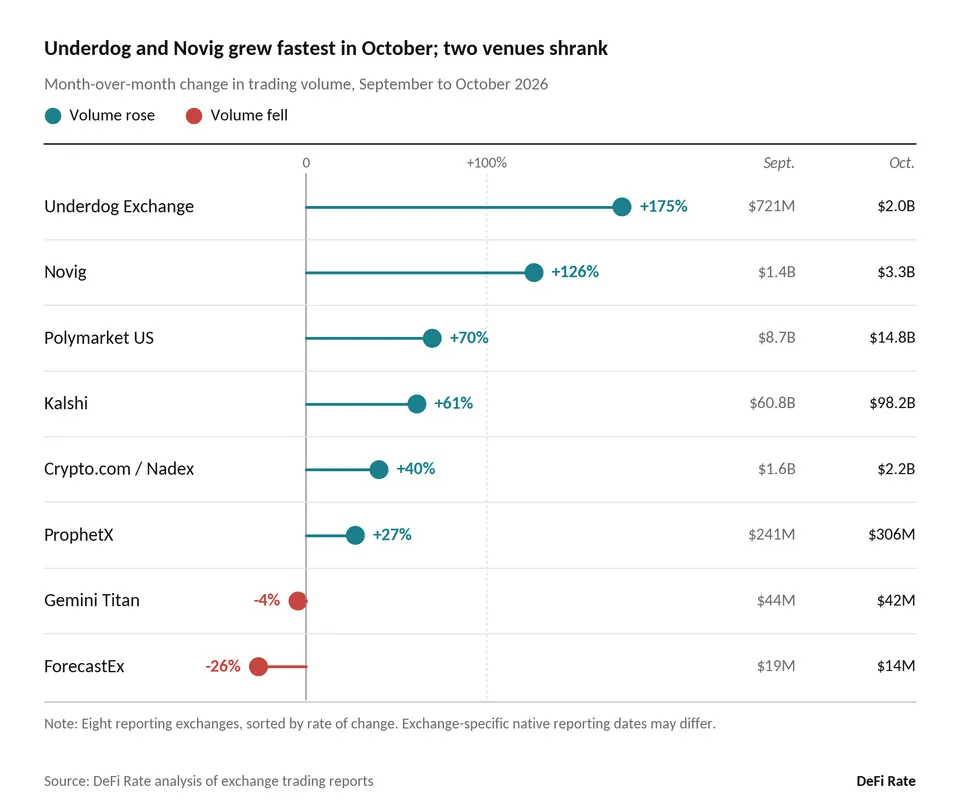
The numbers have flipped since 2024. US prediction market volume reached 120.73 billion dollars in October across eight exchanges, up 64.1 percent from September, according to DeFi Rate. Kalshi led with 98.15 billion dollars, or 81.3 percent, and Polymarket US followed with 14.77 billion dollars, or 12.2 percent. Smaller venues Novig and Underdog more than doubled their volume, but from a low base.
Polymarket owned this market during the 2024 US election, when it held about 95 percent of activity. Its share has since shrunk to a fraction of that, CryptoBriefing reported, as Kalshi used its regulated status and brokerage distribution to take the lead. Polymarket US grew faster in percentage terms in October, at 69.8 percent against Kalshi's 61.3 percent, but on a base less than a sixth the size.
There is an important caveat in those headline figures. Volume is measured in contract value, and cheap multi-leg contracts inflate it. A contract with a maximum 1 dollar payout counts as 1 dollar of volume even if the buyer paid a few cents, Finance Magnates noted, so the totals are not the same as cash wagered or revenue earned.
Combos: the sportsbook inside the exchange
The growth engine is not elections. Combos, which bundle several outcomes into one position much like a sportsbook parlay, made up at least 66.86 billion dollars, or 68.1 percent, of Kalshi's October volume, up from 58.3 percent in September, DeFi Rate said. At Polymarket US, identified combos rose to 58.2 percent of volume. Kalshi's single busiest day in October was a Saturday packed with American football.
Prediction Frontier's third quarter report found that sports, crypto and combo contracts supplied 94 percent of September's 75.5 billion dollars of nominal volume, while political contracts generated only 901 million dollars across four platforms. Kalshi's average purchase price per 1 dollar contract fell from 32 cents to 24 cents between July and September as combos grew. That is the heart of the legal fight: the product that drives the volume looks most like gambling.
Prediction markets sold themselves as a better way to forecast elections. The volume says they became a better way to bet on Sunday football. Regulators have noticed the difference.
Money: valuations, revenue and layoffs
Kalshi is in talks to raise funding at a 65 billion dollar valuation, 62.5 percent above the 40 billion dollars it secured in late October, Bloomberg reported, as summarised by PYMNTS. The valuation was 11 billion dollars at the end of 2025 and 22 billion dollars in May. Bloomberg reported annualised revenue recently topped 5 billion dollars, with gross margin of about 90 percent, and the company has discussed an IPO with banks since at least June. Kalshi says it will expand into indices, single stock perpetual futures and compute markets, with international expansion focused on Latin America and Europe.
Polymarket is restructuring. It confirmed cuts to employees and contractors in November, Crypto Economy reported, with a source telling Reuters more than half of those let go were contractors. The company said its annualised revenue exceeded 1.8 billion dollars in November, up from more than 1 billion dollars in June, and it is closing a 1 billion dollar round led by 1789 Capital at a valuation near 21 billion dollars. It appointed its first chief financial officer in September and is reportedly weighing a 2027 IPO.
The rivalry has a political edge. Kalshi ended Donald Trump Jr.'s advisory role after his firm 1789 Capital led Polymarket's round, Cointelegraph reported. A Kalshi spokesperson said politics played no role, but two people told Reuters some at the company had raised concerns about Democrats winning both chambers of Congress in the midterms.

Regulation: federal shield, state lawsuits
Kalshi's advantage is its status as a CFTC regulated exchange, which lets it argue that federal commodities law overrides state gambling rules. States disagree. Louisiana's attorney general sued Kalshi, Polymarket, Robinhood, Coinbase and a fifth crypto platform in state court on 12 November, seeking a restraining order over sports, awards and election contracts, CryptoBriefing reported. Enforcement actions have been reported in at least 12 other states.
Washington has taken Kalshi's side for now. The Department of Justice and the CFTC sued Arkansas in federal court to stop its enforcement action against Kalshi, arguing the Commodity Exchange Act gives the CFTC exclusive jurisdiction, and a federal judge has separately blocked Kalshi's sports contracts on two California tribes' lands. How the courts settle the preemption question will decide whether these firms are national exchanges or state by state gambling operators. Brokers are watching closely; we covered how IG Group took a UK gambling licence for prediction markets.
How the two leaders compare on the issues that matter to users:
- licensing: Kalshi is CFTC regulated; Polymarket runs a regulated US exchange and an offshore blockchain venue
- settlement: Kalshi settles in dollars through brokers; Polymarket's global venue settles in crypto
- distribution: Kalshi contracts reach users through Robinhood and Coinbase
- product mix: both lean heavily on sports and combo contracts
- legal exposure: both are named in Louisiana's lawsuit
Asia: mostly closed
For readers in Southeast Asia, the comparison is largely academic. Singapore's Gambling Regulatory Authority blocked Polymarket in December 2024 as unlawful gambling, and Thai police said it offered illegal online gambling because bets were placed in crypto, the Bangkok Post reported. Taiwan has also moved against election betting platforms, as we reported in our story on Taiwan blocking Kalshi and Coinbase election betting.
India went further in 2026. A ban on real money online games took effect on 1 May, Polymarket was named among blocked platforms, and internet providers applied DNS restrictions around 21 to 22 May, Mint reported. Kalshi lists India among restricted jurisdictions. Authorities flagged users trying to get around the rules with VPNs and stablecoins such as USDC, the same route Asian regulators worry about elsewhere.
The verdict is a split one. Kalshi wins on volume, valuation and regulatory cover in the US, and Polymarket has a smaller but growing regulated business and a crypto native brand. Neither has a legal path into most of Asia, where event contracts are treated as gambling, and neither has made the region a priority. If US courts confirm the federal shield, the pressure will turn to whether Asian regulators keep treating these products as bets or start treating them as derivatives.
Which is bigger, Kalshi or Polymarket?
Kalshi. It traded 98.2 billion dollars of contracts in October 2026 against 14.8 billion dollars for Polymarket US, according to DeFi Rate.
What is Kalshi worth?
It raised at a 40 billion dollar valuation in October and is reportedly in talks at 65 billion dollars.
What is Polymarket worth?
About 21 billion dollars in a round led by 1789 Capital that was being finalised, according to reports.
Is Polymarket laying off staff?
It confirmed cuts to employees and contractors in November and said it was reorganising for its next phase.
How much revenue do they make?
Bloomberg reported Kalshi's annualised revenue topped 5 billion dollars. Polymarket said its annualised revenue exceeded 1.8 billion dollars.
What are combo contracts?
Positions that bundle several outcomes into one, similar to a sportsbook parlay. They made up at least 68 percent of Kalshi's October volume.
Does volume equal money wagered?
No. Volume counts contract value, so a cheap contract with a 1 dollar payout counts as 1 dollar even if it cost a few cents.
Who regulates Kalshi?
The US Commodity Futures Trading Commission.
Why are US states suing?
They argue event contracts on sports and elections are illegal gambling under state law.
Who did Louisiana sue?
Kalshi, Polymarket, Robinhood, Coinbase and a fifth crypto platform, on 12 November 2026.
Is the federal government involved?
Yes. The DOJ and CFTC sued Arkansas to block its enforcement against Kalshi.
Can I use Polymarket in Singapore?
Singapore's Gambling Regulatory Authority blocked Polymarket in December 2024 as unlawful gambling.
Is Polymarket legal in Thailand?
Thai police said it offered illegal online gambling and moved to ban it in January 2025.
Are prediction markets blocked in India?
Yes. Polymarket was blocked after India's real money gaming ban took effect in May 2026, and Kalshi lists India as restricted.
Will prediction markets come to Southeast Asia?
Not soon. Regulators treat them as gambling, and Kalshi's stated international focus is Latin America and Europe.
Prediction markets have become a large business in a short time, but their growth rests on a legal argument that has not been settled. Kalshi has the volume, the valuation and federal backing for now; Polymarket has a smaller regulated arm and a global crypto brand under financial pressure. Asia, which treats event contracts as gambling, is outside the fight, and that is unlikely to change until US courts decide what these products really are.
Talk to the SpinDepth deskYou've finished this story
Read on, send it to someone, or ask about it.