
Is Thailand in a technical recession? The answer arrives with the third quarter GDP figures from the National Economic and Social Development Council, which usually publishes them on the third Monday of November. The reason the question is live: in the second quarter, the economy grew 1.9 percent from a year earlier but shrank 0.2 percent from the first quarter on a seasonally adjusted basis, Khaosod English reported. A second straight quarterly contraction would meet the common definition of a technical recession.
The evidence points in two directions at once. Exports are booming on demand for AI hardware, private investment is surging on data centres, and the central bank has raised its growth forecast twice this year. At the same time, households are squeezed by inflation that has broken through the target ceiling, floods have hit the centre of the country, and foreign investors are pulling money out of Thai stocks. The GDP release will show which force won the third quarter.
The case that the third quarter grew
The Bank of Thailand has already given its verdict. In its monthly report on 30 October, it said the economy improved in the third quarter compared with the second, mainly because merchandise exports excluding gold kept growing on the global technology and AI cycle. Domestic demand also improved, it said, with a significant increase in private investment, particularly in data centres, and higher private consumption across almost all categories, helped by electric vehicle sales and temporary government support.
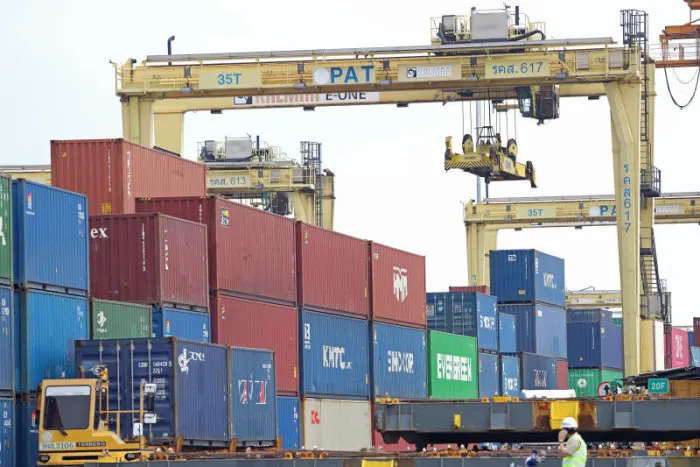
The trade figures back that up. Customs cleared exports rose 24.0 percent in September from a year earlier, the 27th straight monthly increase and well above the 17.85 percent forecast in a Reuters poll, the Bangkok Post reported. Shipments to the United States, Thailand's largest market, jumped 50.1 percent. Over nine months exports rose 19.6 percent, and the commerce ministry now expects 19 percent growth for the year.
On that evidence, the central bank's Monetary Policy Committee raised its 2026 growth forecast to 2.4 percent when it held rates on 28 October, the second upgrade this year. A central bank does not usually raise its forecast if it believes the economy has just slipped into recession.
The case that it barely moved
The private sector is less upbeat. SCB EIC, the research arm of Siam Commercial Bank, described the third quarter as largely flat, with growth concentrated in a few sectors, and estimated that flooding from late September through October would cut 2026 growth by about 0.1 percentage point. Household debt fell to 85.2 percent of GDP in the second quarter, its lowest in more than six years, but SCB EIC said that reflected tight credit rather than stronger finances, and youth unemployment is more than twice the overall rate.
Imports are the complication. They rose a record 50.4 percent in September, mostly equipment for data centres and electronics assembly, which produced a trade deficit of 5.86 billion dollars for the month. In GDP accounting, imports subtract from growth, so an export boom built on imported components adds less to the headline figure than the export numbers suggest.
There is also a data problem. A new industrial production index raised reported growth in factory output to 4.4 percent from about 0.5 percent under the old series, and a balance of payments review cut the current account deficit for the first eight months to 1.3 billion dollars from 15.5 billion. SCB EIC warned these revisions could change historical GDP figures, so the third quarter release may also rewrite the second.
Thailand has an export boom and a household slump at the same time. The GDP number will tell us which one is bigger, not whether both are real.
Inflation has changed the central bank's problem
Whatever the GDP figure shows, the Bank of Thailand faces a harder choice than it did a month ago. Headline inflation jumped to 3.9 percent in October from 2.82 percent in September, above the central bank's 1 to 3 percent target for the first time in more than three years, Bloomberg reported via The Star. More than half of the rise came from oil, after the US war on Iran disrupted energy supplies, with flood hit vegetables adding to food prices.
The central bank has said it sees the spike as temporary and that the 1 percent policy rate remains appropriate. Its committee forecasts headline inflation of 2.1 percent for 2026 and 1.3 percent for 2027, and core inflation of 1.2 percent this year. SCB EIC expects the rate to stay at 1 percent through the end of 2027.
That leaves Thailand out of step with the United States, where a hot October inflation report has traders betting on a Federal Reserve rate increase in December, as we reported in our story on the October US CPI and Asian currencies. A wider gap between US and Thai rates puts pressure on the baht, which the central bank said had already weakened as markets priced tighter US policy.

Foreign money is already leaving
Investors are not waiting for the data. Foreign investors' accumulated net buying of Thai shares has fallen to around 10 billion baht from a peak of 60 to 70 billion baht in mid year, as higher US bond yields pulled money back to the United States, Stock Exchange of Thailand president Asadej Kongsiri said, the Bangkok Post reported. Foreigners were net sellers of 6.67 billion baht in October alone.
They still own a record 6.9 trillion baht of Thai equities, 37 percent of the market, and the SET Index ended October at 1,518.59 points, up 20.6 percent for the year despite a 2.6 percent fall in the month. The exchange expects local buyers of tax saving Thai ESG funds to support the market into year end.
The numbers to watch in the release
When the figures land, these are the details that will decide how markets read them:
- the quarter on quarter change: positive means Thailand avoided a technical recession, negative means it did not
- the year on year rate, compared with 1.9 percent in the second quarter
- private investment, which the central bank says rose significantly on data centres
- private consumption, where inflation and debt are biting
- net exports, where record imports may offset the export boom
- the planner's full year forecast, now 2.0 to 2.5 percent, against the government's 2.5 percent target
- any revisions to earlier quarters after the new industrial and balance of payments data
The fiscal side matters too. Parliament is due to debate the 2027 budget, which we examined in our report on the 3.788 trillion baht spending plan, with public debt already around 66 percent of GDP.
When is Thailand's third quarter 2026 GDP released?
The National Economic and Social Development Council usually publishes third quarter GDP on the third Monday of November, which this year is 16 November.
Is Thailand in a technical recession?
Not yet confirmed. The economy shrank 0.2 percent quarter on quarter in the second quarter, so a second straight contraction in the third quarter would meet the common definition.
What does the Bank of Thailand say about the third quarter?
It said on 30 October that the economy improved from the second quarter, led by AI related exports, data centre investment and private consumption.
How much did Thailand's economy grow in the second quarter of 2026?
1.9 percent from a year earlier, slower than 2.8 percent in the first quarter.
How fast are Thai exports growing?
Exports rose 24.0 percent in September and 19.6 percent in the first nine months of 2026.
Why are Thai imports rising so fast?
Imports rose a record 50.4 percent in September, largely equipment for data centres and electronics production.
What is Thailand's inflation rate?
3.9 percent in October 2026, above the Bank of Thailand's 1 to 3 percent target for the first time in more than three years.
What is the Bank of Thailand's policy rate?
1.00 percent, held unanimously on 28 October 2026.
What is the Bank of Thailand's growth forecast?
2.4 percent for 2026 and 2.1 percent for 2027.
What is the official government growth forecast?
The state planner forecast 2.0 to 2.5 percent in August, with a midpoint of 2.2 percent. The government targets 2.5 percent.
How did the floods affect Thailand's economy?
SCB EIC estimates flooding from late September to October will cut 2026 growth by about 0.1 percentage point.
Are foreign investors selling Thai stocks?
Yes. Their accumulated net buying fell to about 10 billion baht from 60 to 70 billion baht in mid year, and they sold a net 6.67 billion baht in October.
How has the SET Index performed in 2026?
It closed October at 1,518.59 points, up 20.6 percent from the end of 2025.
Will the Bank of Thailand raise rates?
The central bank says the inflation spike is temporary and the 1 percent rate is appropriate. SCB EIC expects no change through 2027.
The third quarter GDP figure will settle an argument that the other data cannot. Exports, investment and the central bank's own report point to growth; flat household spending, floods, record imports and foreign selling point to stagnation. If the quarter on quarter number comes in positive, Thailand's AI export boom will have carried the economy through a hard year. If it does not, the country will have entered a technical recession with inflation above target, the worst combination for a central bank with a 1 percent policy rate.
Talk to the SpinDepth deskYou've finished this story
Read on, send it to someone, or ask about it.