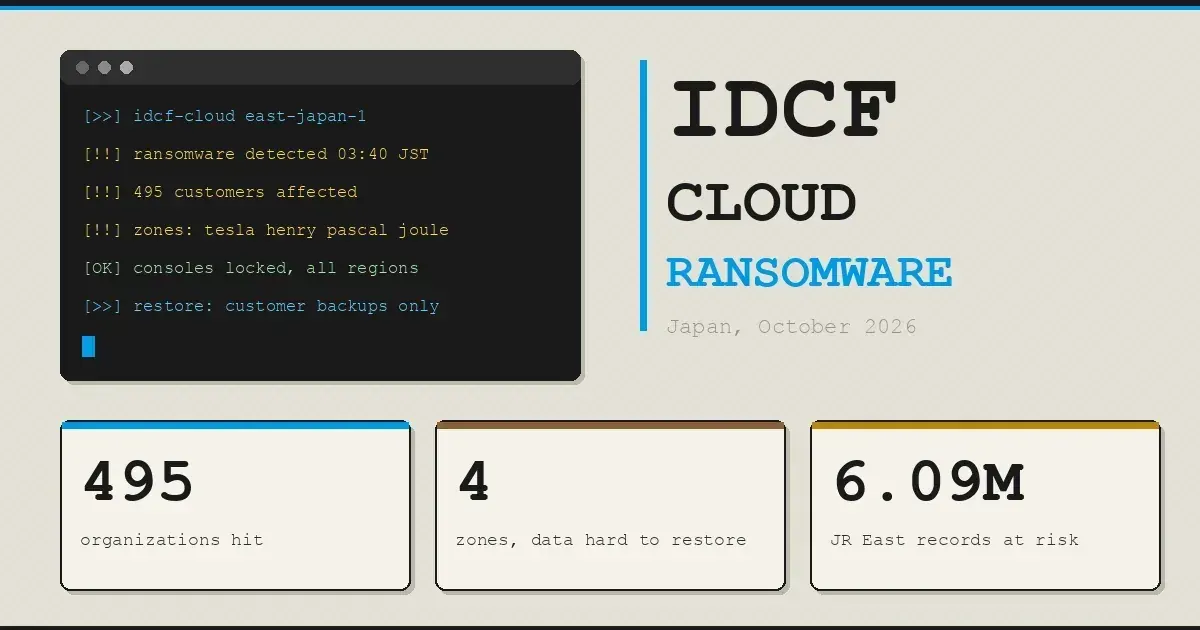
When a single cloud provider is attacked, the damage does not stay in one place. In early October, a ransomware attack on IDC Frontier, a cloud subsidiary of SoftBank, took its IDCF Cloud service offline and disrupted 495 organisations, most of them local governments and companies. Among those affected, JR East warned that about 6.09 million customer accounts may have been compromised, as reported by Jiji Press via Nippon.com.
It was part of a wider wave. Karaoke operator Daiichikosho, which runs the Big Echo chain, said data on about 8.72 million customers may have been exposed through a system managed by an outside contractor, and Bookoff Group reported up to 6.43 million affected customers. Together, the incidents put Japan's cyber resilience, and the hidden risks of outsourcing, under a harsh spotlight.
What happened at IDC Frontier
IDC Frontier provides cloud infrastructure to businesses and public bodies across Japan. When ransomware hit its IDCF Cloud service, the company took it offline on 7 October, cutting off systems used by hundreds of customers. JR East's email delivery service was among the affected systems, which is why the railway operator warned that customer accounts linked to it could be at risk.
The situation evolved quickly. On 14 October, IDC Frontier said that an investigation with an outside security firm had found no evidence that data had been queried or taken, and that no breach of customer information had been confirmed, according to Jiji Press. JR East's figure therefore describes possible exposure rather than confirmed theft.
That distinction matters, but it does not erase the disruption. Hundreds of organisations lost access to services, and millions of people received warnings that their data might be at risk. In cyber incidents, the operational and reputational damage often arrives long before investigators reach conclusions.
The third party problem
The common thread across Japan's breach wave is reliance on outside providers. JR East was affected through a cloud vendor, and Daiichikosho through a system run by a contractor. In both cases, the company holding the customer relationship did not directly control the system that was attacked.
This is the essence of third party risk. Modern companies depend on cloud platforms, software vendors and service contractors for critical functions. Each relationship extends the organisation's attack surface, and a single compromised provider can expose many clients at once, as the 495 organisations hit by the IDC Frontier attack discovered.
Outsourcing a system does not outsource the responsibility for the customers whose data it holds.
Regulators around the world have recognised this risk. Financial regulators in particular now require banks and insurers to assess and monitor their key technology providers, and to plan for the failure of a critical vendor. The Japanese incidents show why those rules exist.

Why this matters for financial services
Banks, brokers, insurers and fintechs rely heavily on cloud providers, and concentration is increasing as a handful of large platforms host more of the financial system. An attack on a major cloud provider could disrupt many financial institutions at once, affecting payments, trading and customer services.
The Japanese wave arrives alongside a cluster of attacks on South Korean banks, where AI tools are suspected of helping hackers find weak points in secondary systems. Taken together, the incidents show that Asian financial systems face both direct attacks on banks and indirect attacks through the vendors they depend on.
The lessons for financial institutions are clear:
- Map every critical third party and understand what data and functions it handles.
- Require strong security standards and incident reporting from vendors.
- Plan for the failure of a key provider, including backup systems and exit options.
- Test how quickly customers can be warned and protected if a vendor is breached.
We examined the Korean attacks in our report on AI hackers hitting Korea's biggest banks, another sign that cyber risk in Asian finance is rising quickly.
What customers should do
For people who receive breach warnings, the practical risks are phishing and account takeover. Even if data was not confirmed stolen, scammers often exploit news of breaches by sending messages that pretend to come from the affected company.
Customers should change passwords on affected services, avoid reusing passwords across sites and be wary of messages asking them to click links or confirm details. Enabling two step verification where available adds an important layer of protection.
Companies, for their part, need to communicate clearly and quickly. Customers forgive breaches more readily when they are told promptly what happened, what data may be affected and what to do, than when information arrives late or in confusing fragments.
Lessons for Southeast Asia
Southeast Asia's rapidly digitising economies face the same risks at even greater speed. Governments, banks and businesses across the region are moving to cloud platforms, often relying on a small number of large providers. A major attack on one of those providers could have region wide effects.
Regulators in Singapore, Malaysia and elsewhere have introduced rules on outsourcing and technology risk, but enforcement and vendor oversight remain uneven, especially among smaller firms and public bodies. Japan's experience is a reminder that resilience depends on the weakest link in the supply chain.
The broader lesson is that cyber security can no longer be managed one organisation at a time. When providers serve hundreds of clients, the whole ecosystem shares the risk, and protecting it requires cooperation between companies, vendors and regulators.
Resilience across the supply chain
Japan's October breach wave shows how a single attack on a shared provider can ripple across hundreds of organisations and millions of people. Even when investigators find no evidence of theft, the disruption and uncertainty carry real costs.
For financial institutions and businesses across Asia, the message is to treat vendors as part of their own security perimeter. The companies that know their dependencies, demand high standards from their providers and plan for failure will be best placed when the next attack comes.
What happened to IDC Frontier?
IDC Frontier, a SoftBank cloud subsidiary, was hit by a ransomware attack that took its IDCF Cloud service offline on 7 October 2026, affecting 495 organisations.
How many JR East accounts were affected?
JR East said about 6.09 million customer accounts may have been compromised, linked to its email delivery service hosted on the affected cloud.
Was customer data actually stolen?
On 14 October 2026, IDC Frontier said an investigation with an outside security firm found no evidence that data had been queried or taken, and no breach had been confirmed.
Which other Japanese companies reported breaches?
Daiichikosho, operator of the Big Echo karaoke chain, said about 8.72 million customers may have been affected, and Bookoff Group reported up to 6.43 million. JR Kyushu reported about 1.3 million accounts.
What is third party risk?
Third party risk is the danger that a company's data or operations are compromised through a vendor, contractor or service provider it relies on, rather than through its own systems.
Why does cloud concentration matter?
When many organisations rely on the same cloud provider, a single attack on that provider can disrupt or expose many clients at once.
How should financial institutions manage vendor risk?
They should map critical vendors, require strong security and incident reporting, plan for vendor failure and test how quickly they can protect customers if a vendor is breached.
What should customers do after a breach warning?
Change passwords, avoid reusing them, be wary of suspicious messages and enable two step verification where available.
Is this connected to the Korean bank attacks?
The incidents are separate, but both show rising cyber risk in Asian finance and business, through direct attacks on banks and indirect attacks through vendors.
Who was behind the IDC Frontier attack?
The sources reviewed did not identify the attackers or explain how they gained access.
Are Southeast Asian firms exposed to similar risks?
Yes. Rapid cloud adoption and reliance on a small number of providers create similar concentration and third party risks across Southeast Asia.
What is ransomware?
Ransomware is malicious software that locks or encrypts systems and data, with attackers demanding payment to restore access or avoid leaking information.
Why did JR East warn customers if no theft was confirmed?
JR East's email delivery service was hosted on the affected cloud, so the company warned that accounts linked to it could be at risk while investigators determined whether data had actually been accessed.
Japan's breach wave turned a single attack on a cloud provider into a crisis touching hundreds of organisations and millions of customers. The investigation may yet show that little data was taken, but the episode has already exposed how deeply modern businesses depend on others for their security. For Asia's banks and companies, the lesson is to manage third party risk as seriously as their own defences, because attackers will always look for the weakest link.
Talk to the SpinDepth deskYou've finished this story
Read on, send it to someone, or ask about it.