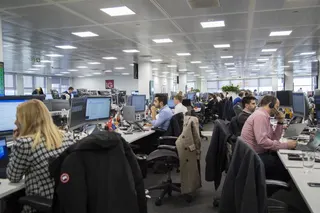
For two years, Asia's chipmakers were the market's favourite way to bet on AI. In mid October, that bet went sharply into reverse. On 15 October, SK Hynix plunged more than 10 percent and Samsung Electronics fell 8.73 percent, a drop so steep that it triggered a circuit breaker on the KOSPI, as reported by CNBC.
The sell off had been building for days. Korean chip shares were already on a five day losing streak by 13 October, when the KOSPI fell more than 6 percent. Across the world's 20 most valuable AI and semiconductor stocks, more than 1 trillion dollars in value was shed in a single week. Analysts described it as the strongest sign yet that the mood on the trade of the decade is shifting.
What triggered the sell off
The main trigger was interest rates. A strong US inflation report bolstered expectations that rates will stay higher for longer, and investors began to worry that more expensive borrowing would make it harder for companies to fund the enormous capital spending required to build AI infrastructure. Many AI companies are already heavily indebted, which makes them sensitive to financing costs.
That concern goes to the heart of the AI story. The boom in chip demand depends on technology companies, cloud providers and data centre operators continuing to spend hundreds of billions of dollars on servers and memory. If financing becomes more expensive, some of that spending may be delayed or cancelled, and chipmakers' growth forecasts would have to come down.
Not everyone agreed. Nvidia's chief executive, Jensen Huang, argued that the cost of capital for some AI infrastructure companies is actually decreasing, pushing back against the idea that financing pressure will stall the build out. But markets were in no mood to wait for proof.
Memory makers took the biggest hit
The losses were heaviest among memory chip makers. SK Hynix and Samsung are the world's leading suppliers of high bandwidth memory, the specialised chips used in AI accelerators, and their shares had risen dramatically on that demand. Japan's Kioxia, another memory maker, fell 13 percent on 13 October.
Two other worries weighed on memory stocks. China's CXMT reported a denser DRAM architecture, raising fears of stronger competition for established players including Samsung, SK Hynix and Micron. There were also concerns about global memory chip oversupply emerging as early as 2029, as new capacity built during the boom comes online.
When a trade is crowded, it only takes a change in the cost of money to send everyone rushing for the same exit.
Equipment makers were also hit hard. Advantest plunged almost 14 percent, and Tokyo Electron and SoftBank fell as well, as investors questioned whether the pace of AI investment could be sustained.

Why TSMC held up
Taiwan's TSMC was a notable exception, falling just 1.81 percent on 15 October, according to CNN. As the dominant manufacturer of the most advanced chips, TSMC has more pricing power and a broader customer base than memory makers, whose products are more exposed to cycles of oversupply and price swings.
The divergence offers a lesson. Not all AI related stocks carry the same risk. Companies with unique technology, strong pricing power and diverse customers are better placed to weather a slowdown in investment than those selling more commoditised products into a market that could become oversupplied.
Investors fleeing chip stocks moved into other sectors and bonds for safety, a rotation that suggests they see the AI trade as overextended rather than broken. Whether that rotation continues will depend on how quickly AI spending data and interest rate expectations evolve.
What it means for Asian markets
Asia's stock markets are heavily exposed to the AI trade. South Korea and Taiwan in particular have seen their indexes driven by a handful of chip giants, and Japan's market includes major equipment makers. A sustained reversal in AI stocks would weigh heavily on these markets and on the currencies of export driven economies.
Southeast Asia is exposed too. Malaysia and Singapore are important links in the semiconductor supply chain, from chip packaging and testing to data centres, and Vietnam has become a growing electronics manufacturing hub. A slowdown in AI investment would ripple through their exports and investment pipelines.
Investors should watch several signals:
- Capital spending plans from large technology and cloud companies.
- US inflation data and interest rate expectations.
- Memory chip prices and inventory levels.
- Quarterly results from Asian chipmakers for signs of slowing orders.
The IMF warned about exactly this risk at its Bangkok meetings, flagging AI market risk as one of the main threats to Asia's growth, as we reported in our analysis of the IMF's Asia outlook.
Bubble or correction
The big question is whether this is a healthy correction in an overheated trade or the start of the AI bubble deflating. Arguments exist on both sides. AI demand remains strong, and many companies continue to report growing orders. But valuations had risen so far, so fast, that even modest disappointments can trigger large declines.
History suggests that transformative technologies often go through boom and bust cycles before settling into steady growth. The internet boom of the late 1990s ended in a painful crash, yet the internet went on to change the world. AI may follow a similar path, with real long term impact but volatile markets along the way.
For investors in Asia, the lesson is to separate the technology from the trade. AI is likely to keep reshaping industries, but that does not guarantee that every chip stock bought at peak prices will deliver returns. Diversification and attention to valuations matter more when sentiment turns.
A trade under pressure
The mid October rout was a reminder of how much of Asia's market strength rests on a single theme. When interest rate fears and competition worries collided, more than a trillion dollars disappeared from AI stocks in a week, and Korea's market needed a circuit breaker to slow the fall.
Whether the AI trade recovers or continues to unwind, the episode has changed the conversation. Investors are now asking harder questions about financing, oversupply and valuations, and the chipmakers that answer them convincingly will be the ones that lead the next phase.

Why did SK Hynix shares fall?
SK Hynix fell more than 10 percent on 15 October 2026 as investors worried that higher interest rates would make AI infrastructure spending harder to finance, alongside concerns about memory oversupply and competition from China.
How much did Samsung shares fall?
Samsung Electronics fell 8.73 percent on 15 October 2026.
Why was there a circuit breaker on the KOSPI?
The scale of the decline in Korean stocks, led by chipmakers, triggered a circuit breaker designed to pause trading during extreme moves.
How much value did AI stocks lose?
More than 1 trillion dollars was shed across the 20 most valuable global AI and semiconductor stocks in a single week.
Why did TSMC fall less than other chipmakers?
TSMC fell only 1.81 percent, reflecting its dominant position in advanced chip manufacturing, strong pricing power and broad customer base.
What role did interest rates play?
A strong US inflation report raised expectations of higher rates, which would make it more expensive for heavily indebted AI companies to fund their capital spending.
What is CXMT and why does it matter?
CXMT is a Chinese memory chip maker. Its report of a denser DRAM architecture raised fears of stronger competition for Samsung, SK Hynix and Micron.
Is the AI bubble bursting?
It is too early to say. The sell off may be a correction in an overheated trade rather than a collapse, but it shows how sensitive AI stocks have become to financing costs and valuations.
How does this affect Southeast Asia?
Malaysia, Singapore and Vietnam are important parts of the semiconductor supply chain, so a slowdown in AI investment would affect their exports and investment.
What should investors watch next?
Investors should watch technology companies' capital spending plans, US inflation and interest rates, memory chip prices and quarterly results from Asian chipmakers.
What is high bandwidth memory?
High bandwidth memory is a specialised type of memory chip used in AI accelerators. SK Hynix and Samsung are the leading suppliers, which tied their shares closely to AI demand.
The mid October rout in Asia's AI chip stocks shows that even the strongest market theme is vulnerable when the cost of money rises. SK Hynix, Samsung and their peers built a historic rally on AI demand, and they lost a large slice of it in days. The technology is not going away, but the easy phase of the trade may be over, and investors will now demand proof that AI spending can keep growing when financing is no longer cheap.
Talk to the SpinDepth deskYou've finished this story
Read on, send it to someone, or ask about it.