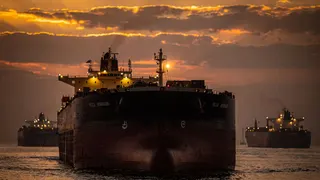
Brent crude touched $98.10 and WTI held $92.63 on 8 September as US-Iran tanker strikes resumed in the Strait of Hormuz, putting oil at levels that rewire every financial forecast built this quarter. A day earlier Brent printed $97.89 with WTI at $92.30, and throughput through the strait has reportedly collapsed to one-fifth of pre-war capacity, a 77 percent fall holding prices near six-week highs. Bonds and stocks are already dropping as oil soars on Middle East fears. For fintech, forex and crypto desks, this is not an energy story. It is the inflation input inside every position they hold. The ECB decision tomorrow and the CPI double-header both inherit this print. Source: Vantage.
How Hormuz broke the price
The strait carries the marginal barrel for Asia and Europe, so a throughput collapse transmits instantly to Brent while WTI follows with a lag. Tanker strikes turn insurance and freight into a second oil price, compounding the futures move with physical-market panic. At one-fifth capacity, every canceled transit is a supply shock that no OPEC spare-capacity statement can talk down in the same news cycle. The progression tells the momentum: $95 on 4 September, near $98 by 7 to 8 September. That slope, not the level, is what forces forecast revisions. The capped dollar shows the currency mirror of the same fear. Source: Eastern Herald.
What $98 oil does to money
Oil at these levels is a tax on growth and a subsidy to inflation expectations simultaneously. It lifts headline CPI and PPI directly, which is why Thursday and Friday's US prints are now hostage to the strait. It steepens the ECB's hiking resolve into tomorrow's decision. It widens deficits in importing Asia, pressuring regional currencies and the fintech margins built on top of them. And it splits risk assets: energy-linked revenues up, everything discount-rate sensitive down. Bitcoin at $78,345 sits squarely in the second camp, as our BTC level piece details. The Riyadh fintech gathering next week meets in the region holding the decisive supply lever. Source: Vantage analysis.
- Brent $98.10, WTI $92.63 on 8 September
- Tanker strikes resumed in Hormuz
- Throughput at one-fifth pre-war levels
- Bonds and stocks dropping on the fear
What it means for financial platforms
For trading platforms, an oil shock is a volume gift with a risk sting: FX, commodity and crypto desks all light up while margin calls propagate across them. Payment and remittance corridors into South and Southeast Asia face fuel-cost pass-through that squeezes household budgets and ticket sizes. Stablecoin settlement rails, from the bank consortium to Felix Pago, get a live stress test of their cost advantage over correspondent banking when volatility spikes.
Ninety-eight dollars is not a price. It is a revision notice stapled to every forecast written in August.
Why the Strait of Hormuz matters so much
The Strait of Hormuz, between Iran and Oman, is the only sea route out of the Persian Gulf. In normal times, oil flows through it equal to roughly a fifth of world consumption, along with large volumes of liquefied natural gas, mostly from Qatar. Most of that oil goes to Asia, with China, India, Japan and South Korea among the largest buyers. There are few alternatives: Saudi Arabia can send some crude west through its East-West pipeline to the Red Sea, and the UAE has a pipeline to Fujairah outside the strait, but their capacity covers only part of normal flows.
A sharp fall in traffic through the strait therefore removes supply that cannot quickly be replaced, which is why prices react so strongly.
Brent and WTI, explained
Brent and WTI are the two main oil price benchmarks. Brent is based on crude from the North Sea and is the reference for most internationally traded oil, including much of what Asia and Europe buy. WTI, West Texas Intermediate, is the US benchmark, priced at a hub in Oklahoma. Because Brent reflects seaborne oil more directly, it usually responds faster to disruptions in Middle Eastern shipping, and the gap between the two can widen during a Gulf crisis.
Insurance, freight and the hidden oil price
When shipping lanes become dangerous, the cost of moving oil rises as well as the price of the oil itself. War-risk insurance premiums for tankers jump, some shipowners refuse to sail and freight rates climb. Buyers pay those costs on top of the benchmark price, so the real cost of a barrel delivered to an Asian refinery can rise faster than Brent suggests.
Tools for easing a supply shock
Governments have several ways to respond. Members of the International Energy Agency hold emergency stocks equal to at least 90 days of net imports and can release them in a coordinated way, as they did in 2022. OPEC+ members with spare capacity, mainly Saudi Arabia and the UAE, can raise output, though that does not help if the extra oil cannot leave the Gulf. Demand also falls when prices rise high enough, which eventually caps prices but at a cost to growth.
What high oil does to Asian economies
For energy-importing economies in Southeast Asia, higher oil prices raise import bills, push up inflation and can weaken local currencies as more dollars are needed to pay for fuel. Governments that subsidise fuel face rising budget costs. Central banks face a dilemma: raising rates to fight inflation risks slowing growth, while holding rates may let inflation become entrenched. Currencies such as the Thai baht, Philippine peso and Indian rupee often weaken when oil spikes.
Futures curves in a crisis
Oil futures for different delivery months form a curve. In a supply crisis, near-term contracts usually rise more than later ones, a pattern called backwardation, because buyers pay a premium for oil they need now. Traders holding CFDs based on futures should know how their broker handles contract rollovers, since rolling from one month to the next in a steeply backwardated market can produce price adjustments.
A checklist for traders in an oil shock
- Expect wide spreads and sudden gaps around headlines from the region.
- Reduce position sizes on oil and on currencies of energy importers.
- Check how your broker handles oil CFD rollovers and margin changes.
- Watch shipping and insurance news, which often leads price moves.
- Remember that de-escalation headlines can reverse prices just as fast.
The bigger picture
Energy shocks are the fastest route from geopolitics to portfolio, and this one arrives in the exact week central banks must decide. The ECB, the Fed's data dependence and Asia's import bills all now run through a strait operating at a fraction of capacity. Whoever controls the throughput narrative controls September pricing.
What to watch next
Watch transit and insurance signals from the strait before headlines, because throughput data leads price. Watch gasoline pass-through in the CPI print. And watch OPEC spare-capacity messaging, since the credibility of the offset decides how far above $98 this can run.
Why did oil spike to $98?
Resumed US-Iran tanker strikes in the Strait of Hormuz cut throughput to about one-fifth of pre-war levels, lifting Brent to $98.10 and WTI to $92.63 on 8 September.
How does $98 oil hit markets?
It feeds directly into CPI and PPI prints, firms ECB hiking resolve, pressures Asian importers and currencies, and splits risk assets as discount-rate trades like Bitcoin sell off.
How much oil passes through the Strait of Hormuz?
In normal times, flows equal to roughly a fifth of world oil consumption, most of it bound for Asia.
What is the difference between Brent and WTI?
Brent is the main international benchmark, based on North Sea crude; WTI is the US benchmark. Brent reacts faster to Middle East shipping disruptions.
What can governments do in an oil shock?
Release emergency stocks, encourage producers with spare capacity to raise output and, where possible, reroute supply through pipelines.
You've finished this story
Read on, send it to someone, or ask about it.