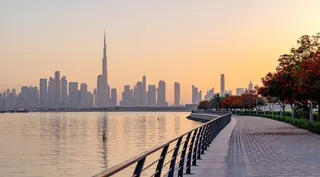

The Gulf's trading map gained two pins. Tickmill opened a Kuwait office on the 19th floor of Nouf Tower, extending its Middle East footprint, while prop firm Blue Guardian announced a Dubai office ahead of its 2026 updates. A global CFD broker and a rising prop firm choosing the same season to go physical in the Gulf is no coincidence. Brokers building Gulf presence can partner with SpinDepth on MENA programs.
Kuwait floors and Dubai desks
Tickmill's Kuwait opening puts advisers and support inside a wealthy, under-branched market. Blue Guardian's Dubai base plants a prop brand where its trader community already clusters. One serves investors, the other serves challengers, and both bet that Gulf traders prefer visitable counterparties.
Why the Gulf, why physical
Capital concentration, expo season in Dubai and regulators maturing across the GCC make addresses productive assets, not cost centres. Local hires unlock Arabic service and IB networks that remote teams cannot replicate. The Dubai expo guide shows where the same firms meet the market in person.
- Tickmill on Nouf Tower floor 19, Kuwait
- Blue Guardian base in Dubai for 2026
- CFD broker plus prop firm, same season
- Visitable addresses win Gulf trust
Key takeaways
Two different models, one shared read: the Gulf rewards physical presence. Kuwait offers wealthy depth; Dubai offers network density. Expect more pins before expo week.
In the Gulf, square footage is a trust signal with air conditioning.
The regulators behind the Gulf map
The Gulf is not one market with one rulebook. In the UAE alone there are three financial regulators: the Securities and Commodities Authority supervises activity onshore across the federation, the Dubai Financial Services Authority covers firms inside the Dubai International Financial Centre, and the Financial Services Regulatory Authority covers the Abu Dhabi Global Market. Each has its own licensing categories, capital rules and conduct standards for leveraged products.
Elsewhere in the region, Kuwait's Capital Markets Authority, Saudi Arabia's Capital Market Authority, Bahrain's central bank and Qatar's financial regulators each set their own terms. A broker opening an office in one of these countries is not automatically licensed to offer trading accounts there. An office can be a sales, support or representative base while client accounts remain with an entity regulated elsewhere.
For a trader, the practical question is always the same: which entity holds my account, and which regulator supervises it? A smart office address is reassuring, but the licence in the client agreement is what decides the protections.
What a physical office changes for clients
Physical presence does bring real benefits. Local staff can offer support in Arabic during regional market hours, meet clients in person and work with local introducing brokers who already have trader networks. Local bank relationships can make deposits and withdrawals faster and cheaper. And a broker that has invested in a lease, staff and local partnerships has a stake in its reputation in that market, which raises the cost of treating clients badly.
What an office does not change is the legal structure. If accounts are opened under an offshore entity, the office does not add the protections of a local licence. Traders should ask the local team directly which entity they will sign with and check the answer in the matching register.
Tickmill's broader footprint
Tickmill has built its business on a multi-entity model, with licences in the UK, Cyprus and several other jurisdictions, including entities serving clients in the Middle East and Asia. Its UK and EU entities carry the familiar retail protections: segregated client money, leverage caps for retail clients and negative balance protection, plus the UK's compensation scheme for eligible clients of the FCA entity. A Kuwait office extends the brand's reach into a wealthy market where face-to-face relationships matter, and the same entity check applies to every new client there.
Prop firms and Dubai
Dubai has become a hub for prop trading firms, drawn by free zones, a large international trader community and its role as a regional events centre. Prop firms are a different business from brokers: they sell evaluations on simulated accounts and pay profit splits to traders who pass, and most are not licensed as brokers. An office in Dubai gives a prop firm a visible base and a place to meet its community, but traders should judge it by the same evidence as any prop firm: clear rules, consistent payouts and fair handling of disputes.
Why expansions cluster before expo season
Firm announcements in the Gulf often bunch up ahead of the region's big trading events, when brokers, prop firms, liquidity providers and introducing brokers gather in one place. Opening an office or announcing a licence just before an expo gives a firm something to talk about on the floor and a reason for partners to book meetings. That timing is a marketing choice, which is why the substance behind each announcement deserves a second look once the events are over.
A checklist for Gulf traders choosing a broker
- Ask which legal entity will hold your account and which regulator supervises it.
- Check that entity in the regulator's own register, not on the broker's website.
- Ask whether client money is segregated and with which banks.
- Confirm the local deposit and withdrawal methods and their fees.
- Test support in Arabic and English during the hours you trade.
- Start with a small deposit and complete a withdrawal before trading larger sizes.
What the two moves say about the region
A global CFD broker adding a Kuwait floor and a prop firm adding a Dubai desk in the same season shows that firms see the Gulf as a market to serve in person rather than from a distance. That brings competition, local service and, over time, more pressure on firms to hold local licences. For traders, more choice is good news, provided the checks keep pace with the marketing.
Warning signs Gulf traders should know
The region's growth has also attracted firms that copy the look of established brokers without the licences. Common signs include accounts opened through messaging apps rather than an official website, account managers who offer trading signals or guaranteed returns, pressure to deposit more after the first trade and withdrawals that suddenly require new fees or documents. Regulators across the Gulf publish warnings about unlicensed firms, and checking those lists takes a few minutes. A genuine broker will always be able to name its regulated entity and point to its record in an official register.
The bigger picture
MENA is formalising from offshore spillover into an onshore industry with offices, licences and expos. Firms arriving early buy relationships at pre-boom prices. The LATAM circuit runs the same presence playbook in Spanish.
What to watch next
Watch staffing depth behind each address. Watch SCA and regional rulebooks for the next compliance step. And watch expo-week announcements for the offices that open next.
Where did Tickmill open?
A new Middle East office on the 19th floor of Nouf Tower in Kuwait, extending its regional footprint.
What did Blue Guardian announce?
A new Dubai office signaling expanded physical presence ahead of its 2026 updates.
Why do Gulf offices matter?
Visitable addresses, Arabic service and IB networks convert trust that remote onboarding cannot, in capital-rich markets.
Does a local office mean a broker is licensed in my country?
Not necessarily. An office can be a sales or support base while accounts are opened with an entity regulated elsewhere. The client agreement names the entity and its regulator.
Who regulates brokers in the UAE?
The Securities and Commodities Authority onshore, the Dubai Financial Services Authority in the DIFC and the Financial Services Regulatory Authority in the Abu Dhabi Global Market.
Are prop firms in Dubai regulated?
Most prop firms sell evaluations on simulated accounts and are not licensed as brokers, so broker client-money rules do not apply. Judge them by their rules and payout record.
You've finished this story
Read on, send it to someone, or ask about it.