 Media & Reputation
 Football
 Culture
 Experiences
 Advertising

How much is the fuel shock costing Asia's airlines? For some, most of their profit; for others, far more. Singapore Airlines' net profit fell 43.9 percent to 134 million Singapore dollars in the first half of its 2027 financial year, even though revenue rose 16.8 percent to 11.3 billion, The Straits Times reported. Cebu Pacific swung to a nine month loss of about 12.8 billion pesos, and Thai AirAsia's parent lost 3.85 billion baht over the same period.
The cause is the same everywhere: jet fuel prices driven up by the war in the Middle East. What differs is how much pricing power, hedging and currency strength each airline has to absorb it. Here is how the region's listed carriers compare, and why airline bosses meeting in Kuala Lumpur this week called the turbulence a possible new normal.
Singapore Airlines: strong demand, weaker profit
SIA's numbers show a business that is growing and still earning less. Second quarter revenue rose 14.3 percent to 5.6 billion Singapore dollars and passenger capacity grew 4.9 percent in the half, helped by its low cost arm Scoot. But fuel costs before hedging rose 63.3 percent to 2.1 billion dollars in the quarter, as the airline put it, because of the war in the Middle East, and total expenditure rose 14.1 percent to 5.1 billion.
There are bright spots. Second quarter operating profit rose 16.3 percent to 463 million dollars and net profit for the quarter quadrupled to 210 million, while cargo demand stayed firm on shipments linked to semiconductors and cloud computing. SIA declared a seven cent dividend including a five cent special payout, and said a lower share of losses from Air India, in which it holds 25.1 percent, cushioned the result. It warned that an extended Middle East conflict could add to inflationary cost pressure and hit demand.
The Middle East also changed SIA's network. Both SIA and Scoot are continuing to suspend flights to the region, and services to Riyadh, which were due to start in June, have been deferred to March 2027, the airline said.
Cebu Pacific: fuel and a falling peso
The Philippines' biggest budget airline was hit twice. Cebu Pacific swung to a nine month loss of about 12.8 billion pesos on higher fuel costs and foreign exchange losses, Manila Standard reported, even as it carried nearly 21 million passengers, according to other reports. Airlines pay for fuel and leased aircraft largely in dollars, so a peso that hit record lows against the dollar in October makes every bill larger.
That double exposure, to oil and to the currency, is why the Philippine carrier has fared worse than Singapore's. The Philippines imports most of its energy and has been running a large current account deficit, which we described in our report on the country's 2.1 percent third quarter growth.
A strong currency and a premium brand let SIA absorb a 63 percent jump in its fuel bill. A budget airline paying in a falling peso has neither.
Thailand: Thai Airways bends, Thai AirAsia breaks
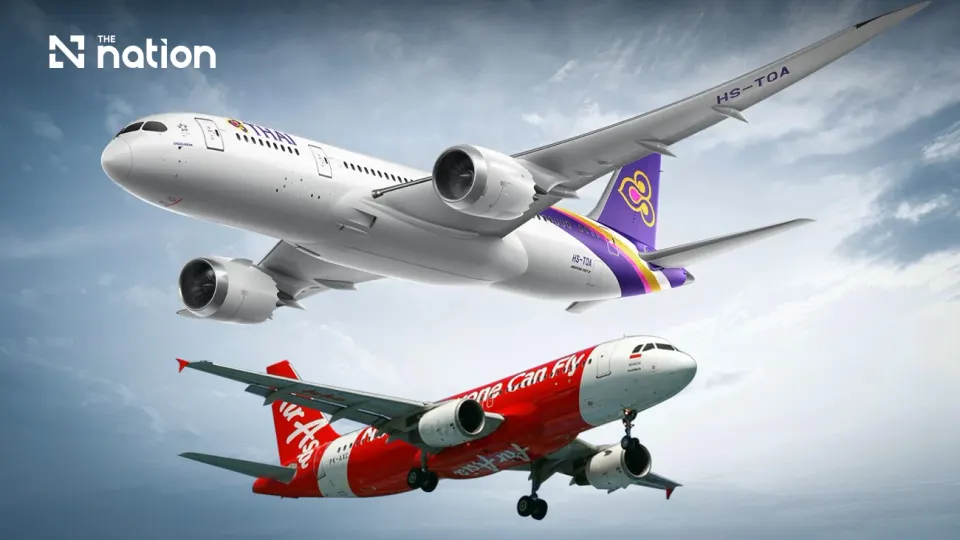
Thailand's two listed carriers diverged. Thai Airways reported a third quarter net loss of 418 million baht, against a profit of 4.42 billion baht a year earlier, as average aviation fuel prices rose 59.8 percent and operating expenses rose 29.1 percent, Nation Thailand reported. It stayed profitable over nine months, with net profit of 11.23 billion baht, down from 26.39 billion, and holds 135.49 billion baht of cash and current financial assets.
Asia Aviation, the parent of Thai AirAsia, fared far worse. It lost 2.37 billion baht in the quarter and 3.85 billion over nine months, against a profit of 727 million a year earlier. Jet fuel averaged 137 dollars a barrel in the quarter; the airline cut seats by 26 percent, passengers fell 29 percent and the average fare rose 24 percent to 2,023 baht, but cost per available seat kilometre still rose 40 percent.
The comparison across the region:
- biggest profit fall: SIA, first half net profit down 43.9 percent
- biggest loss: Cebu Pacific, about 12.8 billion pesos over nine months
- most resilient: Thai Airways, still profitable over nine months with large cash reserves
- hardest hit low cost carrier in Thailand: Thai AirAsia's parent, down 3.85 billion baht
- strongest offset: air cargo, lifted by AI and data centre equipment
A new normal, and a possible relief
Airline chiefs meeting at the Association of Asia Pacific Airlines assembly in Kuala Lumpur on 13 November were blunt. "Crisis disruptions of the external environment will be forever with us," said Cathay Pacific chief executive Ronald Lam, while Air New Zealand's Mike Williams called fuel prices, geopolitics and supply chain problems the new normal, The Business Times reported. Yet they agreed demand is holding up, and Lam said AI related shipments of data centre equipment were sustaining air cargo.
There may be relief ahead. Brent crude has fallen about a third since mid October on hopes that the Iran war is ending, FXStreet reported, although jet fuel and freight costs tend to lag. For investors, the gap between airlines with pricing power and strong currencies and those without has rarely been wider, and the next fuel move will decide which way it closes.
Fuel is not the only cost airlines cannot control. Executives said deliveries of new aircraft and spare parts are still running below expectations, forcing carriers to keep older, thirstier planes flying for longer. "We're forced to anticipate and to mitigate on the airline side for something that's not our fault, and we also have to absorb the costs," said Ibrahim Canliel, chief executive of Air Astana, calling the situation unacceptable and unsustainable.
How much did Singapore Airlines earn in the first half?
134 million Singapore dollars in the first half of its 2027 financial year, down 43.9 percent, on revenue of 11.3 billion.
Why did SIA's profit fall?
Higher fuel costs linked to the Middle East war. Second quarter fuel costs before hedging rose 63.3 percent to 2.1 billion Singapore dollars.
Did SIA pay a dividend?
Yes, seven cents a share for the half, including a five cent special dividend.
How much did Cebu Pacific lose?
About 12.8 billion pesos in the first nine months of 2026, on higher fuel costs and foreign exchange losses.
Why did the peso hurt Cebu Pacific?
Airlines pay for fuel and aircraft largely in dollars, so a weaker peso raises costs in local currency.
Is Thai Airways still profitable?
Over nine months, yes, with net profit of 11.23 billion baht, although it lost 418 million baht in the third quarter.
How much did Thai AirAsia lose?
Its parent, Asia Aviation, lost 2.37 billion baht in the third quarter and 3.85 billion baht over nine months.
How high were jet fuel prices?
Thai AirAsia said jet fuel averaged 137 dollars a barrel in the third quarter.
Did Thai AirAsia raise fares?
Yes. Its average fare rose 24 percent to 2,023 baht in the quarter while it cut seats by 26 percent.
Is air travel demand falling?
Airline leaders said demand remains strong despite higher fares, and air cargo is supported by AI related shipments.
Will fuel prices fall?
Brent crude has fallen about a third since mid October on hopes the Iran war is ending, but jet fuel and other costs tend to lag.
What is the AAPA?
The Association of Asia Pacific Airlines, a trade group with 17 members including Singapore Airlines, Cathay Pacific and Thai Airways.
How much of Air India does SIA own?
25.1 percent of the Air India Group, alongside majority owner Tata Sons.
Which Asian airline is most resilient to fuel costs?
Among those reporting, SIA and Thai Airways have absorbed the shock best, helped by premium demand, cargo and strong cash positions.
Are aircraft delivery delays affecting Asian airlines?
Yes. Executives at the AAPA assembly said deliveries of new aircraft and spare parts remain below expectations, adding costs.
Is SIA flying to the Middle East?
SIA and Scoot are continuing to suspend flights to the region, and SIA's Riyadh service has been deferred to March 2027.
The fuel shock has sorted Asia's airlines by strength. SIA and Thai Airways are earning less but still earning, Cebu Pacific and Thai AirAsia are losing money as fuel and weak currencies combine, and every carrier is betting on demand holding up. If the fall in crude since October reaches jet fuel prices, the weakest will recover fastest; if the war drags on, the gap between the strong and the stretched will keep widening.
Talk to the SpinDepth deskYou've finished this story
Read on, send it to someone, or ask about it.