The US Commodity Futures Trading Commission charged Goliath Ventures and its CEO Chris Delgado with a $400 million crypto fraud on 12 August 2026, according to industry reporting. The action is a blunt reminder that the same week the SEC moved to ease rules for lawful platforms, the enforcement machinery against bad actors is running harder, not softer. For users and platforms, the two stories are not contradictory. They are the two halves of a maturing market: a lane for the compliant, a wall for the fraudulent. The SEC easing framework we cover shows the lane being built; this case shows the wall being enforced. See our SEC easing crypto rules coverage at SEC easing crypto rules. See our white-label forex wave coverage at white-label forex wave. Source: FinTech Global.
What the [CFTC](https://www.cftc.gov) alleges
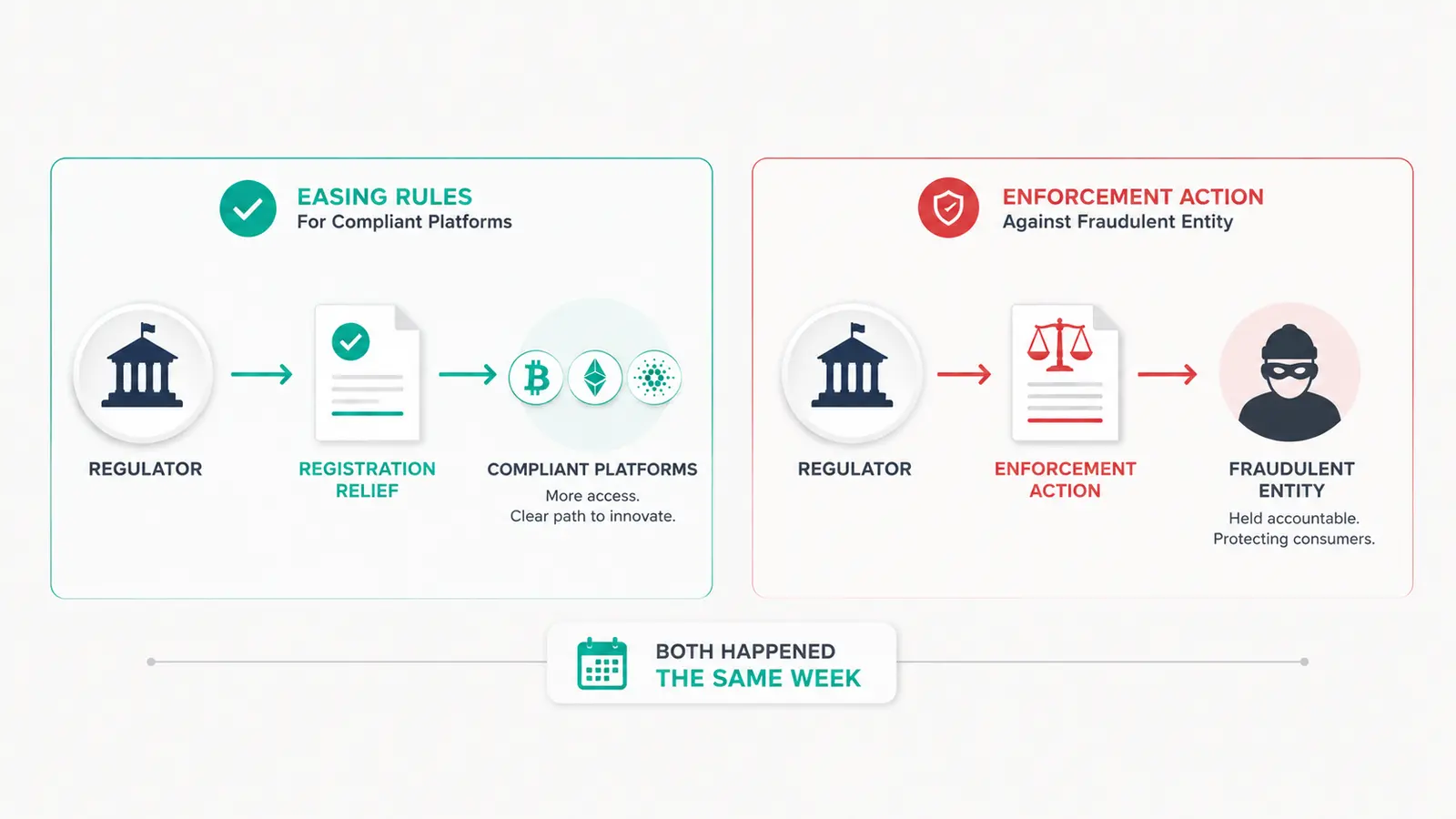
The charges name Goliath Ventures and Chris Delgado personally, alleging a crypto fraud that reached roughly $400 million in scale. The reporting frames it as a systemic enforcement action rather than a minor settlement, which is the signal that matters: the CFTC is using its full authority against alleged fraud even as the broader regulatory climate turns accommodative for legitimate operators. The pattern, large headline fraud cases alongside rule liberalisation, is how a market cleans up without chilling innovation. The contrast with the SEC's 14 August meeting is the story: clarity for the good, consequences for the bad.
Why parallel actions matter
A market cannot both welcome institutions and ignore fraud. The CFTC case does the protective work that makes the SEC's accommodation credible: if regulators only eased rules, users would fear a free-for-all; if they only enforced, innovation would flee. Doing both at once tells legitimate platforms they can build, and tells bad actors they will be caught. That balance is what the forex platform shift reflects too, where established vendors are formalising trust features as the market professionalises. The white-label broker surge we analyse shows the same maturation in trading infrastructure, where compliance becomes the entry ticket.
- CFTC charged Goliath Ventures and CEO Chris Delgado
- Alleged fraud scale near $400 million
- Filed 12 August 2026
- Runs in parallel with SEC rule-easing efforts
What it means for platforms and users
For platforms, the lesson is that trust is now a compliance product, not a marketing claim. Users burned by fraud will gravitate to venues that can show licensing, custody controls, and regulator engagement, which raises the bar for every operator. For users, the case is a prompt to verify who holds the licence and where the entity is regulated before depositing, because the $400 million figure is a measure of how much damage unverified platforms can do. The APAC angle matters here too: as Asian platforms scale, they are watching US enforcement as a template for their own investor-protection standards.
A maturing market needs two things at once: a lane for the compliant and a wall for the fraudulent.
The bigger picture
The Goliath Ventures case is one data point in the professionalisation of crypto enforcement. The agencies are learning to separate the technology from the abuse, punishing the people who exploit it while building room for the people who build it properly. That is the only version of crypto regulation that survives contact with mainstream finance, and it is exactly what the SEC's rulebook push depends on to be taken seriously. The same professionalisation is visible in trading infrastructure, where the forex platform shift and white-label broker wave show vendors competing on compliance and trust, not just features.
What to watch next
Watch the court filings for the structure of the alleged scheme and any asset recovery, because the remedy tells users more than the charge. Watch whether the CFTC coordinates with the SEC, since parallel actions on the same facts would signal a unified enforcement posture. And watch how platforms respond with trust features, because the market's answer to fraud is better rails, not just bigger fines.
What did the CFTC charge?
On 12 August 2026, the CFTC charged Goliath Ventures and its CEO Chris Delgado with an alleged crypto fraud reaching roughly $400 million in scale.
Does this contradict the SEC easing rules?
No. The two actions are complementary. The SEC is building a registration path for lawful crypto platforms, while the CFTC is enforcing against alleged fraud, together balancing accommodation with investor protection.