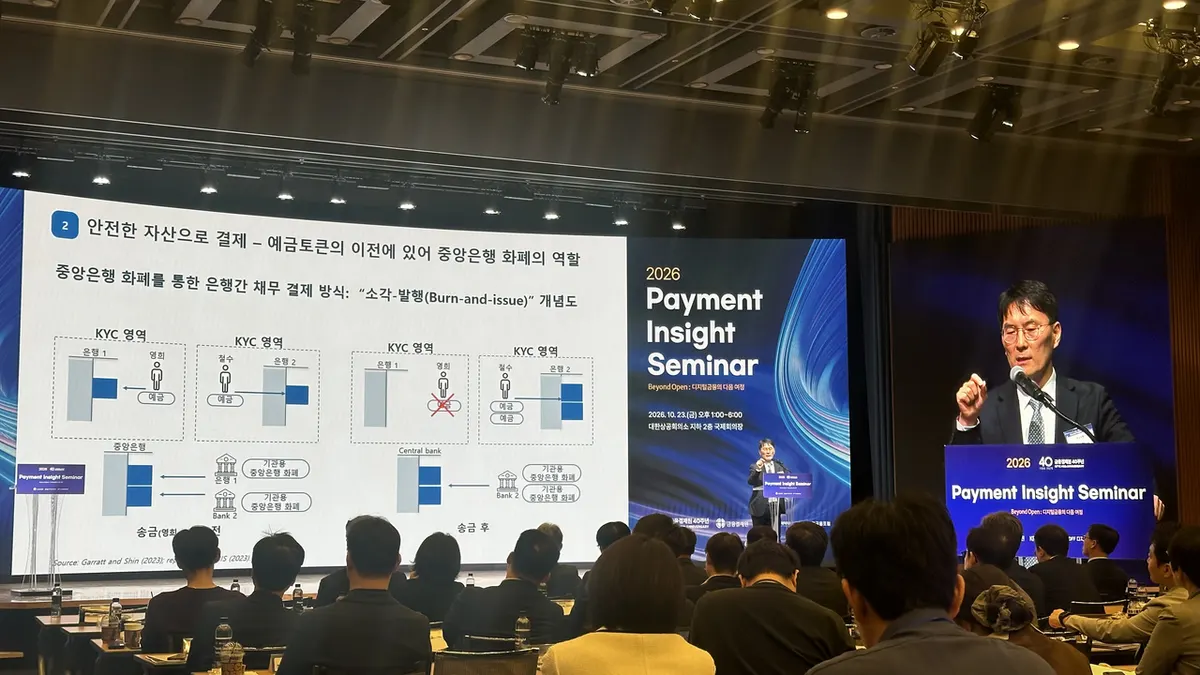
Can digital money end Korea's love affair with credit cards? The Bank of Korea thinks it can at least loosen it. Deposit tokens being tested under the central bank's Project Han River could shift South Korea's card dominated payments market toward cheaper, debit style payments, Yoon Seong-gwan, head of the bank's CBDC division, said at a seminar in Seoul, as reported by The Herald Business.
The pilot is growing fast. Participation is expanding from about 100,000 people in its first real transaction phase to up to 500,000 in the second, and from seven to nine banks. At the same time, the international project the Bank of Korea is part of, the BIS led Project Agora, has completed real transaction testing and is aiming for a 2028 launch. Together, they show how one of Asia's most digitally advanced economies is rethinking how money moves at home and abroad.
Why Korea wants to move beyond credit cards
South Korea is one of the world's most card heavy economies. Consumers routinely pay with credit cards even for small purchases, and merchants pay fees on every transaction. Yoon said deposit tokens, digital versions of bank deposits that can move on a shared ledger, could help rebalance that system.
"Korea's payments market is centred on credit cards," Yoon said. "Deposit tokens could help shift the balance toward a relatively lower cost, debit type payment instrument." For merchants, that could mean lower fees. For banks, it could open new services built on programmable deposits. For card companies, it represents a long term competitive threat.
Credit cards became dominant in Korea partly because of government policy in past decades, which encouraged card use to improve tax transparency by bringing more transactions into the formal system. That policy succeeded, but it also left merchants paying card fees on a very large share of sales. Deposit tokens offer a way to keep transactions transparent while potentially lowering costs.
How Project Han River is growing
Project Han River is the Bank of Korea's CBDC pilot using deposit tokens issued by commercial banks and settled with central bank money. The second phase expands participation from about 100,000 users to up to 500,000, and the number of participating banks from seven to nine.
The government has set a target of processing 25 percent of national treasury disbursements through CBDC based systems by 2030. The Bank of Korea is also discussing with ministries how to extend deposit tokens to government subsidies and local government spending, which could give the system a large base of real payments.
Korea does not need digital money to be faster. It needs it to be cheaper. That is why deposit tokens are aimed straight at the credit card.
"The purpose of Project Han River is to support banks from behind, enabling them to use deposits in token form to create more innovative financial services," Yoon said. The approach differs from a retail CBDC issued directly by the central bank, keeping commercial banks at the centre of the system.

Project Agora and cross border payments
Project Agora is a BIS initiative to improve cross border payments using tokenised central bank money and commercial bank deposits. Eight central banks, including the Bank of Korea, and more than 40 financial institutions are participating. Yoon said the project had completed real transaction testing.
"Next year we plan to establish the operating entity, governance structure and supervisory framework, with the goal of launching in 2028," Yoon said. He identified correspondent banking and anti money laundering checks as the main pain points in international transfers, noting that when funds get stuck, resolving it can take more than a month.
Agora requires all participating institutions to complete anti money laundering screening in advance. Funds move only after every institution has completed recipient verification and checks. It uses atomic settlement, meaning that if any single participant flags a problem, the whole transaction does not execute, preventing funds from getting stuck midway.
For exporters, importers and migrant workers, faster and more predictable cross border payments could reduce costs and delays. Korea is a major trading economy, and smoother international settlement would benefit companies that deal with suppliers and customers across Asia and beyond.
Tokenised bonds and the won
The Bank of Korea also plans to link tokenised government bonds to Agora. The concept involves tokenising government bonds on a domestic ledger the Bank of Korea will build, combining payment versus payment and delivery versus payment settlement, so that currency and securities move together.
"This connects to the internationalisation of the won, and could also make it more convenient for foreign investors to access the Korean government bond market," Yoon said. That ambition matters as Korea seeks wider foreign participation in its bond market. The bank plans to review the design of the domestic ledger next year.
Yoon also argued that central bank money should be the settlement asset in tokenised markets, because central banks carry no credit risk and can supply liquidity flexibly. That stance sets up a contrast with privately issued stablecoins, a debate active across Asia as Korea works on digital asset legislation and Korean companies test stablecoin payments, as we covered in our report on Shinhan Card and SBI's yen stablecoin pilot. The key elements of Korea's approach include:
- Deposit tokens issued by banks rather than a retail CBDC
- Settlement in central bank money for finality and safety
- Cross border payments through the BIS Project Agora
- Tokenised government bonds to attract foreign investors
- Government spending as an early source of real usage
What it means for consumers, banks and card companies
For consumers, deposit tokens could eventually mean new ways to pay directly from bank accounts, potentially with lower costs passed through by merchants. For banks, programmable deposits open opportunities for new services, from automated payments to conditional transfers for subsidies.
For card companies, the long term risk is clear if merchants and the government favour cheaper alternatives. Korea's crypto rules are also evolving, as we covered in our report on the fourth delay to Korea's crypto tax. How deposit tokens, stablecoins and cards coexist will shape Korean finance for the next decade.
Adoption will depend on convenience. Korean consumers are used to fast, reliable card payments and generous card rewards, so deposit tokens will need to match that experience and offer clear benefits, such as lower prices, instant settlement for merchants or useful features tied to government payments. The expansion to 500,000 participants will provide a larger test of whether people actually choose to use them.

What is Project Han River?
It is the Bank of Korea's CBDC pilot using bank issued deposit tokens settled with central bank money.
How many people are in Project Han River?
Participation is expanding from about 100,000 people to up to 500,000 in the second phase.
How many banks participate?
The number of participating banks rose from seven to nine.
What are deposit tokens?
Deposit tokens are digital versions of bank deposits that can move on a shared ledger and be programmed.
Why does the Bank of Korea want deposit tokens?
It says they could shift Korea's credit card dominated payments toward lower cost, debit type payments.
What is Project Agora?
It is a BIS led project to improve cross border payments using tokenised central bank money and bank deposits.
When will Project Agora launch?
The target launch is 2028, with the operating entity and governance planned for 2027.
How many central banks are in Project Agora?
Eight central banks, including the Bank of Korea, and more than 40 financial institutions.
How does Agora prevent stuck payments?
It requires advance anti money laundering checks and uses atomic settlement, so a transaction executes only if all checks pass.
What are tokenised government bonds?
They are government bonds recorded on a digital ledger, allowing settlement together with payments.
Why link tokenised bonds to Agora?
The Bank of Korea says it could support won internationalisation and ease foreign access to Korean bonds.
What is Korea's 2030 CBDC target?
The government aims to process 25 percent of national treasury disbursements through CBDC based systems by 2030.
Who is Yoon Seong-gwan?
He is head of the Bank of Korea's CBDC division.
Is this a retail CBDC?
No. Project Han River uses deposit tokens issued by commercial banks rather than currency issued directly to the public.
What does it mean for credit card companies?
Cheaper debit type deposit token payments could compete with cards over time, especially if merchants and the government adopt them.
The Bank of Korea is betting that deposit tokens can do what decades of policy could not: move Korean consumers away from costly credit card payments. With Project Han River growing to 500,000 users and Project Agora aiming for 2028, Korea is building digital money at home and abroad. For banks, merchants and investors, the result could be cheaper payments and easier access to Korean bonds.
Talk to the SpinDepth deskYou've finished this story
Read on, send it to someone, or ask about it.