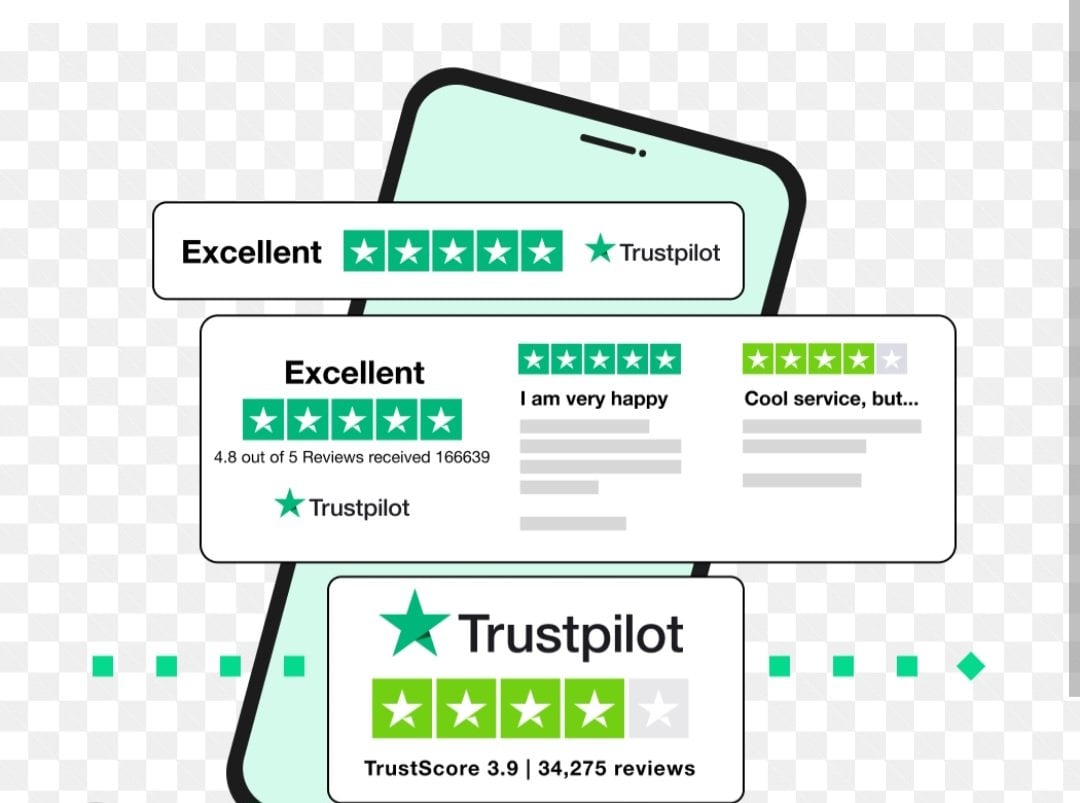
Trustpilot has placed a formal consumer warning banner on 21 of the 100 largest retail broker profiles on its platform, according to a review of those profiles published by Finance Magnates. That is not a low score. A low score is an opinion the market formed about a firm. A warning banner is something else entirely: it is the platform itself telling every visitor that the reviews underneath the banner should not be read as evidence of anything. For a retail brokerage whose entire acquisition funnel runs through comparison sites, star ratings and search snippets, that distinction is the difference between a bad quarter and a broken channel.
The banner is a statement about the reviews, not the firm
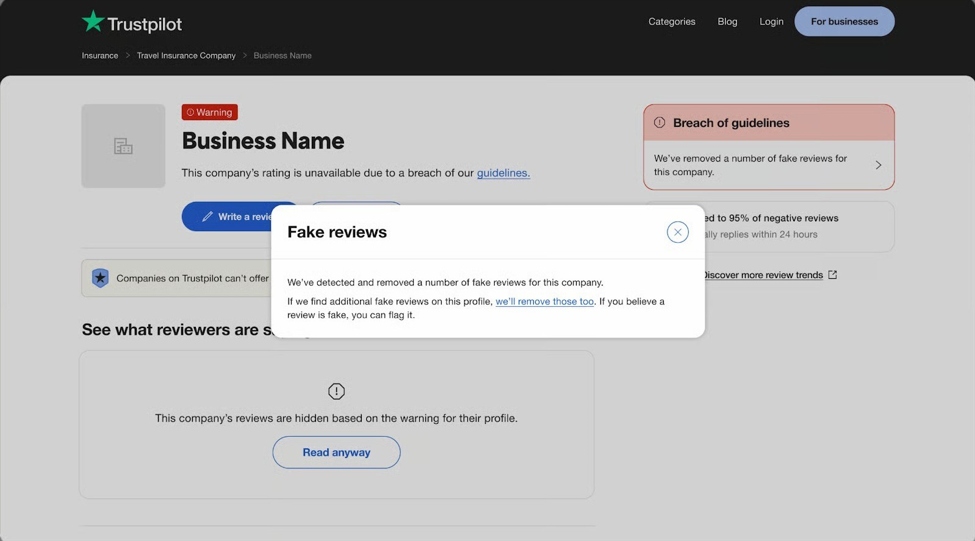
It is worth being precise about what the label does and does not say, because the industry reaction has been sloppy on exactly this point. Trustpilot applies a consumer alert when its detection systems find patterns consistent with misuse of the review system. The stated triggers include fabricated reviews, reviews bought or incentivised, and selectively solicited feedback, which is the practice of inviting only clients already known to be happy while leaving everyone else uninvited. None of those triggers is a finding about whether the broker executes fairly, holds client money properly, or pays withdrawals on time.
That nuance matters, and it is going to be lost. A retail client comparing four brokers on a Sunday evening does not parse the difference between a regulatory sanction and a platform integrity notice. They see a warning, and they move to the next tab. The label is functionally a conversion penalty applied by a private company with no appeal process a broker can point a client toward, which is why it lands harder than most enforcement actions a regulator would take in the same week.
The uncomfortable corollary is that a firm can end up flagged through the behaviour of an affiliate or an over-eager retention team rather than through any decision taken at board level. A partner running an incentivised review campaign in one language market is enough. The broker owns the profile, so the broker owns the banner.
Why the review layer became the battleground
Retail brokerage has spent a decade pushing its trust signals further away from the regulator and closer to the consumer. A licence number in a website footer converts nobody. A four-point-seven average across eleven thousand reviews converts a great deal. The industry built that incentive itself, and then acted surprised when the incentive produced exactly the behaviour incentives produce. Finance Magnates has reported separately on brokers and prop firms building dedicated internal teams to manage review flow, which is a polite description of an arms race.
The economics are brutal and they explain the behaviour better than any moral argument. Cost per acquisition in competitive retail FX markets has climbed to a point where the organic trust layer is one of the few remaining channels that scales without a proportional spend increase. A profile that ranks, carries volume and reads well is worth more than most paid campaigns, and it compounds. So firms optimise it. The line between optimising and manipulating is thinner than compliance functions generally admit.
What has changed in 2026 is the cost of being caught. Generative tools made fabricated reviews cheap enough that volume stopped being a credible signal of authenticity, which forced platforms to invest in detection that looks at patterns rather than content. Detection that looks at patterns catches selective solicitation too, and selective solicitation is something a very large number of otherwise well-run firms have been doing openly for years while believing it was marketing.
- Fabricated reviews, whether generated internally, bought, or produced by an affiliate
- Incentivised reviews, where a rebate, bonus or contest entry is tied to leaving feedback
- Selective solicitation, where only clients already known to be satisfied are invited to review
- Coordinated suppression, where negative reviews are challenged in volume to force removal
- Profile gaming, where review velocity is timed to bury a specific complaint cluster
Southeast Asia carries the asymmetry
This lands unevenly, and it lands hardest in the markets SpinDepth covers most closely. In Southeast Asia the retail trading population skews young, mobile-first and heavily dependent on social proof, because the formal verification route is genuinely difficult. Checking a Cyprus or Australian licence number against a regulator register is not a realistic step for a first-time trader in Jakarta or Ho Chi Minh City, and the local-language guidance that would make it realistic is thin. We have written before about how retail traders in the region actually verify a broker, and the honest answer is that most of them verify through reviews and through people they follow.
That dependence cuts both ways. It means the review layer carries more weight in the region than it does in the United Kingdom or Germany, so a warning banner costs a broker more in Bangkok than in Berlin. It also means the region has been a soft target for exactly the manipulation the banner is designed to catch, because the volume of non-English reviews historically received less scrutiny than English ones. Firms that ran clean English profiles and loose regional ones are now discovering that the detection does not respect that boundary.
There is a second-order effect worth naming. When the most visible trust signal in a market becomes unreliable, the market does not become more sceptical in a useful way. It becomes more dependent on whoever shouts loudest, which in practice means paid placement and influencer endorsement, neither of which is more honest than a manipulated review and both of which are harder for a regulator to see. The rating platforms are solving a real problem in a way that pushes the same problem somewhere less visible.
What supervisors do with a private warning label
There is a question the industry has not thought through, and it will matter more than the banner itself. A consumer alert placed by a commercial review platform is not a regulatory finding, but it is a publicly visible, dated, third-party observation that a firm may have been manipulating consumer-facing information. Supervisors read the same internet as everyone else. A conduct regulator conducting a thematic review of retail marketing now has a free, pre-sorted list of firms worth a closer look, published by someone with no duty of fairness to the firms on it.
That is a meaningful change in the supervisory economics. Historically, identifying misleading retail promotion required a regulator to commission its own sweep, which is slow and resource-intensive and therefore rare. A platform that flags 21 firms out of 100 has effectively done the triage. Whether the regulator agrees with the platform's methodology is beside the point, because the regulator does not need to agree in order to use the list as a starting point for questions it was entitled to ask anyway.
Firms should therefore assume the banner is not the end of the matter. The right internal response is the one a firm would want to have already completed if a supervisor wrote next quarter asking how review solicitation is governed, who signs it off, what affiliates are permitted to do, and how that is monitored. Most firms cannot currently answer those four questions with documents. That gap, rather than the label, is the actual exposure. The question of who actually pays the reviewer has never had a comfortable answer in this industry, and a documented internal process is the only version of it a firm controls.
A licence number in a website footer converts nobody. A four-point-seven average across eleven thousand reviews converts a great deal.
What the label costs in acquisition terms
It is worth putting a shape on the commercial damage, because firms consistently underestimate it by thinking about the banner as a brand problem. It is not a brand problem. It is a funnel problem, and it hits at the point in the funnel where intent is highest and replacement traffic is most expensive. A prospect reading a broker's review profile is not at the top of the funnel browsing. They have shortlisted, they are comparing two or three firms, and they are minutes from a decision. Losing them there is not equivalent to losing an impression.
The compounding effect is worse than the direct one. Review profiles rank in search for exactly the queries that carry commercial intent, the ones pairing a broker name with words like review, scam, withdrawal or legit. A flagged profile does not stop ranking. It keeps ranking, with the warning banner rendered on the page, which means the firm's own brand searches now deliver a warning to the people most likely to convert. Paid search cannot fix that, because the organic result sits underneath the ad and answers the question the ad raised.
Then there is the partner channel. Introducing brokers and affiliates do their own diligence, and a warning banner is the sort of thing a partner cites when renegotiating revenue share or declining to renew. A firm can absorb a drop in direct conversion for a quarter. Losing partner confidence is slower to reverse, because partners who move their flow elsewhere tend to stay moved, and the cost of winning them back is a multiple of the cost of keeping them.
The response that works and the one that does not
The instinctive response is to fight the label, and it is the wrong one. Appealing a platform integrity notice is slow, opaque, and even a successful appeal leaves the broker arguing publicly about its own reviews, which is a conversation no firm wins. The firms handling this well are doing something less satisfying and more effective: they are removing the incentive structures that produced the flag, documenting the removal, and letting the profile normalise over a quarter rather than a week.
The structural fix is to stop treating the review layer as owned media. It is not owned media. It is a third-party surface a broker rents on terms it does not set and cannot negotiate, and any acquisition model that depends on it is carrying a counterparty risk nobody has priced. The firms with durable trust positions in the region built them somewhere they control: published execution statistics, regulator-verifiable disclosures, local-language education that survives without a star rating attached. That is slower. It is also the only version that cannot be switched off by a detection model.
Does a Trustpilot warning mean a broker is unsafe?
No. The banner is a statement about the integrity of the reviews on that profile, not a finding about the firm's conduct, client money handling or execution. A flagged broker may be fully compliant, and an unflagged one may not be.
How many brokers were affected?
Trustpilot had placed consumer warning banners on 21 of the 100 largest retail broker profiles at the time Finance Magnates reviewed them in September 2026.
Is asking happy clients for reviews against the rules?
Inviting only clients you already know are satisfied is selective solicitation, which is one of the stated triggers. Inviting your whole client base on a neutral, automated basis is not.
What should a trader use instead of review scores?
Check the licence directly on the regulator's own register, read the firm's published execution and withdrawal terms, and treat any single aggregated score as one weak input among several.
The banner is a small operational event with a large strategic message inside it. Retail brokerage outsourced its most important trust signal to a platform that owes it nothing, optimised that signal until the platform built a detector, and is now discovering how little of its credibility it actually holds. The firms that come out of this intact will not be the ones with the cleanest profiles. They will be the ones whose clients would still be able to answer why they trust the firm if every review on the internet disappeared tomorrow.
Speak with the SpinDepth desk