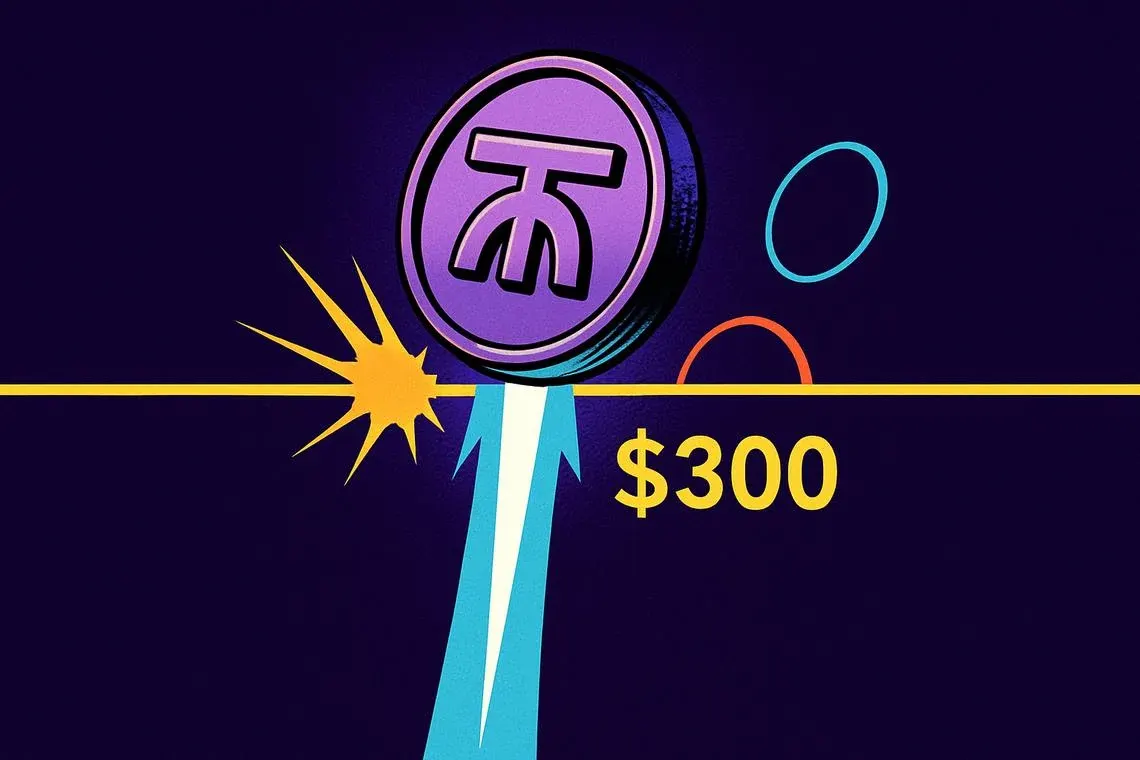
The AI trade is back onchain. Bittensor's TAO extended a five-day rally of roughly 25 percent into Monday, pushing toward a two-month high with traders eyeing the psychological $300 mark. The drivers stack like a 2026 starter pack: technical momentum, a viral meme-coin spinoff literally programmed to buy TAO, and fresh AI hype around ChatGPT-6 Astra. Derivatives agree, with open interest at a three-month high of $428.57 million. Nobody in majors is moving like this today. The Bitcoin range consolidates while AI tokens sprint, and the funding mandate explains why. Source: TAO prediction. Our Kinexys rails tracks the parallel leg. Our pound-euro cross tracks the parallel leg. Our Morph payroll tracks the parallel leg.
The BUTT flywheel, explained
Buttensor, ticker BUTT, is a parody meme coin launched on Raydium that routes its transaction fees directly into buying TAO. Every speculative churn in the memecoin therefore becomes mechanical demand for the parent token, a flywheel traditional markets would call a buyback program and crypto calls a joke that prints. The effect shows in attention data: TAO social dominance jumped from 0.05 percent to 0.12 percent on the launch plus AI-model hype. Breakdowns of the tokenomics all point the same way, with fee routing making BUTT volume a leading indicator for TAO spot. The long-tail frenzy in ORBIO and SHRUB shows the same speculative energy looking for a home. Source: CoinStats.
Levels that decide the breakout
Technicals frame $300 as the gate and $350 as the measured next target in current prediction updates, with $224.25 the level bulls must keep holding beneath. Open interest at three-month highs signals conviction but also leverage, so a rejection at $300 would compress fast on long liquidations. The Base L2 integration from late August quietly expanded the bullish case, opening DeFi and cross-chain accessibility that gives the rally somewhere to live beyond momentum. Watch funding rates alongside price for the blowoff signature. Source: Bittensor updates.
- Five-day surge of about 25 percent
- $300 psychological breakout level
- OI $428.57 million, three-month high
- Social dominance 0.05 to 0.12 percent
What it means for AI-crypto traders
For traders, TAO is the purest AI-beta vehicle with a live catalyst calendar: meme-flywheel flows below, model-release hype above, derivatives conviction underneath. Position against $300 with defined risk, because the same leverage that powers the breakout punishes the fakeout. For allocators, the deeper read is sectoral: AI tokens outperforming majors this week confirms the market pays for AI narratives over store-of-value patience right now. The XRP steadiness next door shows the other side of that coin.
A parody coin that buys the parent on every trade. The joke is the buyback program.
How fee-buyback flywheels work
A token that routes its trading fees into buying another token creates a simple loop: more trading in the first token means more fees, more fees mean more buying of the second, and rising prices attract more trading. Traditional markets would call the buying part a buyback. The loop can be powerful while activity is high. It also works in reverse: when interest in the meme token fades, trading falls, fees shrink and the buying stops. Flywheels built on speculative activity tend to be short-lived, so it is unwise to treat them as lasting support for a price.
Meme coins and their risks
Meme coins launched on decentralised exchanges such as Raydium can be created by anyone in minutes. Many have no team, no roadmap and no purpose beyond trading. Common risks include developers holding a large share of supply and selling it, liquidity being withdrawn from the trading pool, contracts with hidden functions and extreme volatility. Some are openly parody projects, as this one is. Buying them is a bet on other people's enthusiasm, and that enthusiasm can vanish in a day.
What open interest tells traders
Open interest is the total value of outstanding futures and perpetual contracts on a token. Rising open interest during a rally means new positions are being opened, often with leverage. That can fuel further gains, but it also creates fuel for a sharp reversal: if the price stalls at a key level, leveraged longs may be liquidated in a cascade, pushing the price down quickly. Traders watch open interest alongside funding rates; when both are high, the market is crowded and vulnerable to sudden moves.
Why round numbers matter
Levels such as 300 dollars attract attention because many traders place orders, take profits or set alerts at them. That concentration can turn a round number into resistance, where sellers appear, or, once broken, into support. A move through a round number on strong volume and a close above it is more convincing than a brief spike. Many traders wait for a retest of the level before acting, to avoid being caught by a false breakout.
Smaller tokens move more, both ways
A token with a smaller market value than Bitcoin or Ether can move 20 or 30 percent in days on modest buying or selling. That is attractive in a rally and painful in a reversal. Position sizes in such tokens should be much smaller than in large assets, and leverage multiplies the risk further. Major regulators cap retail leverage on crypto at 2 to 1, and the UK bans crypto derivatives for retail clients, precisely because of this volatility.
A risk checklist for trading a fast-moving token
- Decide the maximum you are willing to lose before entering.
- Set a stop at a level that invalidates your idea, and size the position to it.
- Check open interest and funding rates for signs of crowding.
- Avoid chasing a move after a large daily gain.
- Take partial profits into strength rather than waiting for the top.
- Use only exchanges licensed for your country and keep long-term holdings in your own wallet.
How narratives drive token prices
Many token rallies are driven by stories as much as by use: a theme becomes popular, headlines appear and money flows into tokens connected to it. Narratives can last weeks or months, but they rotate, and tokens that rose fastest on a theme often fall fastest when attention moves elsewhere. Asking what a token does, who uses it and how its supply changes over time gives a steadier basis for decisions than the latest story.
The bigger picture
TAO's week is the AI trade refusing to die: every model release reprices decentralized AI, and every memecoin flywheel converts giggles into spot demand. Whether $300 breaks or not, the structure underneath, Base rails, derivatives depth, social mindshare, survives the week. That is more than most rallies can say.
What to watch next
Watch $300 for acceptance versus wick and BUTT volumes as the flywheel gauge. Watch open interest for leverage excess into the level. And watch AI-model headlines, because this rally rents its narrative from them.
Why is TAO rallying?
A 25 percent five-day surge on technical momentum, the Buttensor meme flywheel routing fees into TAO buys, ChatGPT-6 Astra AI hype, and record three-month derivatives open interest of $428.57 million.
What levels matter for TAO?
$300 is the psychological breakout gate with $350 as the next predicted target, while $224.25 is the support bulls must defend beneath.
What is open interest?
The total value of outstanding futures and perpetual contracts on an asset. Rising open interest in a rally often means more leveraged positions.
Are meme coins safe to hold?
They carry very high risk, including concentrated ownership, withdrawn liquidity and extreme volatility. Only money you can afford to lose entirely should be used.
Why do round-number levels matter?
Many traders place orders and alerts at round numbers, so buying and selling concentrates there, making them likely points of resistance or support.
You've finished this story
Read on, send it to someone, or ask about it.