
Stripe-owned Bridge has entered the European Union's MiCA register as an authorised e-money token issuer, a move that matters more than the headline suggests. The listing, recorded in early August, makes Bridge the latest player to earn a passport that lets it offer regulated stablecoin services across all 27 member states from a single Luxembourg base. For Stripe, the win is not a licence. It is access to the world's most coherent regulatory market for digital money, on terms that competitors without a licence cannot match.
What MiCA actually grants
The European Securities and Markets Authority maintains the MiCA register, and an e-money token authorisation under it is the legal basis for issuing a euro-pegged stablecoin inside the bloc. Bridge, part of Stripe, entered the register as the 42nd authorised issuer, alongside three German providers added in the same update that lifted authorised crypto-asset service providers to 324. The detail that counts is the passport: one Luxembourg authorisation, supervised by the CSSF, covers the entire European Union. That is the structural advantage US and Asian issuers lack, because their regimes are still fragmented state by state or jurisdiction by jurisdiction. The contrast with the United States is sharp. There, a stablecoin issuer navigates a patchwork of state money-transmission licences and the federal reserve framework, and no single approval grants the national reach that a MiCA passport grants by default. Europe traded speed for coherence, and coherence is what institutions prize.
Bridge had already secured MiCA and electronic-money institution licences from Luxembourg's CSSF earlier in the year, so the register entry formalises what was already in motion. The sequence tells the strategy: Stripe chose Luxembourg, the same jurisdiction Coinbase picked for its own MiCA licence, because a small, well-regarded financial centre inside the euro area is the cleanest way to reach the whole market. The licence is the cost of entry. The passport is the prize.

Why Stripe wants this now
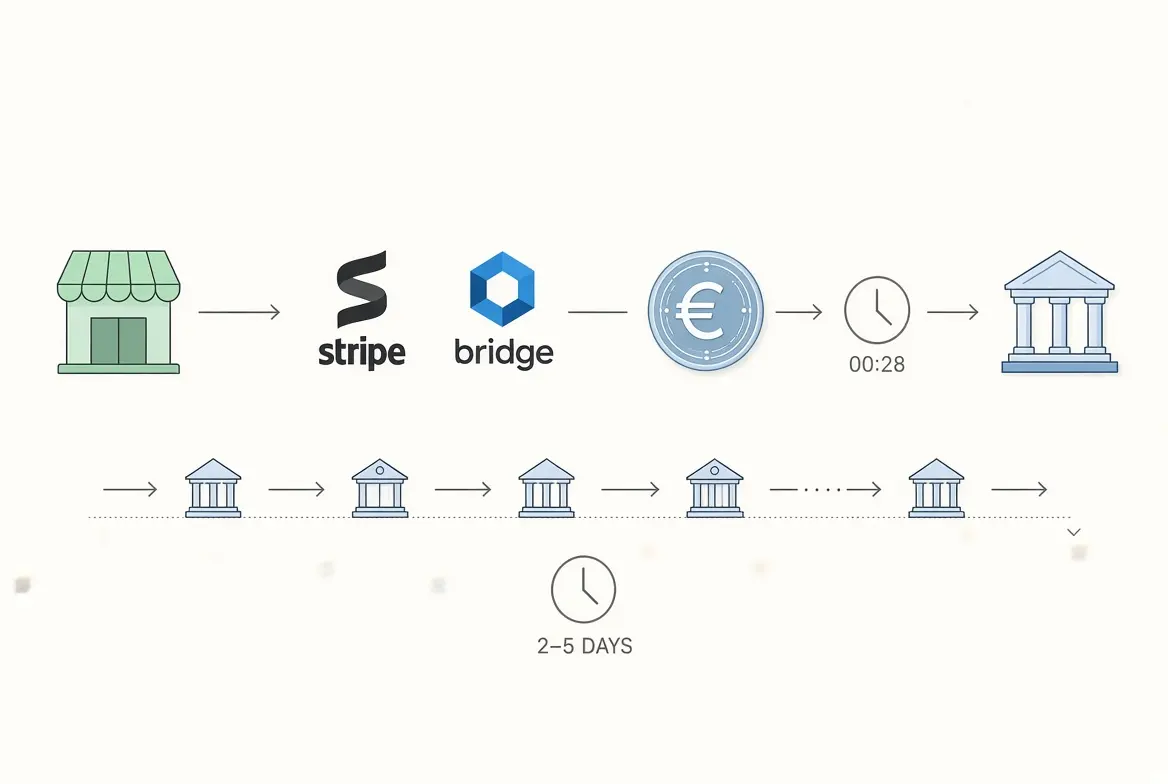
Stablecoins are the settlement layer Stripe has been building toward for years. The company bought Bridge in 2024 to own the rails rather than rent them, and a regulated euro token is the piece that lets Stripe move money across borders without touching the slow, costly correspondent-banking chain. For merchants and platforms that already use Stripe, a licensed euro stablecoin turns cross-border payouts from a multi-day reconciliation problem into a near-instant settlement, and the MiCA passport means it works the same way from Lisbon to Tallinn.
- Bridge entered the EU MiCA register as the 42nd authorised e-money token issuer
- One Luxembourg CSSF authorisation covers all 27 EU member states
- Same update lifted authorised CASPs to 324 across the bloc
- Stripe picked the same jurisdiction Coinbase used for its MiCA licence
The competitive edge
The moat here is regulatory, not technical. Anyone can issue a token. Few can issue one that a bank, a regulated exchange, or a public company is allowed to hold on its balance sheet. MiCA status does that, and it compounds: the more of the European payments stack Stripe controls under one licence, the harder it is for a fragmented set of local players to compete on the same footing. Circle, the USDC issuer, is the other heavyweight in this race, and the two are now positioning on opposite sides of the Atlantic with overlapping ambitions and different home regulators. The European Union built the single rulebook, the CSSF supervises the licence, and ESMA holds the register, three institutions that together turn one Luxembourg approval into a continent-wide permission.
The moat is regulatory, not technical. Anyone can issue a token. Few can issue one a bank is allowed to hold.
What it means for operators
For a European business moving money, the practical takeaway is that regulated stablecoin settlement is now a real option rather than a pilot. If your provider holds MiCA status, the token it uses can sit inside a compliant flow, which means treasury, audit, and risk teams stop treating it as a special case. That removes a layer of internal friction that has slowed stablecoin adoption in conservative markets, and Stripe's distribution means the option arrives inside software teams already use. The Stripe brand is the reason this lands differently from a standalone issuer: the token arrives inside a product finance teams already trust.
For builders outside Europe, the lesson is that the EU moved first with a single rulebook and is now reaping the network effect. A US issuer that wants the same reach has to clear a patchwork; a European issuer with a MiCA licence already has the map. The fragmentation the United States still lives with is, for once, Europe's advantage, and Stripe just used it. The next phase of stablecoins in Europe will be written by the licensed few, and Bridge is now clearly among them. Coinbase reached the same Luxembourg register earlier, and Circle runs the other large euro token, so the licensed field is no longer empty.
The bigger picture
Stripe's Bridge joining the MiCA register is a quiet milestone in the shift from crypto-native stablecoins to payments-native ones. The technology did not change this week. The permission did, and permission is what scales. When the most valuable payments company in the West puts a regulated euro token on a European passport, the signal to banks, merchants, and regulators is that this is infrastructure now, not experiment. The unlicensed boom built the market. The licensed phase is about to own it, and Stripe just took a seat at the front of the regulated line. The longer arc is about settlement itself. For three decades, cross-border payments inside Europe ran on correspondent banking and card networks that extracted fees and time at every hop. A regulated stablecoin with a passport removes most of those hops, and when the issuer is also the largest payments processor, the rails and the network become the same company.
Where this leaves the rivals
The immediate losers are the unlicensed and partial-licence stablecoin players who cannot offer a euro token a European bank is allowed to hold. Before MiCA, a serious European merchant had to weigh whether holding a stablecoin tripped its own compliance rules, and many quietly declined. A licensed Bridge token removes that hesitation, and the volume that follows does not come back to the unlicensed side. The second-order effect is on the card networks and correspondent banks whose fees the token undercuts, because a licensed euro stablecoin inside Stripe's distribution reaches merchants who already trust the brand and never have to learn what a stablecoin is.
The euro stablecoin race
Bridge is not alone. Circle's euro product and the bank-issued tokens already on the register mean the euro stablecoin market is now contested by licensed issuers rather than dominated by one. The race is no longer about who can issue, but who can distribute, and Stripe's merchant base is the largest ready-made channel in the West. That is the real story behind the register entry: not that Bridge got a licence, but that the licence lands inside the largest payments distribution machine in the market, which is the combination every rival is now racing to match and none currently matches.
The merchant experience underneath
Strip away the regulatory framing and the change is quiet for the merchant. A European business that already runs on Stripe sees a new settlement option appear inside the dashboard it uses daily, with no new counterparty to onboard and no new compliance questionnaire to file, because the licence sits with Stripe, not with the merchant. That is the distribution advantage made concrete: the regulated token does not ask the customer to become a crypto expert, it asks them to tick a box. The same dynamic is why earlier stablecoin pushes stalled at the enterprise gate, the compliance burden fell on the wrong party. Bridge on MiCA flips that, and the unglamorous result is adoption by default rather than by conviction, which is how most payment rails actually win.
Why Luxembourg, and why it matters
The choice of Luxembourg as the licensing home is not incidental. It is a small, euro-area financial centre with a respected supervisor in the CSSF, which made it the natural base for a passport that covers the whole bloc, and it is the same logic that drew Coinbase to the same jurisdiction for its own MiCA licence. The pattern, multiple global issuers converging on one small state for one large market, is how European financial integration actually works in practice: the single rulebook pulls supervision toward a few recognised centres, and those centres become the on-ramp for the continent. For Stripe, Luxembourg is the key that turns a US payments company into a European one, and the Bridge register entry is the moment the door opens.
The settlement-speed dividend
The benefit most often understated in stablecoin analysis is time. Cross-border settlement that takes days through correspondent banking takes seconds on a licensed token, and for a business managing float, the recovered time is real working capital, not a footnote. Stripe's pitch to merchants is therefore not only cheaper rails but faster ones, and the two compound: lower fees free cash, faster settlement frees more of it sooner. The MiCA licence is what makes a conservative treasurer allowed to capture that dividend inside a compliant flow, and permission is the unlock that turns a technical advantage into a line item. Without the licence, the speed exists but the risk team blocks it. With it, the same speed becomes policy.
Is Bridge now a licensed stablecoin issuer in Europe?
Yes. It entered the EU MiCA register as an authorised e-money token issuer, which lets it offer regulated stablecoin services across all 27 member states from its Luxembourg base.
Why does the Luxembourg base matter?
A single CSSF authorisation under MiCA carries a passport across the entire European Union, so one licence covers 27 countries rather than requiring separate approvals in each.


