
The dollar just hit a 13-month high and Asia's currencies are feeling it
Asian currencies weakened across the board as the US dollar climbed to a 13-month high, pressuring the yen, the yuan, and emerging-market peers.
The US dollar climbed to a 13-month high this week, and Asia's currencies moved in the opposite direction. The yen, the yuan, and a broad set of emerging-market peers all weakened as resilient US economic data pushed markets to expect the Federal Reserve to keep rates higher for longer. For businesses that price in dollars and earn in local currency, the move is not a chart curiosity. It is a margin event that lands in the same quarter it happens.
What actually moved
The US dollar index rose as Treasury yields pushed higher on strong US growth and labour figures. The Japanese yen and the Chinese yuan both came under pressure, and currencies across Southeast and South Asia followed. The pattern is familiar: when the dollar strengthens, capital tilts toward dollar assets, and the currencies of import-heavy, dollar-funded economies soften in response. The dollar index is the cleanest read on the shift, and it is the number Asian finance teams now check before they check their own markets. The move is not happening in a vacuum. It follows a year in which the Federal Reserve held rates at the top of its range while most of Asia either cut or held, opening a yield gap that pulled money toward New York and away from regional fixed income, the mechanical engine behind the currency drift.
The breadth of the weakness is the part worth noting. It is not one currency having a bad week. It is a region-wide move led by the yen and the yuan, the two anchors of Asian FX, with the Indonesian rupiah, the Malaysian ringgit, the Indian rupee, and the Thai baht all softening in sympathy. When the anchors move, everything pegged to or correlated with them moves too, because regional trade and capital flows are denominated in those two currencies more than any other. A 13-month dollar high is therefore a regional event wearing the clothes of a single index, and the businesses that feel it first are the importers whose costs are set in the strong currency and whose revenues are collected in the weak one.
Why it matters for Asia
Most regional trade is settled in dollars. When the local currency weakens, importers pay more for energy, electronics, and food, and that cost lands in consumer prices. Exporters win on paper, but the relief is uneven because their input costs are often dollar denominated too. The net effect in a weak-currency, high-dollar environment is margin compression for the firms that sit in the middle of Asian supply chains, which is where most of the region's manufacturing and logistics value actually lives.
- Importers face higher input costs in local-currency terms
- Exporters gain on price but lose on dollar-denominated inputs
- Households absorb higher prices for fuel and imported food
- Central banks face a choice between defending the currency and supporting growth
The policy bind
Asia's central banks are caught between two pressures. Defending a falling currency means spending reserves or raising rates, which slows growth. Letting it fall protects exports in the short term but imports inflation and raises the cost of external debt. The Bank of Japan faces the added complication that a weak yen feeds imported inflation even as it supports exporters, a tension that has defined its policy debate for years and shows no clean resolution while US rates stay elevated. The Bank of Japan has been the clearest case study: its long effort to nurse inflation to target collided with a currency so weak it made that inflation imported rather than earned, and every rate decision became a three-way trade between growth, prices, and the exchange rate. That knot is the textbook version of the bind, and most of the region lives somewhere on the same spectrum.
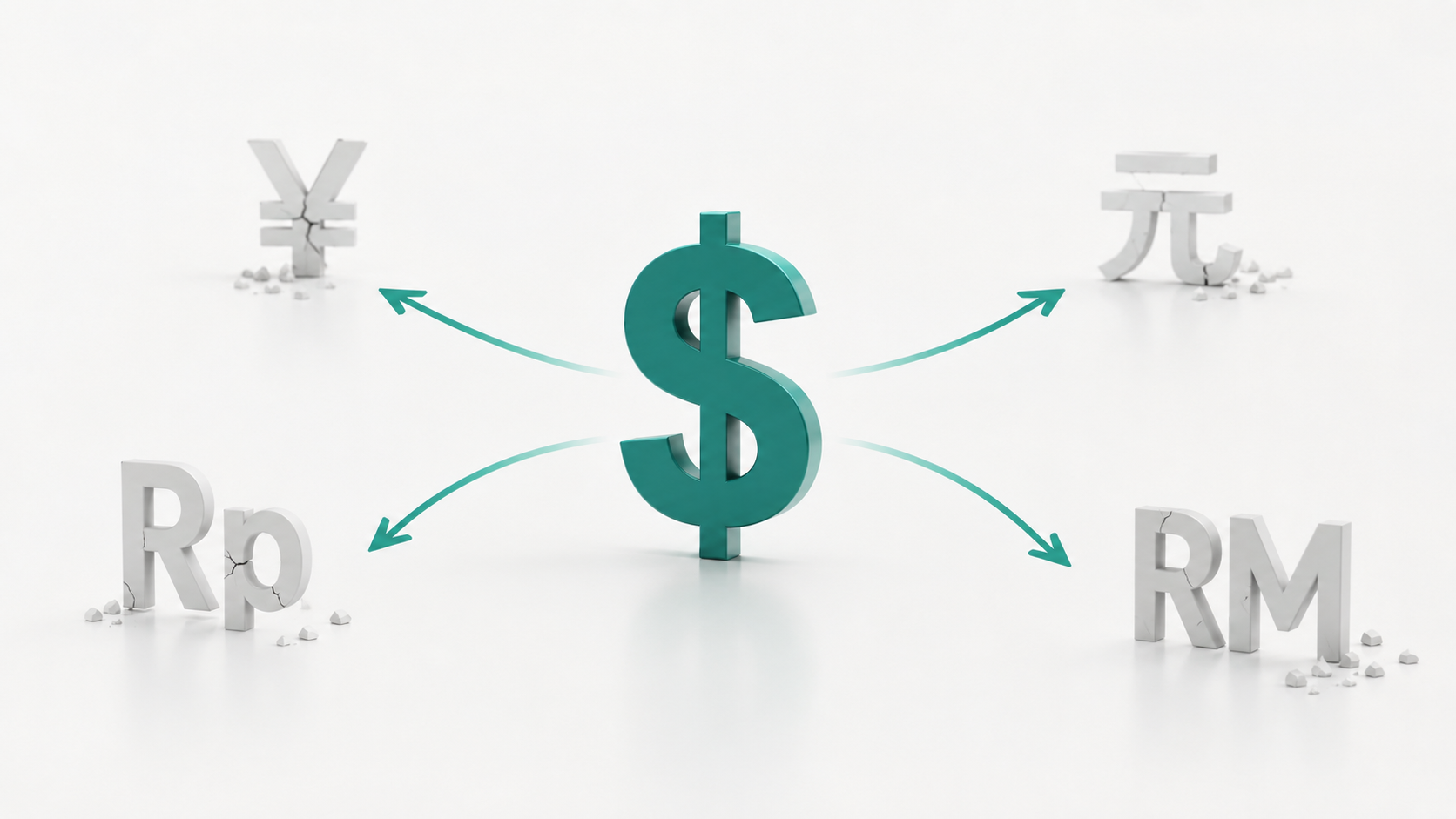
When the dollar strengthens, capital tilts toward dollar assets, and Asia's currencies soften in response.
What operators should watch
For a treasury or finance team running an Asian business, the signal is to revisit dollar exposure now rather than after the next leg. Hedge local-currency receivables, stagger dollar debt maturities, and price contracts with a currency clause where the counterparty will accept one. The cost of a hedge is predictable. The cost of an unhedged move through a 13-month dollar high is not, and the gap between the two is the difference between a planned quarter and a surprised one.
For investors, the weak-currency episode is a screen, not a verdict. Currencies that weaken on dollar strength but sit on strong fundamentals tend to recover when the rate cycle turns. The mistake is to read a dollar-driven move as a fundamentals verdict on a specific economy, when the dominant cause is offshore and macroeconomic. The local story has not changed; the global discount applied to it has, and the two should not be confused when positions are sized. The Federal Reserve sets the rate path that drives the whole move, and its next meeting is the event the currency desk is actually trading.
The bigger picture
The dollar's run is a reminder that Asian markets still price off US rates more than local narratives. Regional growth stories are real, but they share a balance sheet with the world's reserve currency, and when that currency's yield rises, the whole region adjusts. The current move is a normal cycle event, not a crisis, but it is the kind of event that separates operators who hedge from those who hope. The hope strategy works until it does not, and a 13-month dollar high is exactly when the difference shows up in the numbers. The last time the dollar sat at this level, the regional response ranged from intervention to rate hikes to quiet acceptance, and the economies that fared best were the ones that entered the episode with reserves built and debt short.
What to watch next
The signal to track is not the dollar index alone but the gap between US rates and Asian policy rates, because that gap is what feeds the currency move and it is the one variable central banks can still influence. Watch the Bank of Japan's next step, the yuan's band, and whether regional central banks choose to defend or accommodate. When those three lines move, the currency story moves with them, and the operators who read the rates first are the ones who book the margin.
How this compares to past dollar runs
The current move is not the first time the dollar has squeezed Asia, and the comparison is reassuring in one way and warning in another. In 2022 the dollar index hit a two-decade peak and Asian currencies fell hard, with the yen at one point near 150 to the dollar and several emerging-market units at multi-year lows. What is different now is the starting point: reserves are rebuilt, external debt is shorter, and most central banks have already done the rate work, so the region enters this episode in better shape than the last. The warning is that the cause is the same as then, a wide US-rate gap, which means the relief also arrives the same way it did before, only when the Federal Reserve actually turns, not when markets hope it will.
For a finance team, the practical hedge is boring and effective. Layer forward contracts on the dollar payables you cannot avoid, price dollar inputs with a clause that passes movement beyond a band to the customer, and keep a cash buffer in the stronger currency for the quarter you expect the move to persist. The firms that got hurt in 2022 were the ones that treated a dollar spike as a one-off and let unhedged exposure ride. The ones that did well treated it as a cycle and hedged accordingly, and the same playbook applies now at a lower cost because the volatility is milder than the last peak.
A note on the data we used
The anchor figures in this piece, the dollar at a 13-month high and the broad weakening of Asian currencies, are drawn from the US dollar index and reported currency moves, not from a single national statistic. That matters for how to read the analysis: the index is a clean measure of the dollar against a basket, and the regional currency moves are reported market levels, so the direction is solid even where exact percentages shift day to day. We have avoided citing a specific yen or yuan figure because those levels moved during the writing, and a hard number would date the piece within hours. The structural point, that a higher-for-longer US rate path pressures Asian currencies through the yield gap, holds regardless of the exact print, and that is the claim operators should act on.
The import-bill transmission
The most direct channel from a strong dollar to a household is the import bill. Asia imports a large share of its energy and a meaningful share of its food, and both are priced in dollars, so a stronger dollar raises the local-currency cost of the same barrel or bushel before any change in the underlying price. That cost shows up first at the wholesale level and then, with a lag, on shelves and at the pump, which is why currency weakness is felt as inflation even when domestic demand is soft. The central-bank bind described earlier is really a fight over who absorbs that pass-through: a stronger currency defends households but hurts exporters, a weaker one does the reverse, and most economies end up splitting the difference and hoping the dollar turns before the lag closes.
The practical read for a regional operator is to watch the import-index linkages, not just the exchange rate. A weaker currency with flat global commodity prices still raises input costs, because the denominator moved. The teams that model their margin on the dollar price alone miss the local-currency hit that arrives through the currency leg, and that miss is exactly how a profitable quarter becomes a surprise loss when the pass-through lands. Building the currency leg into the cost model is the cheapest insurance available, and it costs nothing but attention.
Is a stronger dollar bad for Asia?
It pressures currencies and raises import and debt costs, but helps exporters and remittance recipients. The net effect depends on a country's trade and debt profile, so the answer differs by economy.
Should businesses hedge now?
Teams with dollar exposure should review hedges, because a 13-month dollar high tends to persist while rate expectations stay elevated, and the cost of waiting is an open position.