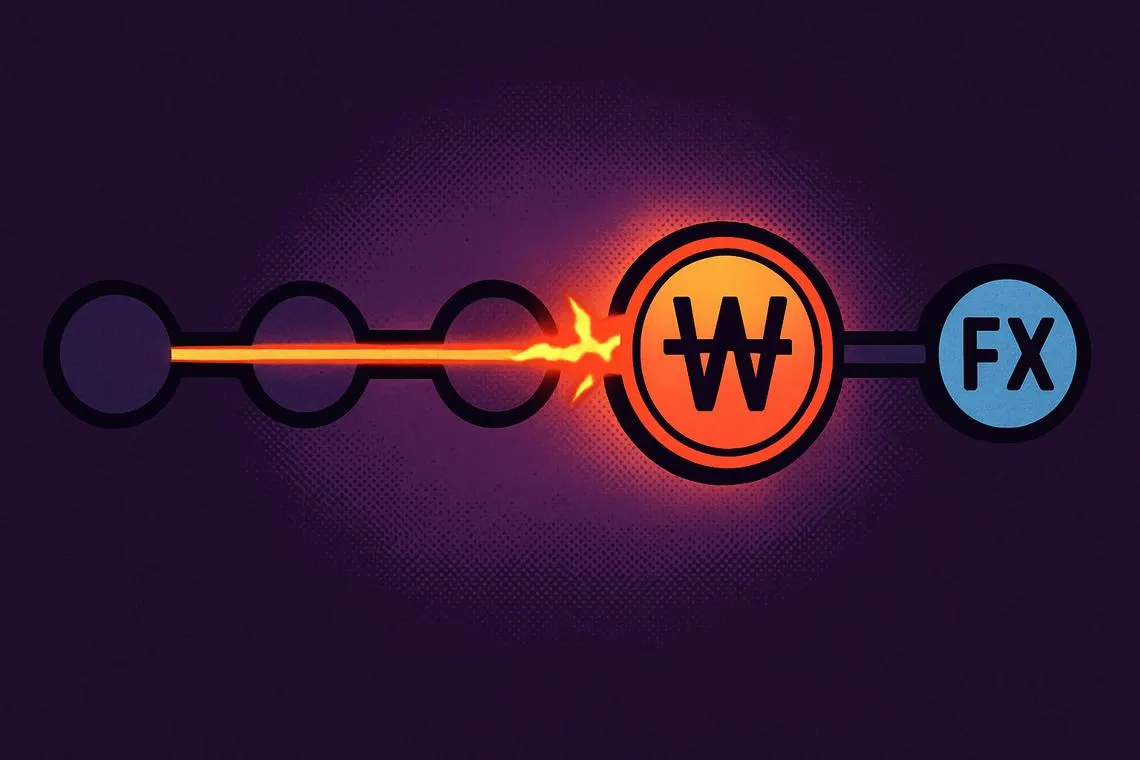
A central bank just confirmed crypto moves currencies. The Bank of Korea found on 3 September 2026 that dollar-backed stablecoin demand can weaken local currencies where global exchanges let investors buy tokens with them. For Binance-paired currencies, stronger stablecoin buying pressure was linked directly to local depreciation, with distinct effects measured in South Korea and Brazil. Korea lacks a direct won-stablecoin pair on Binance, which makes the finding sharper: demand leaks offshore through dollar tokens and comes back as FX pressure. Crypto demand is now a capital-flow variable. The stablecoin bank wave builds the rails, and Seoul just showed where they drain. Source: CoinPaprika. Our gold wilt tracks the parallel leg. Our Kalshi mainstream tracks the parallel leg. Our Ethena Pay tracks the parallel leg. Our Robinhood flip tracks the parallel leg.
How stablecoin demand reaches FX
The channel runs through access: where investors can buy tokens with local money on global venues, incremental crypto demand converts into dollar-token demand first and local-currency selling second. Stablecoin buying pressure becomes a parallel dollar bid operating outside the banking system and its reporting lines. For managed currencies like the won, that leakage complicates intervention math, since stablecoin outflows do not appear in the usual flow data until the damage shows in spot. Brazil's inclusion in the findings proves this is not a Korean quirk but an emerging-market structure. The yen intervention watch shows how seriously Asia already takes flow mysteries. Source: CoinDesk Korea.
What it means for Asian central banks
For regional central banks, the study forces stablecoins onto the FX surveillance dashboard: monitoring onshore flows while offshore token demand moves the currency is flying half-blind. Expect responses ranging from won-stablecoin licensing that re-onshores demand to reporting requirements on exchange off-ramps. For Korea specifically, the absence of a direct pair is now a policy choice with a measured cost. For traders, won and real sensitivity to crypto-demand cycles becomes a tradeable input: risk-on crypto weeks should cheapen both at the margin. The MAS statute next door is one regulator's answer to the same leakage. Source: Blockchain Reporter.
- BOK finding published 3 September 2026
- Stablecoin demand linked to FX depreciation
- Korea and Brazil measured effects
- No direct won pair makes leakage worse
What it means for stablecoin policy
For stablecoin architects, the Korean finding is the strongest argument yet for local-currency tokens: dollar tokens export monetary sovereignty along with convenience, while licensed won tokens would recycle demand onshore. The G20's deferred stablecoin chapter is where this evidence lands hardest, since FSB reviewers now have central-bank data showing cross-border FX impact. For the bank consortium, G7-first issuance looks prudent: start where currencies can bear it.
Every stablecoin buy is a tiny FX trade. Korea just added up millions of them and found a currency move.
How crypto trading works for Koreans
South Korean residents trade crypto mainly on domestic exchanges, which must register with the country's anti-money laundering authority and link customers to real-name bank accounts. Trading on these exchanges happens in won. Foreign exchanges are not permitted to market to Korean residents without registration. Korea's Virtual Asset User Protection Act, in force since July 2024, added rules on safeguarding customer assets and preventing market abuse.
Korean crypto prices have at times traded above global prices, a gap known as the kimchi premium, because capital controls and exchange rules make it hard to move money in and out quickly to arbitrage the difference.
How stablecoin demand can weaken a currency
When investors in a country buy dollar stablecoins with their local currency, they are in effect selling local currency for dollars. If that demand grows large enough, it adds to pressure on the exchange rate, much like buying dollars through a bank. Where global exchanges offer trading pairs between a local currency and dollar stablecoins, investors can make that switch easily. The Bank of Korea's finding suggests this channel has become large enough in some countries to show up in currency movements.
Brazil's experience
Brazil offers a clear comparison. Stablecoins account for a large share of crypto activity there, used for trading, payments and holding dollars outside the banking system. Brazil's central bank has developed rules for virtual asset service providers and has paid close attention to stablecoin flows because of their links to foreign exchange and capital movements. That makes Brazil, like Korea, a natural place to measure the effect.
Why central banks care
Central banks manage currencies and capital flows to keep their economies stable. Large flows into dollar stablecoins can work around capital controls, weaken the local currency and reduce the central bank's view of what is happening. For countries with weaker currencies, there is also the risk of digital dollarisation, where people hold savings in dollar tokens rather than local money, weakening the central bank's ability to steer the economy.
The case for local-currency stablecoins
One response is to allow regulated stablecoins backed by the local currency, so that demand for digital money stays in the domestic system. South Korea has debated allowing won-backed stablecoins issued under strict rules. Supporters say they would keep payments and savings in won while offering the convenience of tokens; critics worry about risks to banks and monetary control. The outcome will shape how much of Korea's crypto activity flows through dollars.
What it means for traders in the region
For traders, the main lesson is that crypto and currency markets are linked more closely than many assume. Large swings in stablecoin demand can coincide with moves in local currencies, and policy responses, such as new rules on foreign exchanges or stablecoin issuance, can change how money moves. Using registered local exchanges, understanding local rules on foreign platforms and keeping an eye on central bank announcements are sensible steps.
The bigger picture
Money that moves on blockchains still lands in currency markets, and central banks are done pretending otherwise. The BOK study turns anecdote into data: crypto adoption has an exchange-rate footprint. Every subsequent stablecoin framework will now carry an FX chapter, and issuers that ignore it will discover monetary sovereignty the hard way.
What to watch next
Watch Korean regulators for won-stablecoin licensing signals. Watch Binance pair listings as policy events, since each new local pair changes the leakage map. And watch the FSB review for FX-impact language borrowed straight from Seoul.
What did the Bank of Korea find?
On 3 September 2026 the BOK found dollar-backed stablecoin demand can weaken local currencies where global exchanges offer access, with Binance-paired buying pressure linked to depreciation in Korea and Brazil.
Why does it matter for policy?
It puts stablecoins on the FX surveillance dashboard, argues for licensed local-currency tokens, and gives the FSB review central-bank evidence of cross-border currency impact.
What is the kimchi premium?
A gap where crypto prices on Korean exchanges trade above global prices, caused by limits on moving money in and out of the country.
Can foreign exchanges serve Korean residents?
Not without registering with Korea's anti-money laundering authority. Domestic exchanges must also use real-name bank accounts.
How can stablecoins weaken a currency?
Buying dollar stablecoins with local currency is effectively selling that currency for dollars, adding pressure on the exchange rate.
You've finished this story
Read on, send it to someone, or ask about it.