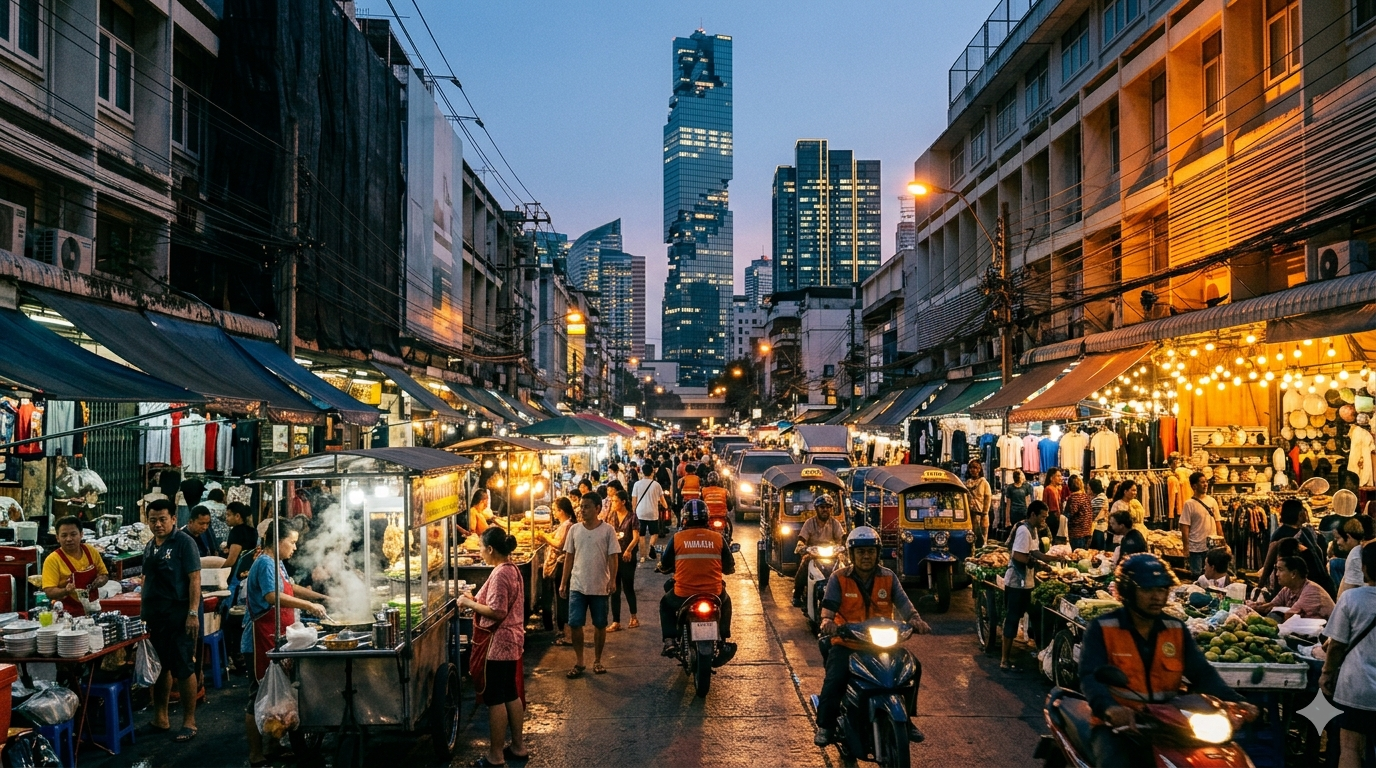
The Street Economy and the Market Economy Are Now Two Different Countries
While Korean semiconductor stocks break records and gold holds above $4,700, fuel prices are cutting into household budgets across Southeast Asia and airlines are absorbing billions in unexpected costs. The bifurcation is not happening in markets. It is happening in real life, on real streets, in the real economies where your clients live.
In Bangkok this week, the price of a motorcycle taxi ride has gone up. Not dramatically. Not in a way that makes headlines. But enough that the riders who use them every day to get to work have noticed, and enough that the drivers have noticed too, because the fuel they fill up every morning costs more than it did two months ago.
At the same time, in Seoul this week, SK Hynix reported that customer demand for memory chips over the next three years far exceeds current supply capacity. Samsung Electronics forecast an eightfold jump in first-quarter operating profit. The Kospi closed at an all-time record of 6,388. Goldman Sachs raised its 12-month Kospi target to 8,000.
These two realities, the Bangkok motorcycle taxi driver paying more for fuel and the Seoul semiconductor engineer whose company just reported extraordinary earnings, are not happening in different economic cycles. They are happening in the same week, in the same world, shaped by the same set of forces. The Iran war closed the Strait of Hormuz. Oil prices surged. Airlines, factories, logistics companies, and ordinary commuters absorbed the cost. Simultaneously, the AI infrastructure investment cycle kept compounding, pushing semiconductor demand and earnings growth to levels that no geopolitical disruption has managed to interrupt.
This is the bifurcation that financial analysts are calling a two-speed economy. But behind the analytical language is a human reality that is deeply relevant to the retail trading and investment audience that financial brands in Southeast Asia are trying to reach.
The Southeast Asian Household Facing the Energy Cost Wave
The energy cost transmission from the Strait of Hormuz crisis is not abstract for the 600 million people living across Thailand, Vietnam, Indonesia, Malaysia, and the Philippines. The Philippines declared a state of emergency as fuel supplies tightened. Vietnam faced oil reserves estimated at less than 20 days. Indonesia and Thailand saw transportation costs rise, affecting everything from the price of fresh produce at morning markets to the cost of sending goods between provinces.
American Airlines quantified this transmission for its own business at $4 billion in additional fuel costs in 2026. The proportional equivalent across the airlines, manufacturers, fishing boats, rice farmers, and delivery businesses of Southeast Asia represents an aggregate economic burden that is reshaping household budgets and corporate margins simultaneously, in ways that will take quarters to fully surface in official economic data but are already visible to anyone who fills up a tank, buys groceries, or runs a small business in the region.
For retail financial brands serving audiences in these economies, this ground-level economic reality is not separate from the markets their clients trade. It is the most immediate and personal form of the macro environment that is driving currency movements, central bank decisions, and the inflation data that shapes monetary policy. The trader in Vietnam who understands that the energy cost wave they are experiencing personally is the same force depreciating the dong against the dollar and suppressing their central bank's ability to cut rates has a more grounded and more durable analytical framework than one who processes these relationships only as abstract market data.
The Distance Between the Market and the Street
One of the most persistent failures in financial brand communication in Southeast Asia is the assumption that the retail trading audience exists at a distance from the macro economic forces being discussed. The reality is that in Southeast Asian markets, the retail trading audience is often more directly exposed to those macro forces than their counterparts in developed markets, precisely because the social safety nets, financial buffers, and institutional shock absorbers that exist in wealthier economies are thinner in emerging markets.
The Thai trader who is also a small business owner importing raw materials from China is personally exposed to both the tariff restructuring and the energy cost wave. The Vietnamese trader who works in manufacturing is directly affected by the supply chain repositioning that has lifted ASEAN exports by 14 percent. The Indonesian trader who manages family finances is navigating the same inflation that the Bank Indonesia is attempting to contain without damaging growth.
This proximity of the retail trading audience to the actual economic forces they are trading creates a specific and powerful content opportunity for financial brands that understand it. The brand that talks about the Strait of Hormuz crisis in terms of its effect on the daily cost of living in Bangkok, rather than only in terms of Brent crude futures, is demonstrating that it understands the real lives of the people it is trying to serve. That understanding, communicated consistently and in the language those people actually speak, is the foundation of the deepest form of brand trust available in these markets.
ASEAN on the Better Side of the Split
The ground-level story of Southeast Asian household budgets under energy cost pressure exists alongside a structural economic story that is genuinely positive. McKinsey's 2026 global trade research confirmed that ASEAN exports jumped nearly 14 percent as the region captured supply chains displaced from China. Malaysia is outperforming regional peers in currency markets, supported by its semiconductor manufacturing positioning. Vietnam is weeks away from the foreign investment hurdle removal that clears the path for its FTSE Emerging Market reclassification in September.
The same region where a Bangkok motorcycle taxi driver is paying more for fuel is also the region where Vietnamese factory workers are producing the consumer electronics that used to be made in Shenzhen, where Malaysian engineers are packaging the semiconductors that power AI data centers in the United States, and where Thai agricultural exporters are finding new markets in a world where supply chains are being reorganized from scratch.
The bifurcation does not break neatly along national borders. Within ASEAN, the household paying more for fuel and the factory worker benefiting from supply chain repositioning can be the same person, living in the same neighborhood, whose economic reality is shaped by forces pulling simultaneously in both directions. Understanding this complexity, and communicating it with honesty rather than reducing it to a simple directional market call, is what distinguishes financial brands that genuinely serve their audiences from those that produce content about their audiences from a distance.
What Honest Market Communication Looks Like
For financial brands in Southeast Asia, the bifurcated economic environment of 2026 creates a specific and commercially significant opportunity to communicate honestly about a market that is genuinely complex rather than pretending it is simpler than it is.
The honest communication is this: ASEAN is structurally positioned well in the global economic reshuffling driven by the AI cycle and supply chain diversification. That structural advantage is real and it is compounding. At the same time, the energy cost wave from the Strait of Hormuz crisis is creating genuine household and corporate pressure across most of the region's economies, and that pressure is real too. Both things are true simultaneously, and the market price movements across currencies, commodities, and regional equities reflect both truths at once.
The financial brands that can hold both of these truths in the same analytical frame, explaining the structural tailwind and the cyclical headwind with equal honesty and equal analytical depth, in the languages of the people they serve, are the ones building the kind of trusted relationship with the Southeast Asian retail trading audience that transcends any individual market cycle. That relationship, built through honest, grounded, locally relevant communication over a sustained period, is the most durable competitive asset available in this market.