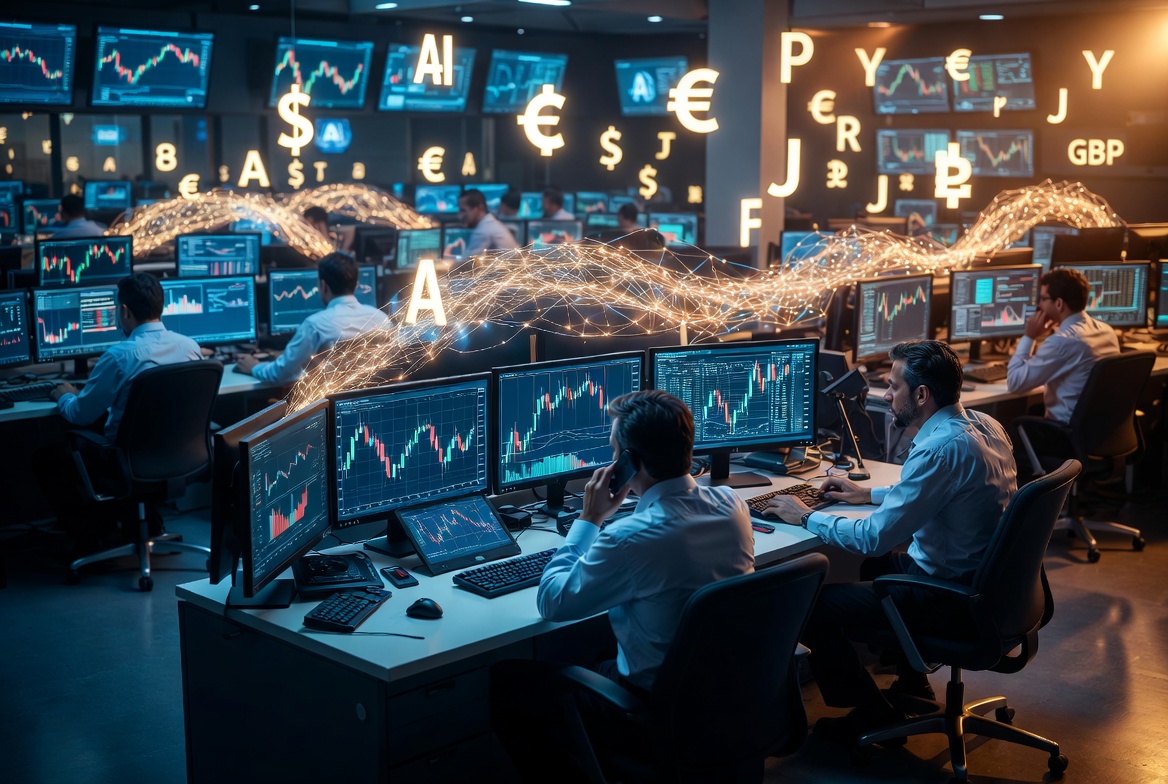
The Algorithmic Revolution: How AI Is Reshaping the Global Forex Market
AI and algorithmic trading are fundamentally changing how the forex market operates. Here is what traders, brokers, and advisors need to know.
The foreign exchange market has always moved fast. With over 7.5 trillion dollars traded daily, it is the largest and most liquid financial market in the world. But something deeper than volume is shifting. The rise of artificial intelligence and algorithmic forex trading is not just changing how trades are executed - it is rewriting the rules of who can compete, what information matters, and how risk is managed at scale.
For any firm operating in or adjacent to the forex market, understanding this transformation is not a luxury. It is a strategic imperative. The algorithmic forex trading revolution is creating new winners, exposing new vulnerabilities, and forcing a fundamental rethink of what it means to have an edge in currency markets.
The Rise of the Algorithm
For most of its modern history, the forex market was dominated by human judgment. Traders built careers on reading macro trends, interpreting central bank signals, and reacting to geopolitical events faster than their counterparts. Skill, experience, and access to good information were the foundations of competitive advantage.
Algorithms began entering the picture in the 1990s, initially as execution tools designed to minimise market impact on large orders. But the transformation accelerated dramatically in the 2010s as computing costs fell, data availability exploded, and machine learning techniques matured. Today, algorithmic forex trading accounts for the majority of volume on major currency pairs, and AI-driven systems are increasingly making decisions that were once the exclusive province of senior traders.
The implications are profound. Algorithms do not sleep, do not panic, and do not second-guess themselves at the moment of execution. They can process thousands of data signals simultaneously - technical indicators, order book dynamics, news sentiment, options market positioning, and cross-asset correlations - and act on their conclusions in microseconds. In a market where price advantages are measured in fractions of a pip, this is a decisive structural advantage.
What AI Actually Does in Forex
It is worth being precise about what algorithmic forex trading systems actually do, because the term covers a wide range of capabilities and sophistication levels.
At the simpler end, algorithmic systems automate rule-based strategies: execute a buy when the 50-day moving average crosses above the 200-day, or close a position when the stop-loss level is hit. These are algorithmic in the sense of being automated, but they do not involve machine learning or genuine artificial intelligence.
More sophisticated systems use statistical models to identify patterns in historical price data and build probabilistic forecasts of future price movements. These quantitative strategies - familiar from the hedge fund world - have been migrating into retail and mid-market forex trading platforms at an accelerating pace.
At the frontier, deep learning models and neural networks are being applied to forex trading in ways that genuinely challenge human comprehension. These systems can identify non-linear relationships between variables that no human analyst would think to look for, and they can adapt their behaviour in near-real-time as market conditions shift.
- High-frequency trading systems execute thousands of trades per second, profiting from tiny price discrepancies across venues - Sentiment analysis algorithms process news feeds, social media, and central bank communications to position ahead of market-moving events - Reinforcement learning models train themselves by simulating millions of trading scenarios, developing strategies that no human would derive through intuition - Natural language processing tools extract trading signals from earnings calls, parliamentary testimony, and regulatory filings faster than any human analyst
The Regulatory Dimension
The rise of algorithmic forex trading has not gone unnoticed by regulators. In the European Union, MiFID II introduced stringent requirements for firms deploying algorithmic trading systems, including obligations around pre-trade risk controls, kill switches, and algorithmic strategy documentation. In the United States, the CFTC has issued guidance on the risks of automated trading systems and the responsibilities of firms that deploy them.
The regulatory trajectory is clear: greater scrutiny, higher compliance costs, and increasing expectations around model governance and explainability. For firms using third-party algorithmic systems, understanding what those systems are doing - and being able to demonstrate that understanding to regulators - is no longer optional.
This creates a genuine strategic challenge. The most powerful AI trading systems are often the least explainable. A deep learning model that consistently generates alpha may be impossible to explain in terms that satisfy a regulatory examiner. Firms that have invested in simpler, more transparent algorithmic approaches may find themselves with a compliance advantage even if their raw performance lags.
The Human Factor
It would be a mistake to conclude that the rise of algorithmic forex trading has eliminated the human element. In fact, the most successful firms in this space have found ways to combine algorithmic execution with human strategic oversight in ways that outperform either approach alone.
Human traders bring capabilities that current AI systems genuinely lack: the ability to reason about genuinely novel situations that have no historical precedent, to understand the political context of central bank decisions, to recognise when a model is likely to be wrong because the world has changed in ways the training data does not capture. The firms winning in algorithmic forex trading are those that have figured out the right division of labour between human judgment and machine execution.
What Legacy Brokers Must Do Now
For traditional forex brokers and dealers, the algorithmic revolution creates both existential pressure and genuine opportunity. The pressure is obvious: firms with superior algorithmic capabilities can offer tighter spreads, faster execution, and better risk management than those relying on human market-making. The opportunity is less obvious but equally real.
- Invest in data infrastructure: Algorithmic systems are only as good as the data they train on. Brokers with proprietary order flow data have a genuine edge that pure technology players cannot easily replicate. - Build or acquire algorithmic capability: The choice between building in-house and acquiring existing technology is a genuine strategic decision that depends on talent availability, capital, and competitive timeline. - Reposition around advisory value: As execution becomes increasingly commoditised by algorithms, the differentiating value for brokers shifts toward strategic advisory, risk consulting, and regulatory expertise. - Engage proactively with regulators: Firms that help shape the regulatory framework for algorithmic forex trading will be better positioned than those that simply react to it.
The Road Ahead
The algorithmic forex trading revolution is not a future event - it is happening now, and its pace is accelerating. The firms that will thrive in this environment are those that treat algorithmic capability as a core strategic asset rather than a technology add-on, that invest in the human talent needed to govern and improve their systems, and that engage seriously with the regulatory dimensions of operating AI-driven trading infrastructure.
At SpinDepth, we help forex brokers, dealers, and advisory firms navigate exactly this transition - from competitive positioning and technology strategy to regulatory communication and market narrative. The next chapter of the forex market is being written by those who understand both the technology and the strategy. The conversation starts here.