
PromptPay Became a Verb in Thailand. Now Other Countries Want the Blueprint.
PromptPay handles a huge share of Thailand's electronic payments and has entered everyday speech. Its success is now being studied as a model for modernising trade finance and building cross-border payment infrastructure across the region.
In Thailand, people say let me PromptPay you the way people elsewhere say let me send you the money. A national payment system has become a verb. That linguistic detail captures something a statistic cannot: PromptPay did not just get adopted, it became the default assumption about how money moves.
The scale
According to the Chambers and Partners Fintech 2026 Thailand guide, PromptPay and the Thai QR Code payment rail account for approximately 44 percent of account-to-account electronic payments in the country, and the same guide notes PromptPay accounted for roughly 44 percent of e-commerce transaction value in 2025.
Data shared at Money20/20 Asia 2026 and reported by Fintech News Singapore put Thailand at 181.8 million digital banking accounts in January 2026, with transaction volume up 10.6 percent year on year to 3.5 billion. In a country of roughly 70 million people, that account figure tells you how deeply digital payment has penetrated daily life.
Why it worked when others did not
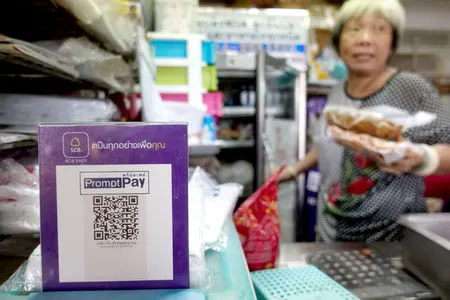
Plenty of countries have launched national payment schemes that never achieved this depth. Several factors distinguish the Thai case. The Bank of Thailand drove it as national infrastructure rather than leaving it to competing private systems, so there was one rail rather than five incompatible ones. It was built free or near-free for consumers, removing the cost objection entirely. And it reached the smallest merchants, from street food stalls to market vendors, where a printed QR code costs nothing to deploy.
That last point is the hardest part and the most important. A payment system that only works in shopping malls does not become a verb. One that works at a noodle stall does.
From domestic rail to regional model
PromptPay's next chapter is crossing borders. According to Nation Thailand, it already connects through cross-border QR links with Singapore, Vietnam, Indonesia, Laos, Japan and Hong Kong. Thailand has also deepened bilateral QR arrangements with major Chinese payment platforms, creating connectivity with the world's largest digital payments market.
Beyond consumer payments, the model is being studied for trade finance. Fintech News Singapore examined PromptPay as a blueprint for modernising trade finance and infrastructure, on the logic that if a country can build instant, low-cost, universally adopted rails for retail payments, the same architectural thinking can be applied to slower, costlier commercial flows.
A payment system that only works in shopping malls never becomes a verb. One that works at a noodle stall does.
What comes next
Thailand is now building on top of this foundation. The Bank of Thailand has said its baht stablecoin guideline has entered its final stage, with regulations expected by 2026 or early 2027, adding programmability to a payment environment that is already instant. The country's first virtual bank, Clicx, began serving the public in June 2026, and TouristDigiPay lets foreign visitors convert crypto to baht through licensed operators and spend it via regulated e-wallets.
Each of these builds on the assumption that instant digital payment is normal, which PromptPay established.
What this means for financial brands
For any brand entering Thailand, PromptPay support is not a feature decision. It is table stakes. A financial product that cannot connect to the rail Thai consumers use by reflex will struggle regardless of how good the rest of it is. Beyond integration, the deeper lesson is about expectation: Thai users expect instant, free, mobile-first money movement, and anything slower or more expensive feels broken.
This is exactly where SpinDepth helps, building products, positioning and presence that fit how Thai consumers actually behave.
FAQs
Q1: How large is PromptPay?
A1: PromptPay and Thai QR account for roughly 44 percent of account-to-account electronic payments and a similar share of e-commerce transaction value in 2025, according to Chambers and Partners.
Q2: Why did it succeed?
A2: Central bank leadership creating one national rail, near-zero consumer cost, and adoption down to the smallest merchants through low-cost QR.
Q3: Where does PromptPay connect internationally?
A3: Cross-border QR links with Singapore, Vietnam, Indonesia, Laos, Japan and Hong Kong, according to Nation Thailand.
Q4: What is built on top of it?
A4: Thailand's virtual banks, a planned baht stablecoin framework, and the TouristDigiPay sandbox for tourists spending converted crypto as baht.
For brands entering Thailand, PromptPay integration is table stakes, and that is exactly where SpinDepth helps brands show up.
Source:
Source 1: Fintech News Singapore, PromptPay as a Blueprint to Modernize Trade Finance and Infrastructure
Source 2: Chambers and Partners, Fintech 2026 Thailand
Source 3: Nation Thailand, Thailand's Digital Payment Revolution
Source 4: Baker McKenzie, Thailand Bridging Payments and Digital Assets