
How Retail Traders in Southeast Asia Choose Their Broker in 2026
With millions of retail traders across Thailand, Vietnam, Indonesia, and Malaysia actively trading forex and CFDs in 2026, the broker selection process has matured well beyond platform features and spreads. Independent verification platforms, community signals, and regulatory standing now define which brands convert and which ones lose clients at the research stage.
Across Thailand, Vietnam, Indonesia, and Malaysia, the retail forex and CFD trading audience has been growing in both size and sophistication through 2025 and 2026. The Money20/20 Future of Fintech APAC 2026 report confirmed that Southeast Asia dominates APAC fintech expansion plans, with digital financial services penetration accelerating across the region's mobile-first consumer base. The retail trading dimension of that growth has produced a market that is more analytically capable, more community-connected, and more demanding of independent verification than it was three years ago. The brands that understand this shift and have built their regional presence accordingly are winning. The brands that have not are paying acquisition costs that cannot be justified by their conversion and retention numbers.
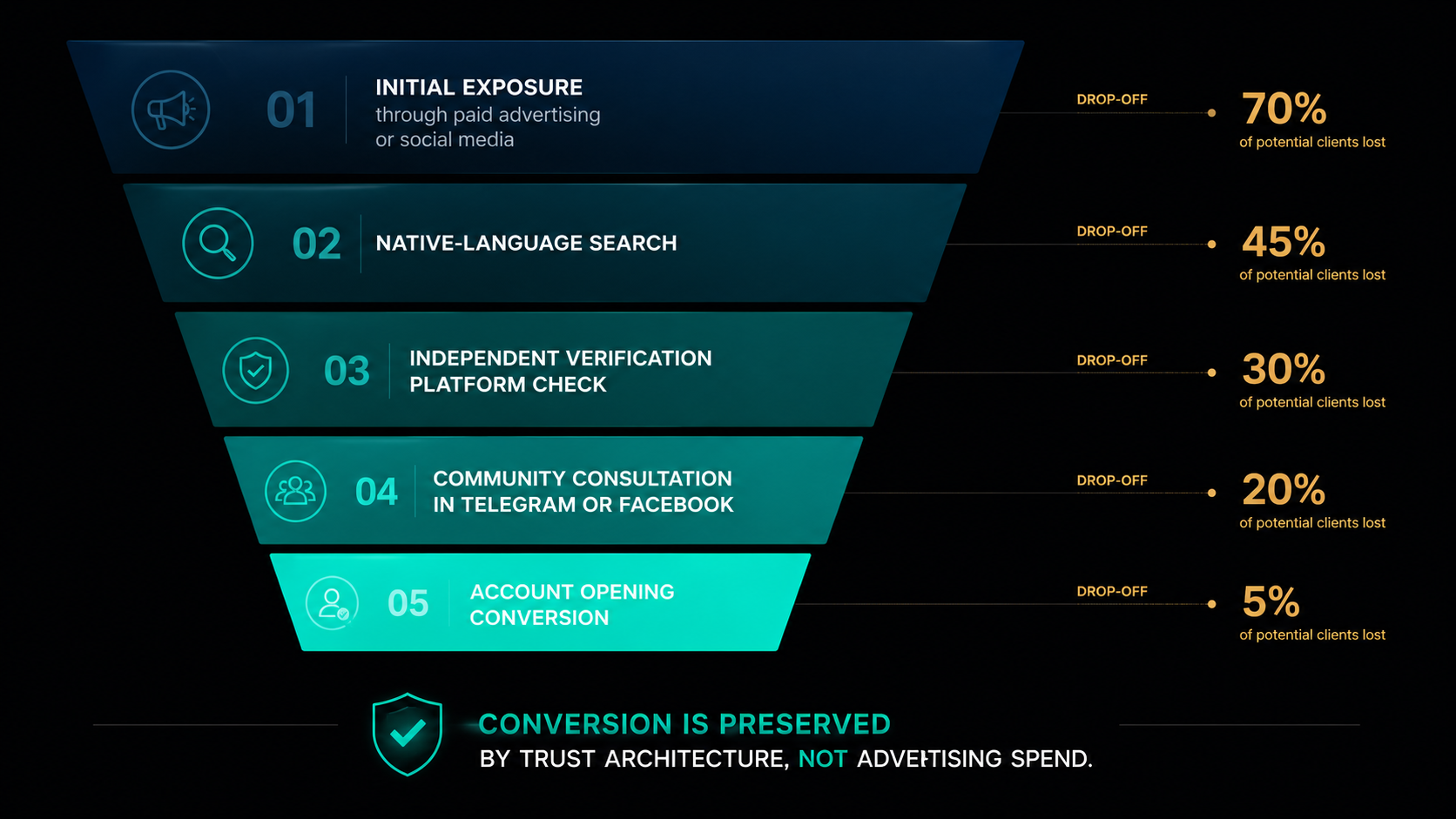
The broker selection process that a retail trader in Bangkok, Ho Chi Minh City, Jakarta, or Kuala Lumpur goes through before opening a live account in 2026 is structured and multi-stage. It does not begin with a paid advertisement and end with an account opening. It begins with a paid advertisement, moves to a native-language search for the broker's name, cross-references the result against independent review and verification platforms, checks community discussions in trading groups, and only then, if all those signals are positive, returns to the account opening flow. The brands that are visible, credible, and positively represented at every stage of that research journey are the ones whose advertising spend produces the conversion rates that the business model requires.
The Brokers That Have Built Regional Presence at Scale
The brokers that have achieved the deepest and most durable market penetration across Southeast Asia have done so through different strategic emphases, but all share a common commitment to local market investment that goes beyond translated landing pages and regional call centre operations.
FBS is consistently cited across Southeast Asian trading communities as one of the most recognised broker brands in the region. Founded in 2009 and operating in over 150 countries, FBS has built its Southeast Asian presence through sustained investment in local trading education, physical presence at regional expos and community events, and a mobile-first product architecture that matches the primary access device of the Southeast Asian retail trader. FBS has received awards including Best Forex Broker Southeast Asia and Best Forex Broker Thailand and Indonesia from multiple regional award bodies, and its community-level recognition across Thai, Indonesian, and Malaysian trading forums reflects years of consistent engagement rather than campaign-cycle visibility. XM occupies a different but equally established position in the Southeast Asian market, known for its structured educational programme, the consistency of its trading conditions, and a regulated operating framework that provides the compliance transparency that the region's more sophisticated retail traders prioritise. XM's approach to Southeast Asia combines broad geographic coverage with locally relevant educational content, creating a brand that is trusted at both the beginner and intermediate trader level across the region.
XS.com represents a newer generation of broker building regional authority through institutional-grade infrastructure combined with a retail-accessible product suite. Regulated across multiple jurisdictions and operating with a multi-asset offering that extends beyond conventional forex and CFD pairs into commodities and indices, XS.com has been building its Southeast Asian presence with a focus on the growing segment of retail traders who want access to global markets through a broker with demonstrably institutional standards. MH Markets and Lirunex are among the regional and boutique players that serve specific segments of the Southeast Asian retail market, with product and service profiles tailored to the trading behaviours and preferences of their target audiences. Both operate in a competitive space where differentiation increasingly depends on the quality of their trust signals rather than marginal differences in trading conditions.
The Verification Infrastructure Retail Traders Actually Use
The most commercially significant shift in Southeast Asian retail broker selection over the past three years is the normalisation of independent verification platforms as a standard stage in the research process. These platforms, which aggregate trader reviews, regulatory status data, fraud alerts, and trust scoring, function as the independent reference layer that retail traders use to validate or disqualify brokers before committing any capital.
TrustFinance has established itself as one of the most referenced independent broker verification platforms for retail traders across Southeast Asia. Its structured approach to broker assessment, combining regulatory compliance data with verified trader reviews and ongoing fraud signal monitoring, provides the retail audience with the specific information they need at the decision point in their broker research journey. In a market environment where synthetic identity fraud has risen 142 percent across APAC and scam broker platforms have become sophisticated enough to mimic legitimate operators with convincing accuracy, the independent third-party verification that TrustFinance provides is not a peripheral convenience. It is the credibility infrastructure that the retail audience relies on to distinguish legitimate brokers from fraudulent ones at a moment when that distinction is increasingly difficult to make from brand presentation alone.
For regulated brokers, maintaining an accurate, comprehensive, and actively managed presence on TrustFinance and equivalent platforms is not a marketing task to be delegated to a junior team member. It is a commercial priority with direct impact on conversion rates. The retail trader who searches a broker name on TrustFinance and finds a well-maintained profile with strong regulatory documentation, genuine trader reviews, and no active fraud alerts is at the final stage of a conversion journey. The retail trader who finds an incomplete or unmanaged profile, or worse, finds nothing at all, is likely to abandon the research and select a competitor whose verification signals are more complete.
In Southeast Asian trading markets, zero press and zero verification signals are not a neutral condition. They are a disqualifier that no advertising budget can override.
Community Standing and the Telegram Layer
Alongside formal verification platforms, the informal but commercially significant community discussion layer of Southeast Asian retail trading markets plays a role in broker reputation management that most international financial brands have systematically underestimated. Telegram trading communities in Thailand, Vietnam, Indonesia, and Malaysia range from a few hundred to tens of thousands of active members. The most respected channels and groups serve as real-time information networks where broker reputations are discussed, withdrawal experiences are reported, and red flags are raised with a speed and reach that no formal complaint mechanism can match.

The commercial implication for brokers is direct. A withdrawal delay complaint that is posted in a major Thai trading Telegram group on a Monday morning can be the primary information that two thousand active retail traders receive about a specific broker by Tuesday. The broker's response to that complaint, or the absence of a response, becomes the data point that defines its reputation in that community for an extended period. The brokers that are genuinely present in these community spaces, that respond to issues promptly and visibly, and that have built relationships with the community educators and channel administrators who shape the information environment, have a reputation management advantage that is invisible in standard marketing metrics but is commercially decisive in the conversion numbers that ultimately matter.
Regulatory Status as the Non-Negotiable Floor
The community and verification infrastructure that surrounds broker selection in Southeast Asia operates on top of a regulatory compliance foundation that the retail audience checks directly and independently. National regulators across the region maintain public registries of licensed and regulated financial service providers, and the retail trader who has been educated by community experience to verify broker credentials directly on these registries before depositing represents the most discerning and most valuable segment of the regional retail market.
For brokers operating in or targeting Southeast Asian retail markets, the regulatory compliance question is not simply a legal obligation. It is a competitive differentiator. The broker that is licensed by a credible jurisdiction, that publishes its regulatory documentation transparently, and that maintains an accurate and consistent regulatory profile across the verification platforms that the retail audience consults, occupies a categorically different trust position from one that is offshore-registered and whose regulatory claims require significant effort to verify. The sophisticated retail trader in Thailand or Vietnam who is managing a meaningful portion of their personal savings through a trading account will not accept regulatory ambiguity at the level that the earlier-stage retail trader might overlook. Regulatory transparency is not just the floor. In the current market environment, it is an increasingly important ceiling differentiation between the brokers that the most commercially valuable segment of the regional retail audience will trust.